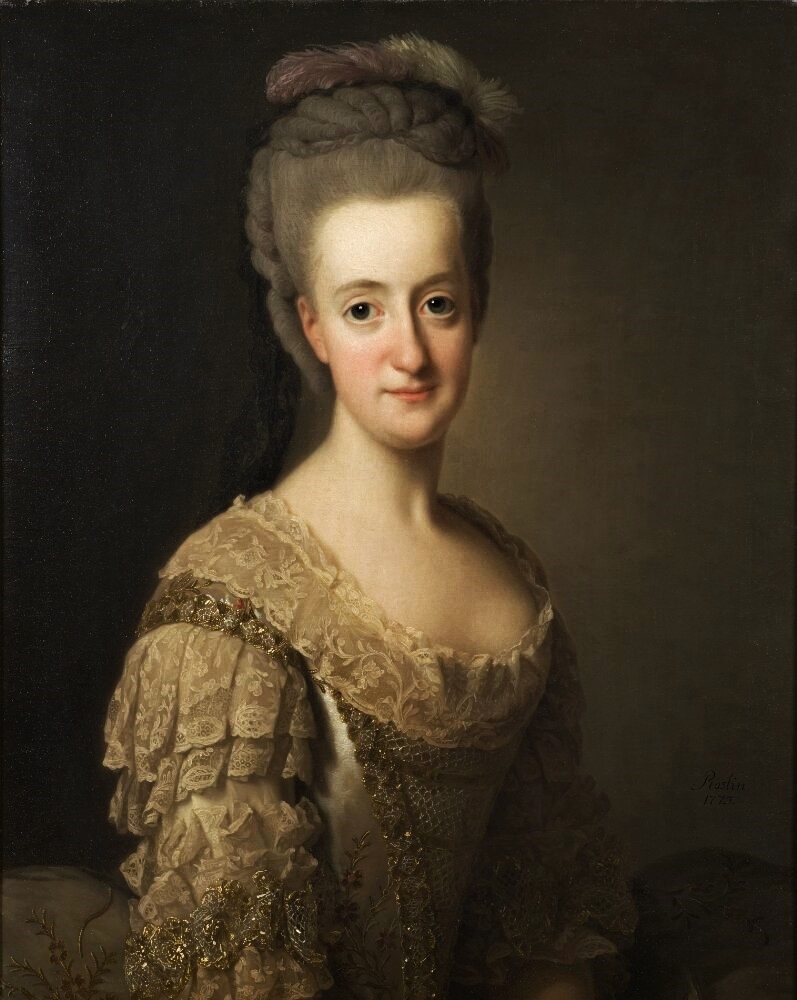
ALEXANDER ROSLIN (1718-1792)
Princess Sofia Albertina (1775)
Oil on canvas (73 x 58 cm)
Stockholm, Nationalmuseum
This portrait is quite unusual, considering it represents a royal princess and is what was known as a half-length. The usual format employed in France for that kind of portrait was a canvas known as “of 30 sols” (91 x 73 cm) or “of 40 sols” (101 x 81 cm); however, Roslin chose to use a standard “20 sols” canvas (73 x 60 cm), which was reserved for portraits of “head and shoulders”.
I have chosen to reproduce this mediocre portrait because it illustrates what I have said and what I believe. All great portraitists have produced some dull, mediocre paintings which are rare exceptions among a series of brilliant likenesses. I believe that those regrettable portraits are the reflection of the disagreeable or dull nature of the sitters who failed to arouse some sympathy or interest in the artist.
Reynolds was very reserved and did not talk much to his sitters. In contrast, Gainsborough was very friendly and outgoing, which made it much easier to establish a rapport with his sitters and elicit a smile or a lively expression. A good example of a painter trying to achieve that and failing spectacularly was the very young Thomas Lawrence, who, obviously annoyed by the grim expression of Queen Charlotte, whom he was portraying at Windsor Castle, asked her royal sitter to chat with her daughters to give some animation to her features; the Queen arrogantly refused to do so, and that was it. The whole story is described in my blog dedicated to Sir Thomas Lawrence under the entry “A Royal Command”.
Sophia Albertina (1753-1829) was the daughter of King Adolf Frederick of Sweden and Louisa Ulrika of Prussia. She was thus a princess of Sweden, a princess of Holstein-Gottorp and a sister to Gustav III of Sweden. Sophia Albertina and her youngest brother, Prince Frederick Adolf of Sweden, were the favourites of their mother and also very close to each other. Like her mother, Sofia Albertina did not like his brother’s wife, Queen Sofia Magdalena, and was quite rude to her, which explains Gustav’s decision to ban her from court in 1781. According to her contemporaries, Sofia Albertina was not very bright; this is not surprising when we look at her portrait. Unlike some of his colleagues, Roslin was not a subservient portrait painter who flattered or idealised his sitters; he painted people as they were with that implacable objectivity and attention to detail typical of the Germanic or Nordic artists. If Sofia Albertina looks dull and simple-minded is because she was like that.