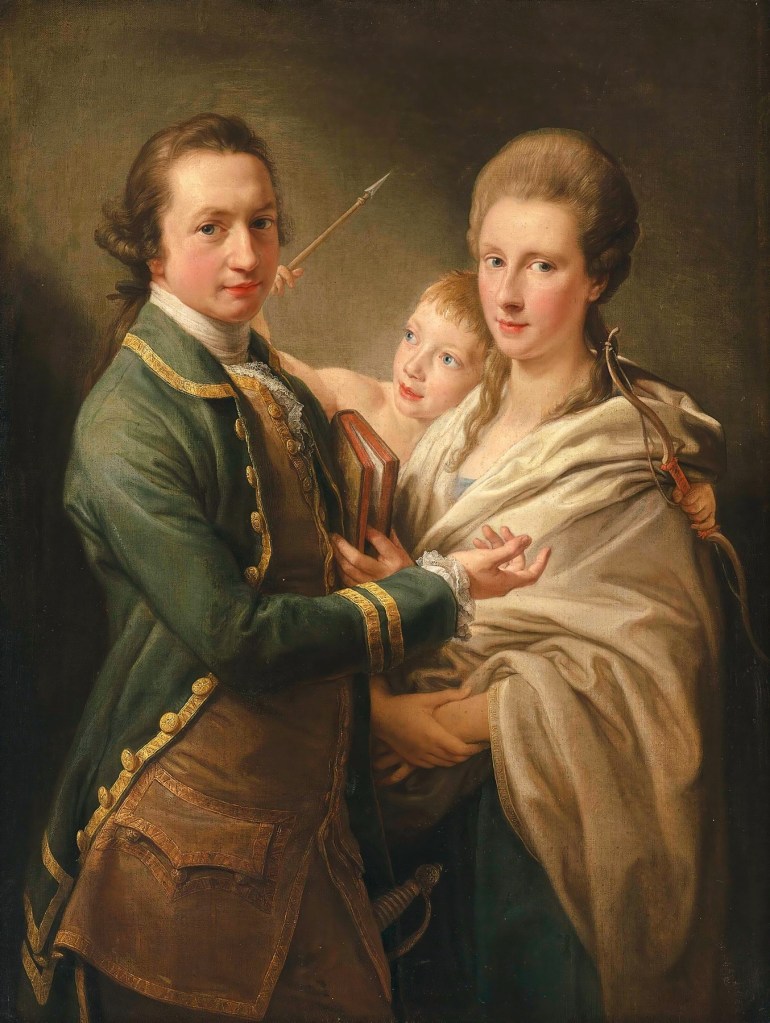
POMPEO BATONI (1708-1787)
Arthur Saunders Gore, 2nd Earl of Arran and his wife. (1767)
Oil on canvas (114 x 86 cm)
Private coll.
To enlarge the picture, click on it and open it in a new tab
This beautiful and moving group portrait is unique within the vast work of Pompeo Batoni because, out of the nearly two hundred portraits of British travellers in Rome painted by Pompeo Batoni, only seventeen depict women, and only one, the present work, shows a husband and wife together.
Arthur Saunders Gore, 2nd Earl of Arran, (1734-1809), styled The Honourable Arthur Gore from 1758 to 1762 and Viscount Sudley from 1762 to 1773, was an Irish peer and politician.
On 14 July 1760, Lord Arran married Hon. Catherine Annesley (1739–1770), only daughter of the 1st Viscount Glerawly and Lady Anne Beresford (eldest daughter of the 1st Earl of Tyrone). They had six children, the eldest of whom, Arthur Saunders Gore, 3rd Earl of Arran (1761-1837), is traditionally identified as the child depicted as Cupid in this beautiful family portrait. However, the presence of Gore´s son in Italy has not been verified; therefore, it is possible that the boy who appears in the picture was an Italian model.
The Gentleman´s Magazine described Arthur Gore as: “A nobleman of the mildest disposition and most elegant manners” (No. LXXIX, October 1809, p. 988). He was elected to the Irish House of Commons for Donegal Borough in 1759, a seat he held until 1761 and again from 1768 to 1774 and also represented County Wexford between 1761 and 1768. In 1773, he succeeded his father as second Earl of Arran and entered the Irish House of Lords. Arthur Gore was also appointed High Sheriff (1) of County Wexford in 1757 and High Sheriff of Mayo in 1765.
Gore and his wife arrived in Italy in January 1767. On the 24th, Sir Horace Mann (1706-1786), the long-standing British consul in Florence, wrote to his friend Horace Walpole that he had presented ‘Mr Gore, Lord Arran’s son’ at the Florentine Court (2), where Gore had been invited to dinner by Leopold of Austria, Grand Duke of Tuscany (1765-90) and later Holy Roman Emperor from 1790-92.
The couple went to Rome and then to Naples where Lady Sudley must have been responsible for important charitable works since she was remembered with great affection by the Neapolitans; at least, this is what Lady Miller (1741-81) tells us in his memoirs: “This lady’s humanity, generosity, and every virtue, joined to a refined understanding, a most liberal education, and an elegant person, has made such an impression upon the hearts of the Neapolitans…that whenever she is mentioned, they with great difficulty restrain their tears; a grateful tribute to her memory in a foreign country!” (3)
The Gores returned to Rome sometime during 1769 when they sat to Batoni. It is rather strange that Lord Sudley was portrayed wearing contemporary clothes, whereas his wife is dressed in a kind of classical drapery; on the other hand, this could easily be explained if we consider the portrait as an allegory of Love, something that is reinforced by the presence of Cupid. The painting acquires a poignant significance when we remember that Catherine, Lady Sudley, died a year later. This magnificent portrait remained in the possession of the Earls of Arran until 2018, when it was auctioned by Christie´s in London on the 5th July. The painting was valued between 200.000 and 300.000 pounds, and it was sold for 320.750 pounds.
NOTES
1 The High Sheriff was the British Crown’s judicial representative in each Irish county. The sheriff had judicial, electoral, ceremonial and administrative functions and executed High Court Writs. The office was abolished in 1922.
2 “Horace Walpole’s Correspondence with Sir Horace Mann”, New Haven & London, 1960, p. 482.
3 Anna Riggs, Lady Miller: “Letters from Italy, Describing the Manners, Customs, Antiquities and Paintings of that Country”, London, 1777, Vol. II, p. 350.