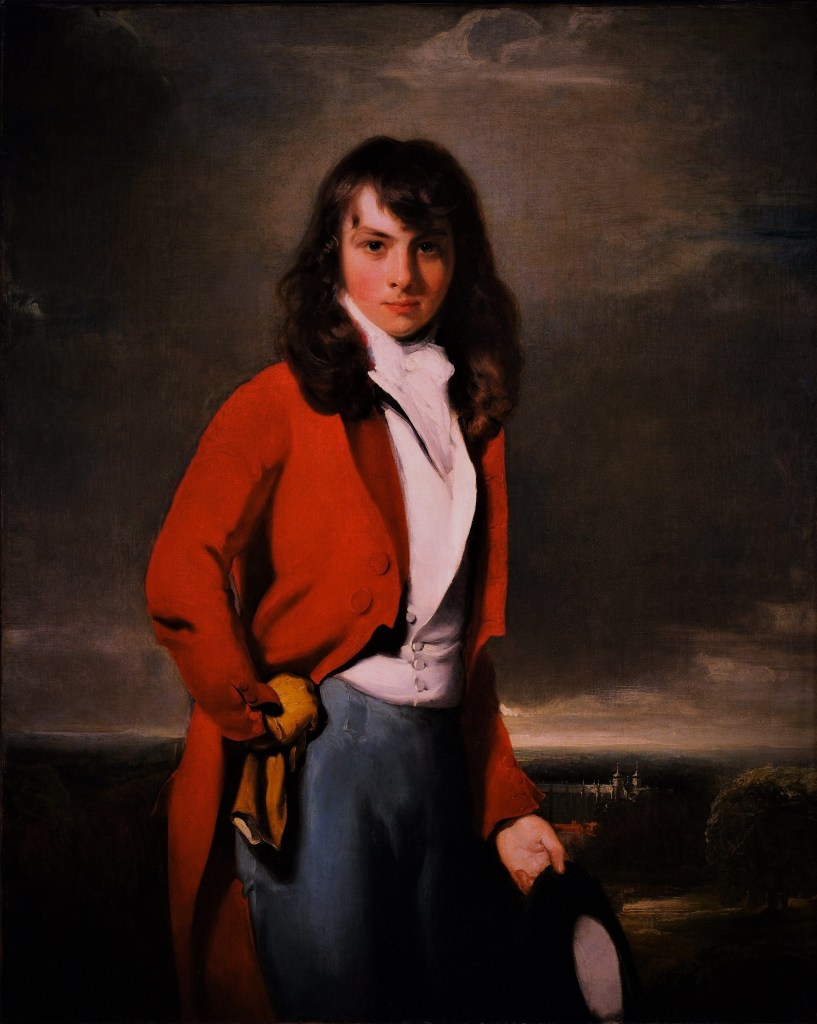
SIR THOMAS LAWRENCE (1769-1830)
Arthur Atherley Jr (1791)
Oil on canvas (126 x 100 cm)
Los Angeles County Museum of Art (LACMA), California, USA
To enlarge the picture, click on it and open it in a new tab
In 1791, Lawrence began the portrait of a very young and handsome Etonian named Arthur Atherley (1772-1844). It was a head and shoulders that, for some reason, remained unfinished (Holburne Museum, Bath). Most probably, the sitter changed his mind, since next year Lawrence presented at the Royal Academy a magnificent half-length. Lawrence´s portrait of Arthur Atherley Jr may have been what is known at Eton as “a leaving portrait”. The tradition of leaving portraits was started by Dr Barnard, who was Headmaster from 1754 to 1765. They owe their origin to a custom at Eton, first recorded in the 17th century, by which the headmaster presented books “to all young gentlemen who took their leave of him handsomely”. The expression refers to the present of £10 or £15 (noblemen paid double) slipped unostentatiously onto the headmaster’s desk when taking final leave. Dr Barnard had the idea of asking for a portrait instead of a leaving fee, and for nearly one hundred years, this tradition was scrupulously observed
Although Eton´s leaving portraits were mostly in the standard and popular size of 30 x 25 inches (76 x 64 cm), known as “three-quarters”, some students commissioned larger ones, known as “half‑length”, measuring 50 × 40 inches (127 × 102 cm). Arthur Atherley´s portrait belongs to the latter category. According to the website of Eton:
“Most Leaving Portraits were painted within three years of the sitter leaving the College. However, Charles James Fox, whose portrait can be seen on the Main Staircase, is shown at 13, while Frederick Irby, whose portrait is in a boarding house, was painted from an earlier portrait in the year he turned 36.”(1)
In the case of Atherley, the portrait was commissioned a year after he left Eton in 1790. By the time Lawrence exhibited it at the Royal Academy in 1792, he had finished his studies of Law and become a barrister at Lincoln’s Inn.
Arthur Atherley Jr. was the son of Arthur Atherley, a banker from Southampton who co-founded the local bank known as Atherley & Fall (1770-1869). Atherley Snr, whose business concerns extended to brewing and distilling in Portsmouth, left ample provision for his descendants at his death, 26 Feb. 1820, out of a personal estate of about £90,000 (2). The young Arthur inherited his father´s estates in Hampshire and the Isle of Wight, but continued to live in Arundel, Sussex, and did not get involved in the family´s business. He was active as a barrister until 1806, when he became MP for Southampton. He left politics in 1808 but returned to Parliament twice, serving as MP for Southampton between 1812 and 1818 and again from 1831 to 1833.
The press reviews were very favourable. The St. James’s Chronicle and The Times described it as: “A rich and spirited head in the manner of Rembrandt”. The Morning Herald was more realistic and accurate: “This picture might be placed by the side of the best of Sir Joshua’s and the artist would be entitled to exclaim with the conscious pride of Correggio: I too am a painter” (3)
The portrait shows a handsome, dashing young man, towering over a stormy landscape. Unlike Mrs Farren’s portrait, where the sitter is depicted in a brightly illuminated landscape, here Lawrence imitates his idol, Titian, who favoured dark, stormy skies. I agree with Kenneth Garlick when he said: “It is perhaps to be regretted that he largely abandoned this kind of landscape background after 1800, although he revived it to some extent in the background of some of the military portraits he painted, or at least began, in Europe in 1818-19” (4)
NOTES
1= FDA-P.291-2010 | Eton Collections
2= To give an idea of the magnitude of that sum, today (2026), according to the Office for National Statistics composite price index, it would be worth £11.290.000 £90,000 in 1820 → 2026 | UK Inflation Calculator
3= Michael Levey: “Sir Thomas Lawrence” (p.29). Catalogue of the exhibition organised by the National Portrait Gallery in 1979
4= Kenneth Garlick: “Sir Thomas Lawrence: Portraits of an Age 1790-1830” (p.26) Art Services International (1993)