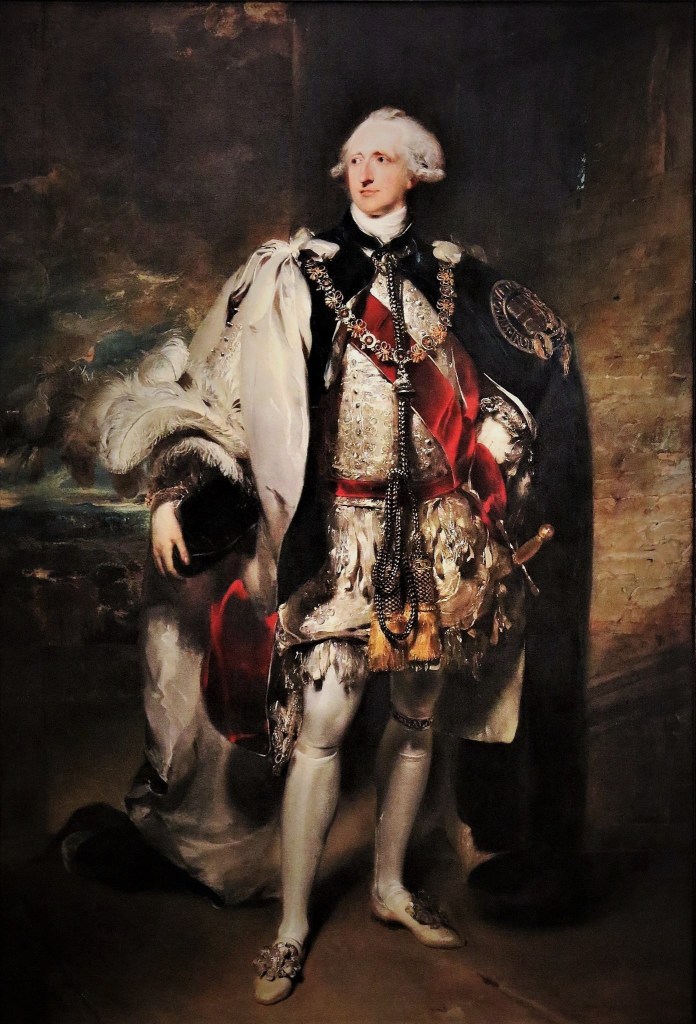
SIR THOMAS LAWRENCE (1769-1830)
Francis Osborne, 5th Duke of Leeds (1794-96)
Oil on canvas (224 x 142 cm)
Oxford, Ashmolean Museum.
To enlarge the picture, click on it and open it in a new tab.
Francis Godolphin Osborne (1751-1799) was a man of modest intellect and scarce political ability. The reason he is here is due to Lawrence’s magnificent portrait of him, painted between 1794 and 1796. He was known as Marquess of Carmarthen until 1789, when he succeeded his father as Duke of Leeds. In 1777, he entered the House of Lords and became Lord Chamberlain of the Queen’s Household. In 1783, he was offered the position of ambassador to France, but before he could take up his new post abroad, William Pitt the Younger, who had become Prime Minister, appointed him Secretary of State for Foreign Affairs on the 23rd December 1783. He held this post until April 1791, when Pitt sacked him because of his anti-Russian views.
Osborne was an implacable enemy of the United States, and when John Adams and Thomas Jefferson visited England in March 1786, they were shocked by the rudeness of the Marquess of Carmarthen. While Adams, who was rather Anglophile by inclination, was prepared to forgive and forget, Jefferson was not, and it can be argued that Osborne’s only lasting achievement was to foster Jefferson’s implacable hostility towards Great Britain (1). The Duke of Leeds never returned to politics and died in London, aged 48, on the 31st January 1799.
When looking at the Duke of Leeds portrait, one is impressed by the splendid figure of the English nobleman who chose to be portrayed as a Knight of the Garter. Besides being rather slim and tall (something that Lawrence, like the great Van Dyck, always emphasised), he has adopted a most elegant pose. In this beautiful painting, Lawrence prefigured his magnificent portrait of the Prince Regent in Garter robes (Royal Collection), painted nearly 25 years later. The shimmering white silk tunic and breeches sparkle thanks to Lawrence’s superb brushwork. The massive tassels of gold braid were brilliantly done with a few brushstrokes, as well as the collar of the Order of the Garter.
Like all great portrait painters, Lawrence had the gift to make very difficult pictorial effects look deceptively easy. His achievements are even more admirable considering he had no artistic education whatsoever.
NOTES
1= David McCullough: “John Adams” (2001), Simon & Schuster.