POMPEO BATONI (1708-1787)
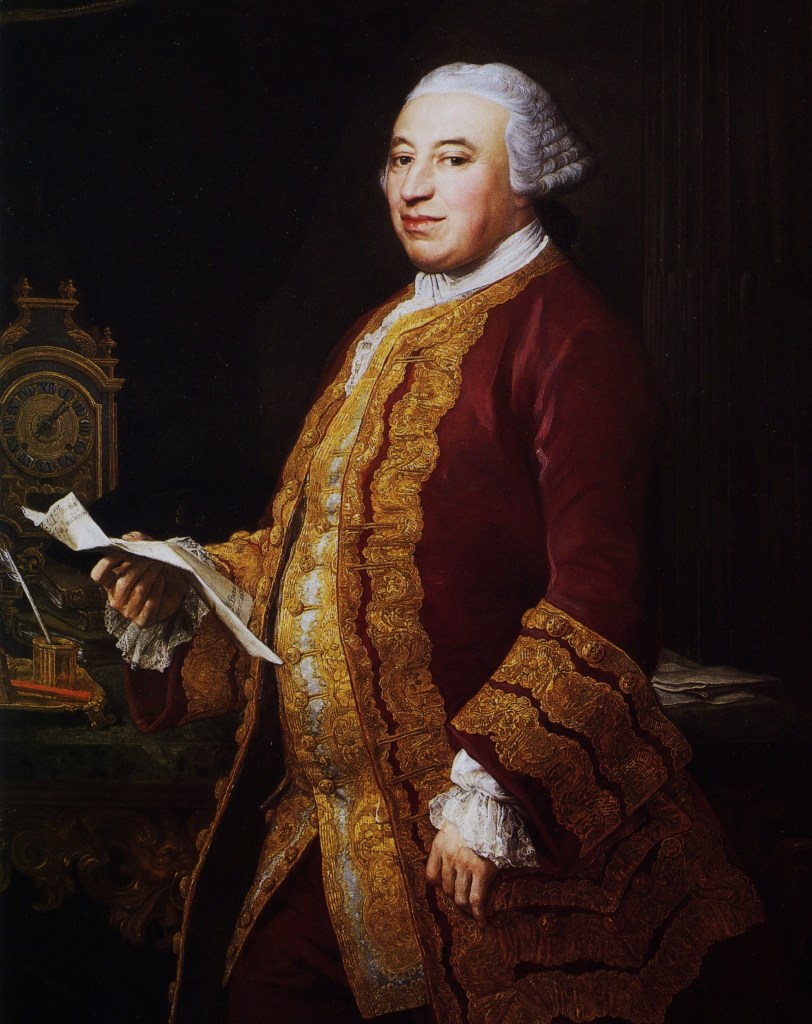
Count Niccoló Soderini (1765)
Oil on canvas (134 x 97 cm)
Palazzo Barberini, Rome
To enlarge the picture, click on it and “Open in a new tab”
If Batoni needed to prove that, besides being a superb colourist, he was also a master in the difficult art of reproducing the texture of sumptuous fabrics, this portrait is a perfect example of his skill as such.
Count Soderini was the Tuscan ambassador to the Papal States and a prominent figure in Roman high society of his time. Batoni has portrayed him as a hard-working diplomat, attending affairs of State well into the night, as the clock on his desk tells us it is 2.05 am. Interestingly, forty-five years later, Jacques-Louis David will use the same flattering device in his famous portrait of Napoleon I in his study (Washington, DC, National Gallery of Art).
Although we do not know if Count Soderini really worked so late into the night, what we do know is that he was an important link between the Grand-Dukedom of Tuscany, the Papacy and the exiled Stuarts with whom he sympathised; in fact, he was the only Italian member of a Jacobite lodge established in Rome around 1735. Since the days of Pope Clement XI (1700-21), one of the main goals of the Papacy was the re-establishment of the Stuart dynasty on the English throne, since this, in theory, would have entailed the return of England to the Catholic faith.
Unfortunately, I could not find any information about Niccoló Soderini; even the excellent Italian encyclopaedia Treccani does not have any information about him. The Soderini belong to the small group of patrician families that ruled Florence over the centuries. They were implacable enemies of the Medici, whom they managed to expel from the city in 1494. So important was the role played by the Soderini in the overthrow of the Medici that one of them, Piero Soderini (1451-1522), was elected gonfaloniere (1) for life, holding the reins of the city.
Niccoló Soderini belonged to the Roman branch of the Florentine family that left Florence in 1573 after the Medici murdered Alessandro Soderini. Alessandro´s son, Anton Francesco, became a Roman nobleman in 1582. The Roman branch of the Soderini family became extinct in 1812 with the death of Tiberio Soderini and the Florentine branch in 1839.
This magnificent portrait was painted by Batoni in 1765 and is now on display at the Palazzo Barberini in Rome, one of the seats of the Galleria Nazionale d´Arte Antica (National Gallery of Ancient Art).
NOTES
1= Old Italian expression that describes the person who carried the gonfalone, that is, the standard or banner of a militia or guild; synonymous, therefore, of ‘standard-bearer’. In the Middle Ages, the word described the man who was entrusted with the gonfalone of the commune. The term later came to denote specific magistracies, particularly in Tuscan cities. The title of gonfaloniere de giustizia (standard-bearer of justice), established in Florence in 1289, applied to the captain of a thousand armed men tasked with defending the magistrates of the city. Over the years, the power and authority of the gonfaloniere increased, becoming the ruler of the city or the state. (Enciclopedia Treccani)