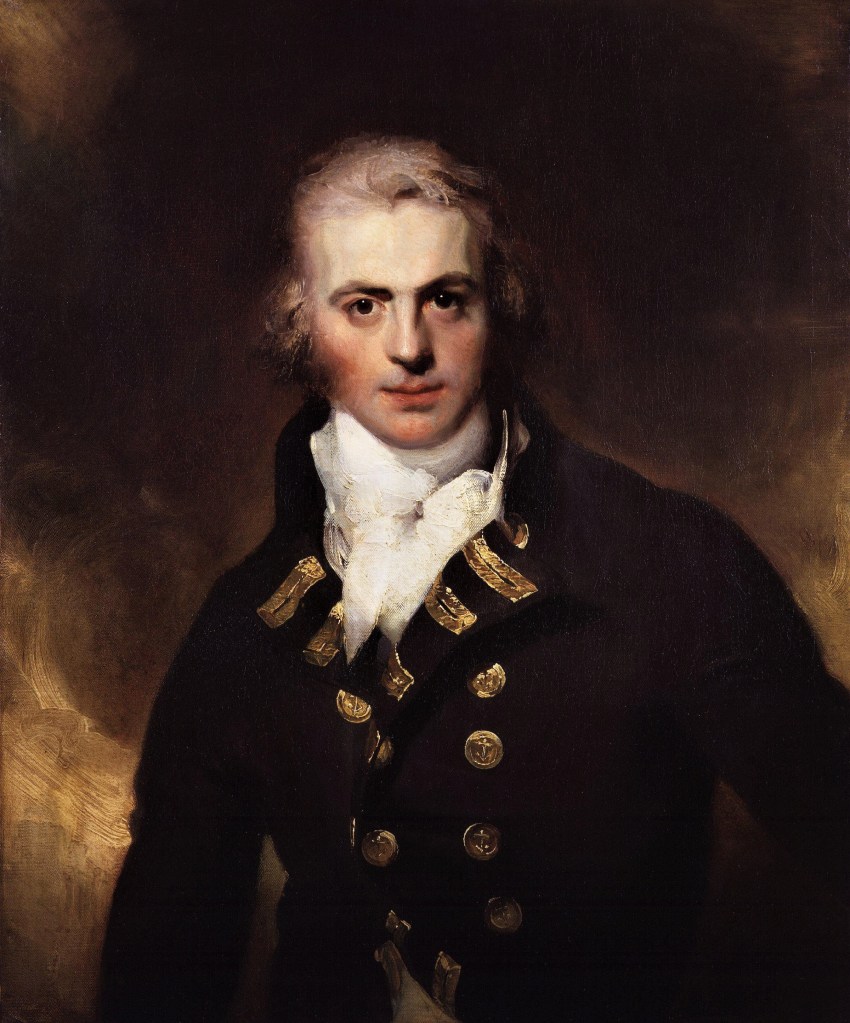
SIR THOMAS LAWRENCE (1769-1830)
Commander Graham Moore (1792)
Oil on canvas (76 x 64 cm)
London, National Portrait Gallery
To enlarge the picture, click on it and “Open in a new tab”
Sir Graham Moore, GCB, GCMG (1764-1843) was the son of the renowned Scottish physician and author, Dr John Moore (1729-1802) and brother of the famous general Sir John Moore (1761-1809). Following the traditional custom of those days, he entered the Navy at a very young age (13). He was promoted to lieutenant in 1782 and took part in the relief of Gibraltar under Lord Howe. On 22 November 1790, he was promoted to commander and given the command of a sloop-of-war, the HMS Bonetta, before returning to England in 1792, when he was portrayed by Lawrence.
Lawrence created a stormy, dark background to set off the fair complexion of his sitter. The young naval officer stares at the viewer, something fairly unusual; perhaps he either chose to do so or it was suggested by the artist. Commander Graham Moore comes across as a forceful character, as it should be expected of a young Royal Navy officer in those days when would-be officers joined the service at a tender age and matured very rapidly in a harsh, often brutal, environment. Promotion was swift, as the losses were very high and the burden of command imposed at an early age made grown men out of youngsters. Graham Moore was 28 years old when portrayed by Lawrence, who, once again, displayed all this talent and skill, producing a magnificent likeness. The immaculate, crisp, white cravat painted with swift, broad brushstrokes shows Lawrence’s total command of his craft. The handsome features of the sitter glow against the dark clouds; the flesh tones show Lawrence’s fine sense of colour, while the gleaming buttons and gold lace are proof of his extraordinary skill to reproduce metallic objects.
Moore went on to pursue a brilliant career. On the renewal of the war against France in 1803, he was appointed commander of the HMS Indefatigable and, with three other frigates under his command, captured a Spanish treasure fleet of four ships transporting gold bullion from the Caribbean to Spain. In 1808, he was made a commodore (rank between captain and rear-admiral, equivalent to a brigadier in the British Army). He was responsible for the transportation of the Portuguese royal family to Brazil.
In August 1812, he was promoted to rear-admiral and in 1814, he became Commander-in-Chief of the Baltic fleet. Having been appointed Knight Commander of the Order of the Bath on 2 January 1815, he became second-in-command of the Mediterranean fleet. In May 1816, he was made First Sea Lord, which means Commander-in-Chief of the Royal Navy. He left the Admiralty in 1820 and was Commander-in-Chief, Mediterranean Fleet from 1820 to 1823. In 1832, he was made Knight Grand Cross of the Order of St. Michael and St. George (GCMG), and in 1836, he was made a Knight Grand Cross of the Order of the Bath (GCB). Promoted to full admiral on 10 January 1837, he served as Commander-in-Chief, Plymouth from 1839 to 1842. Admiral Sir Graham Moore died on 25 November 1843.