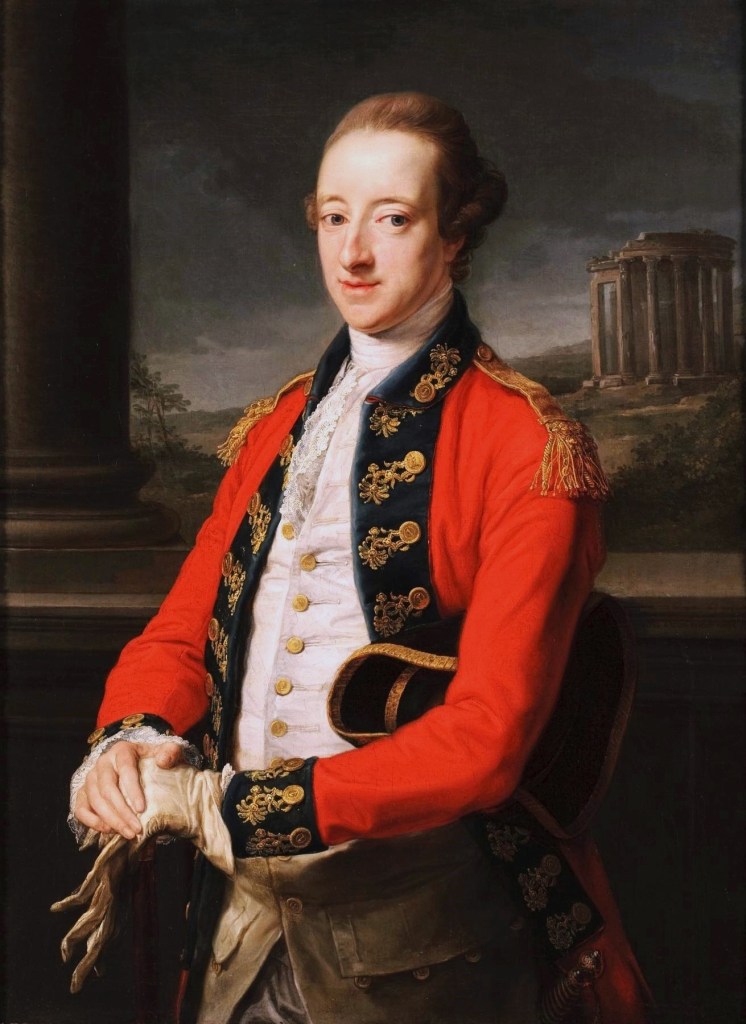
POMPEO BATONI (1708-1787)
Captain Otway Cuffe, 3rd Baron Desart (1769)
Oil on canvas (134 x 96 cm)
Museum of the Shenandoah Valley, Winchester, Virginia, USA
To enlarge the picture, click on it and open it in a new tab
Otway Cuffe (1737-1804) was the second son of John Cuffe, 1st Baron Desart, by his second wife, Dorothea Gorges. On 11th July 1752, the 15-year-old Otway Cuffe crossed the seas to study at Christ Church College, Oxford. On 31st January 1756, shortly after he left Oxford, Otway Cuffe was admitted to the Inner Temple, where he embarked on a legal career. Despite this, it seems as though Otway had plans for a military career. He eventually joined the army on 6th August 1766 when he purchased a captaincy in the 1st Royal Regiment of Foot, later The Royal Scots, the oldest and most senior infantry regiment of the line in the British Army.
In 1768, Otway Cuffe´s regiment was posted to Gibraltar; he obviously did not enjoy garrison service, and in 1769, he took leave to visit Italy, where he was portrayed by Batoni. The portrait tells us quite a lot about the young 3rd Baron Desart; he was obviously a very vain man who chose to be portrayed in his very elegant, and expensive, full dress uniform. According to the regimental Standing Orders: “Such officers who choose can wear the embroidered coat when in full dress, but not on duty.” That means that this coat was for full dress occasions only, while for parades and military duties, the officers wore a coat with plain gold-laced buttonholes.
Otway not only chose to be portrayed wearing his finest uniform but also cheated, as Stephen Luscombe pointed out in an article about the uniforms of the 1st Regiment of Foot in 1769 and Otway Cuffe´s portrait in particular: “He has a gold epaulette on each shoulder, which is puzzling because he held the rank of captain entitling him to only one epaulette on the right shoulder. Officers of the Grenadier Company and field officers wore two epaulettes, but Desart was not a grenadier officer. Perhaps he ordered his tailor to add the extra epaulette, knowing that he would only wear the coat for the portrait.” (1)
Otway did not enjoy military life and left the army in 1770. On his return to Ireland, he got involved in local politics and served as Mayor of Kilkenny between 1771 and 1772 and again between 1779 and 1780. During this time, he introduced street-lighting and “scavenging” (i.e., rubbish collecting) programmes to the city and, in 1773, oversaw the restructuring of the Linen Market there. On 6 January 1781, he was created Viscount Desart, of Desart in the County of Kilkenny, in the Peerage of Ireland. He was further honoured when he was made Earl of Desart and Viscount Castlecuffe, also titles in the Peerage of Ireland, on 4 December 1793.
This is not only one of the finest portraits painted by Batoni but also one of the very few where his sitter wears a military uniform. The extraordinary skill and flair of the Italian painter to reproduce the texture of different fabrics and the minute detail of the most exquisite embroidery or lace work is evident here, particularly in the gold embroidery of the buttonholes and the gold thread of the epaulettes, as well as the lace of Otway´s splendid cravat.
NOTES
1) In the British army, the officers were divided into three categories: A: Company officers or subalterns (2nd lieutenant, 1st lieutenant and captain), B: Field officers (major, lieutenant-colonel and colonel), C: General officers (major-general, lieutenant-general and general). Here is a link to Stephen Luscombe´s article: 1st or Royal Regiment of Foot (Royal Scots)