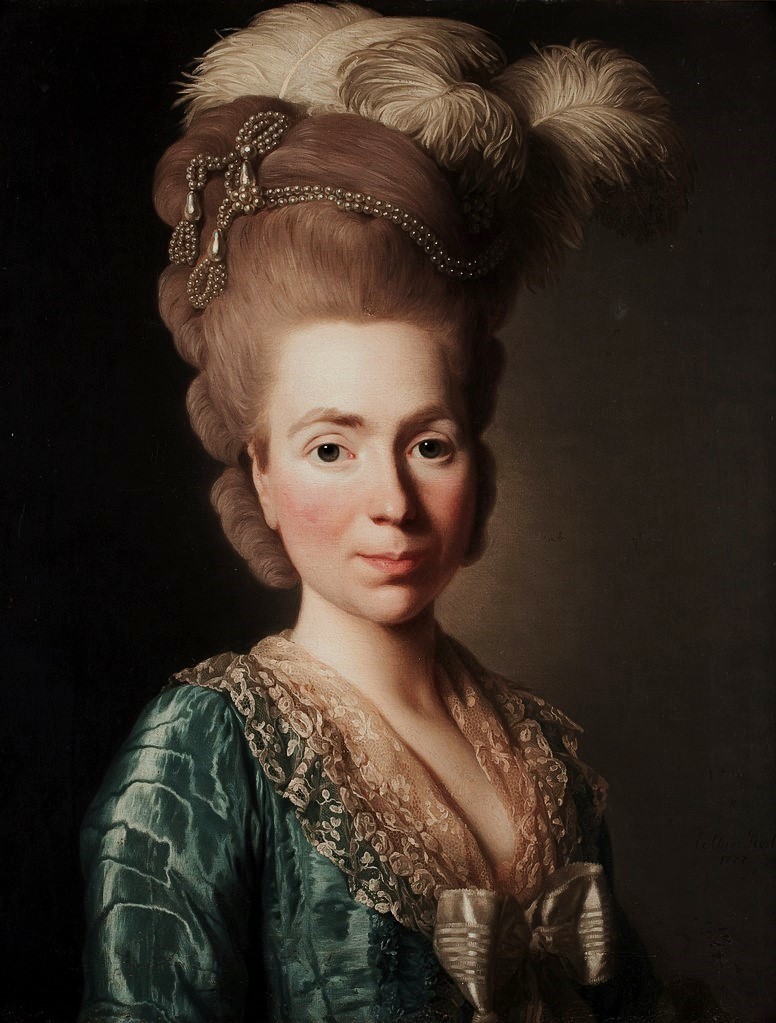
ALEXANDER ROSLIN (1718-1793)
Princess Natalya Petrovna Golitsyna (1777)
Oil on canvas (63 x 54 cm)
Mälmo Museum of Art, Sweden
To enlarge the picture, click on it and “Open in a new tab”
Born into the noble Chernyshyev family, Natalya Petrovna Golitsyna (1741-1837) was the daughter of the diplomat Pyotr Chernyshev, ambassador to the Prussian court at the time of her birth. Subsequently, Natalya spent nine years with her parents abroad, travelling around Europe. Pyotr Grigorievich Chernyshev served as ambassador not only to Prussia, but also to other countries, for example, to Denmark and England. According to the memoirs of her contemporaries, Natalia was a very lively and, at the same time, willful girl who insisted that the servants at home called her Natalya Petrovna and not “her ladyship” or “Countess”.
By the time her father was recalled to Russia in 1756, Natalya was 15 years old, and had received an excellent education, being fluent in five languages: French, German, English, Italian and Latin (1). Pyotr Chernishev spent four years in the country before his appointment in 1760 as ambassador to the court of Louis XV. The Chernyshevs spent only two years in France; during that time, Natalya shone at the French court. Although she was not pretty, her wit and excellent education made her a celebrity and the sycophants at Versailles nicknamed her “la Vénus de Moscou” (the Venus from Moscow).
In October 1766, she married the 35-year-old Prince Vladimir Borisovich Golitsyn, in a wedding attended by the Empress herself, who decorated the Princess’s hair with diamonds and accompanied her to the church. (2) The early years of her marriage were spent setting her husband’s estates in order. The Golitsyns had very extensive households and landholdings, but they were in some disarray. Natalya Petrovna, by travelling from estate to estate, was able to put the estates in order, while also significantly increasing their income.
Roslin visited St. Petersburg in 1777. He had been invited by Catherine the Great, who did not like Roslin´s too truthful portrait of her. During his stay, he portrayed several members of the Russian imperial family and some prominent members of the nobility. One of them was the princess Golitsyna, who was 36 years old at the time. As it would be expected from Roslin, the portrait is not flattering at all. Natalya looks exactly as she was described by her contemporaries. A hard, conceited and domineering woman who was the undisputed queen of the Russian high society. Looking at her portrait, one understands why her children did not dare to sit in her presence.
Princess Golitsyna´s choice of dress and jewellery shows clearly that she intended to be recognised as a very wealthy noblewoman. Her dress is of the most expensive silk available, which was known as moiré or “watered silk”. The beautiful, wavy pattern that produces that unique shimmering effect is the result of a complex process known as calendering. Few painters were able to reproduce this rare and very expensive fabric as beautifully as Roslin did. The other detail that tells us she was extremely wealthy is the strings of pearls that decorate her incredibly tall hairdo, typical of the last three decades of the 18th century.
Natalya Golitsyna continued her salon hosting duties into her old age, and it was considered a signal honour to attend on her. She received all guests while sitting in her chair, making an exception only for the emperor (3). Near her chair stood one of her close relatives, who presented the guests, since her eyesight was poor. Depending on the rank or nobility of the guest, the princess would either incline her head or say a few kind words.
Why the title of “Queen of Spades”? In 1834, Pushkin published his novel, “The Queen of Spades”, a story about greed and gambling. The main character, a Russian officer of German origin called Hermann, is obsessed with finding the secret that would allow him to win a colossal fortune at cards. The depository of the secret is an old countess who obtained it from the mythical and mysterious Count of Saint-Germain. What was the link between the countess and Natalya Golitsyna? Well, rumour had it that Princess Golitsyna’s grand-nephew, Prince Sergei Grigorievich Golitsyn (1803-1868), had gone to her for help after losing a large sum of money at cards. Princess Golitsyna replied that she knew the secret of the three magic cards, the three, the seven and the ace, having been told it by her friend in France, the Count of Saint-Germain. Sergei Golitsyn then used this knowledge to win the money back. Sergei Golitsyn had then related this story to Pushkin. Princess Golitsyna, who by the time of the novel´s publication was in her 90s, began to be identified with the character, being nicknamed the “Queen of Spades”, while her house in St Petersburg became known as the “House of the Queen of Spades”.
NOTES
1= Valery Fedorchenko (2003): Императорский дом. Выдающиеся сановники. Энциклопедия биографий (The Imperial Household. Distinguished Statesmen. An Encyclopaedia of Biographies) Vol. I, p. 322-323.
2= Aleksandr Popov (2018): Два Петербурга. Мистический путеводитель (The Two St Petersburgs: A Mystical Guide)
3= Valery Fedorchenko (2003): Op. cit.