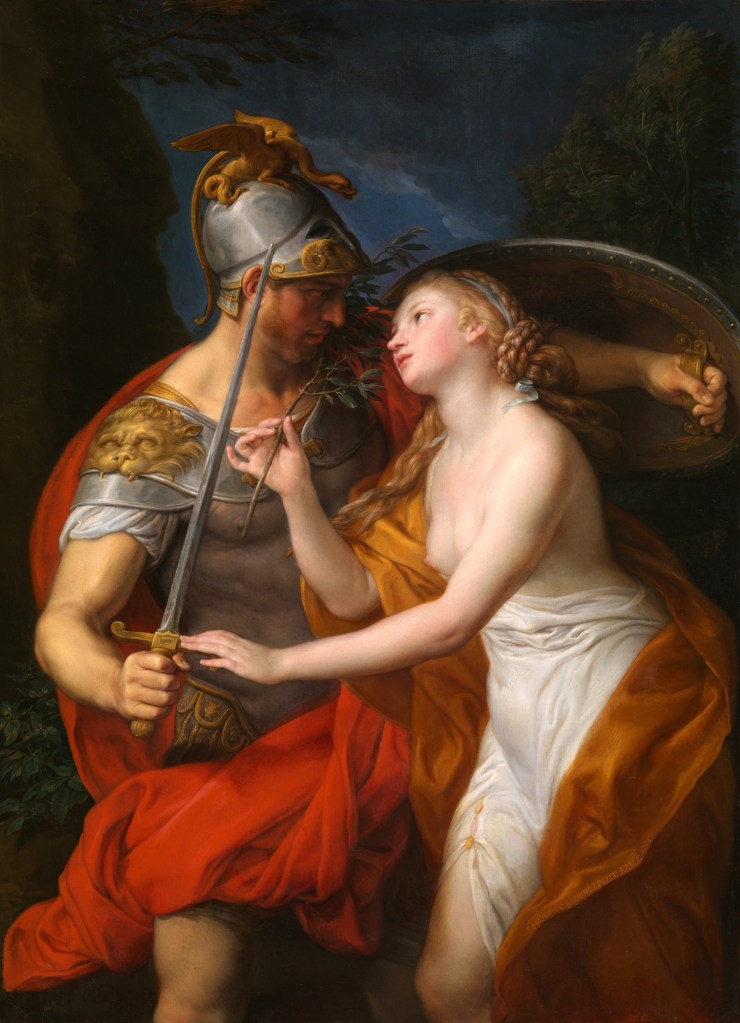
POMPEO BATONI (1708-1787)
Allegory of Peace and War (1776)
Oil on canvas (136 x 99 cm)
The Art Institute of Chicago, USA
To enlarge the picture, right-click on it and “Open in a new tab”
In 1998 the Art Institute of Chicago (AIC) acquired one of Pompeo Batoni´s most beautiful allegorical paintings. The picture was not commissioned by anyone, but painted by Batoni for his own pleasure and as an exercise in a genre of which he was very fond of. The painting was finished in 1776 and remained in Batoni´s studio until 1781. The whereabouts of it remained unknown until 1932 when it appeared in Brussels as part of the collection of the Countess Clotilde Eugénie d’Oultremont (1850–1932). The painted passed to her daughter Elisabeth Marie Sylvie d’Oultremont (1879–1953) who married Baron Adolf Louis Egon Hubert Vincent von Fürstenberg-Stammheim. The picture remained in the possession of the von Fürstenberg family until 1998 when it was sold to the art dealer Jean-François Heim.
The fact that the painting was not the product of a commission came from John Thorpe (1726-92), an English Jesuit resident in Rome from 1756 until his death in 1792, who acted as a guide for English Catholics visiting Rome and also as an agent for English Catholic art collectors and patrons. One of the latter was Henry Arundell, 8th Baron Arundell of Wardour (1740-1808). On 28th September, 1776, John Thorpe wrote to Lord Arundell:
“Pompeo has finished his picture of two figures representing Peace and War; it is surely a masterpiece, and shows powers perhaps superior to any master who ever painted at his time of life: it has all the brilliancy and perfection of his best and favourite performances (…) It is certainly an admirable piece into which Pompeo has thrown all the excellence of his art with a singular beauty of colouring. It was not painted by commission, nor will the painter part with it unless tempted by a very high recompense” (1)
The same feeling of admiration is echoed by one of Batoni´s assistants, a young Prussian named Johann Gottlieb Puhlmann (1751-1826), who spent thirteen years in Pompeo´s studio. On the 28th September, 1776, he wrote to his parents telling them he had brought some people to his master´s studio “…in order to look at the painting he has now finished, which presents War as a young hero, who is held back by Peace, a most attractive young maiden. This is one of the most beautiful things Batoni has ever made…” (2)
The “young hero” mentioned by Puhlmann is more likely a personification of Mars, the god of War. John Thorpe described eloquently the young woman who represents Peace as “…a most amiable young female with all the charms of beauty and modesty who is restraining Mars. With one hand she gently presses back his sword hand, while with the other she sweetly offers him her olive branch…” (3)
In the 18th century, very few artists concerned themselves with historical accuracy regarding the garments worn or the weapons employed by the characters depicted. Batoni was not one of them; he was particularly interested in the aesthetic aspect of his works, hence the impeccable draughtsmanship, attention to detail and the beautiful, glowing colouring that characterise his paintings. As an example of the aforesaid, Mars is wearing a Greek helmet crowned by a fanciful dragon, but his armour is Roman and the sword he is holding is a chimerical version of a medieval sword.
Batoni´s extraordinary talent and skill are evident in the expressions of both protagonists. Mars does not look like the brutal, bloodthirsty deity who enjoys fighting and killing. He seems already mystified, and at the same time pacified, by the beautiful young maiden who is offering him the olive branch.
NOTES
1 = Wiltshire and Swindon Record Office, Arundell MS 2667
2 = Eckhardt Götz: “Ein Potsdamer Maler in Rom: Briefe des Batoni Schülers Johann Gottlieb Puhlmann aus dem Jahren 1774 bis 1787” (Henschel Verlag, 1979, p. 121)
3 = Arundell MS 2667