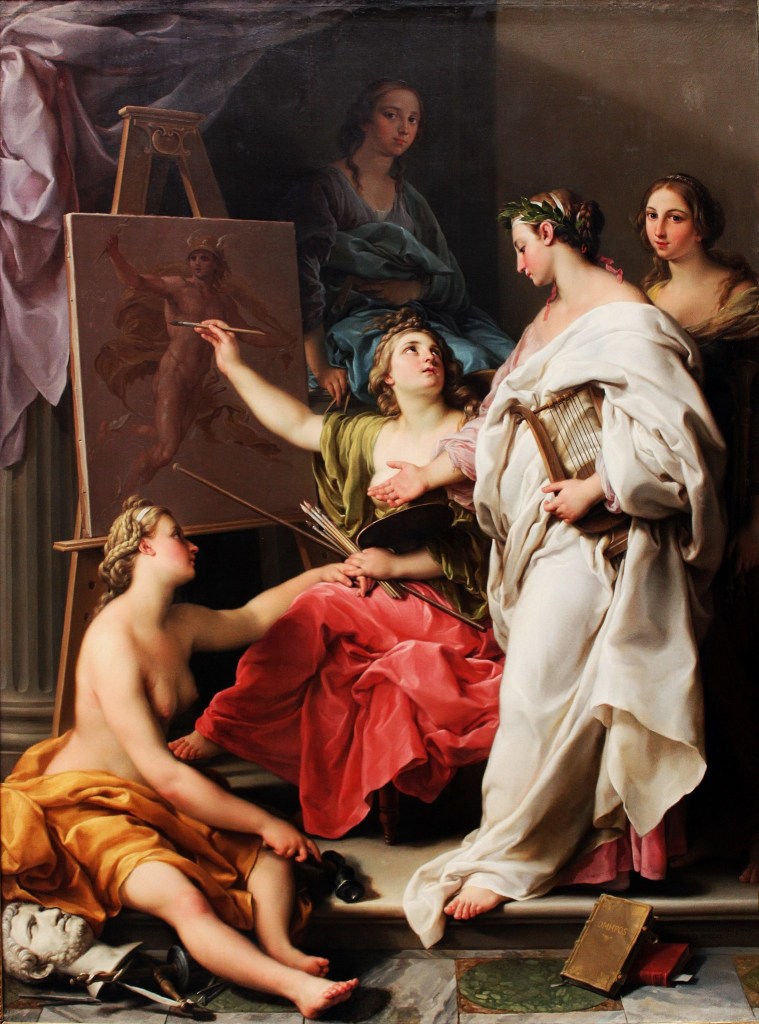
POMPEO BATONI (1708-1787)
Allegory of the Arts (1740)
Oil on canvas (175 x 138 cm)
Frankfurt, Städelisches Museum
To enlarge the picture, right-click on it and “Open in a new tab”
In 1740, Pompeo Batoni began to work on a large canvas that was commissioned by a Florentine nobleman, the Marquess Vincenzo Riccardi. The subject was an allegorical representation of the Arts: Painting, Poetry, Sculpture, Architecture and Music. Sometimes the person who commissioned a painting of this kind left the design to the artist, but sometimes the patron had very clear ideas about the composition of the work of art and would impose these on the painter. In this case it seems that the design, where Poetry takes literary centre stage, was the brainchild of Riccardi´s librarian, Giovanni Lami (1697-1770), who was also a writer and a scholar.
Like most writers, Lami believed in the superiority of Literature over Painting and also, according to the prevalent aesthetic theories of the day, that painters should get their inspiration from Literature and History rather than doing it from Nature. This concept stemmed from the idea that an artist should be knowledgeable about History, Theology, Philosophy, Literature and Classical Mythology; in other words, he must possess a humanistic education that would enable him to deal with complex compositions representing historical or religious subjects; by doing so, he was considered a far superior artist than the mere “mechanics” who just painted what was in front of them; the artists included in this undeservingly despised category were the landscape and still-life painters.
Batoni made clear the predominant role of Poetry, not only by placing her at the centre of the picture but also by the rather submissive attitude of Painting, which is looking up to Poetry as if waiting for approval. The gesture of the latter implies approval, but it is done in a rather condescending manner. Her face does not show any emotion whatsoever, a reflection of the growing tendency towards the cold, expressionless attitude championed by Anton Raphael Mengs and Johann Winckelmann, the intellectual leaders of the neoclassical movement.
On the other hand, Sculpture, sitting at the feet of Painting, looks up to her affectionately, their hands entwined, suggesting the close relationship between them; a relationship that only existed in Lami´s mind, who attributed to Michelangelo opinions about this subject that he did not express; in fact, Michelangelo considered Sculpture a form of art far superior to Painting. This did not prevent Giovanni Lami from saying in 1757: “I have also to consider the progress of sculpture, which has such an affinity with painting that Michelangelo Buonarroti considered them as just one art form” (Edgar Bowron & Peter Kerber: “Pompeo Batoni, Prince of Painters in 18th-Century Rome” (Yale University Press, 2007), p.18)
At Sculpture´s feet, we can see a bust of the emperor Hadrian, a chisel and a drill. Why a bust of Hadrian? Most probably because he was a great admirer and lover of Greek art who was also responsible for two of the most spectacular surviving works of Roman architecture: the Pantheon and the complex known as “Villa Adriana” (Hadrian´s Villa) in Tivoli.
At the feet of Poetry there are two books bearing the names of the greatest classical poets: Homer (OMPHOS) and Virgil (VIRGILIUS). In the background, sitting behind Painting is the personification of Architecture who can be easily identified by the dividers and the T-square she is holding in her right and left hands, respectively. On the right, we can see Music, who is holding a large flute.
As a whole, and bearing in mind the predominant aesthetic theories of the mid-18th century and Batoni´s brilliant technique, “Allegory of the Arts” is a fine painting. In my opinion, the most admirable traits of the picture are Batoni´s glowing colours and his skill in depicting flesh tones. The only weak point in the composition is the figure of Poetry, completely devoid of emotion. Had Batoni represented Poetry facing the viewer with an expression of satisfaction or pride in the painting on the easel, the message would have been far more eloquent.