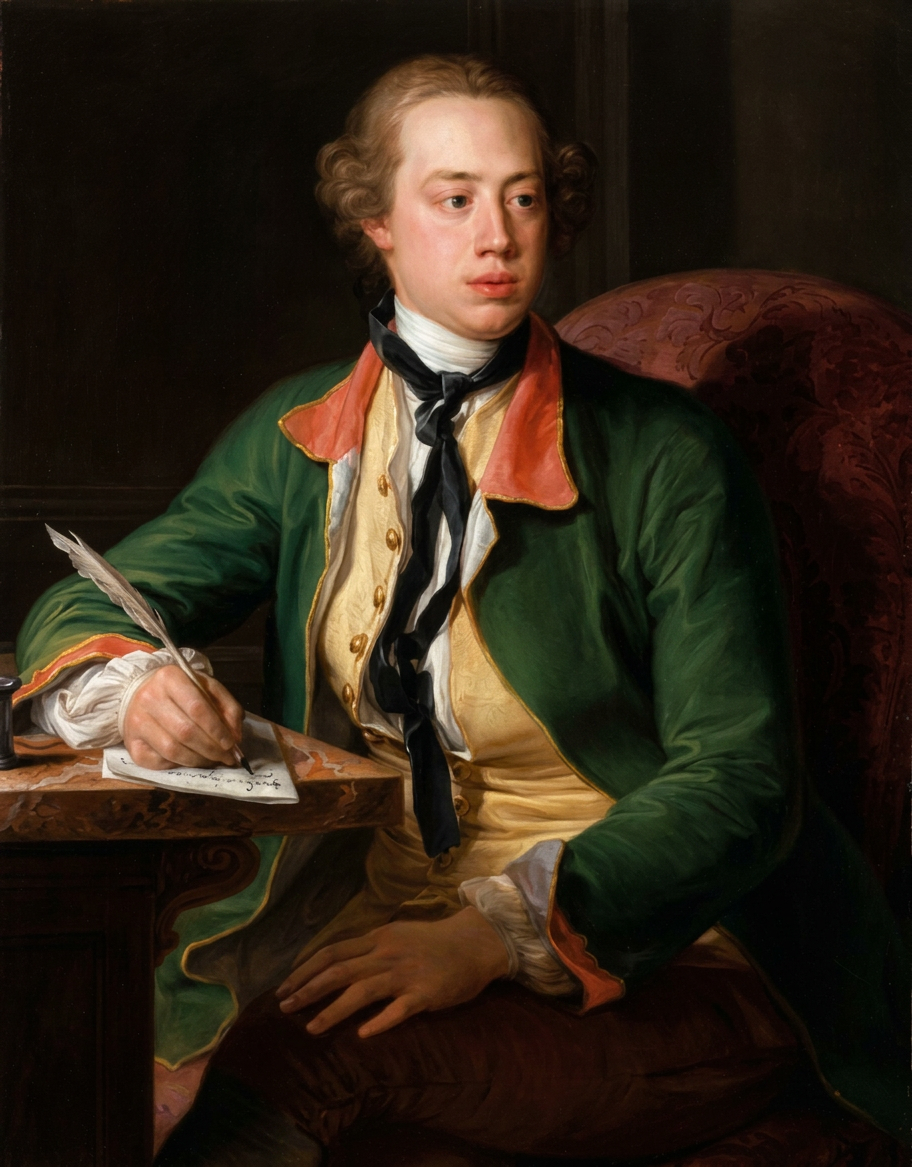
POMPEO BATONI (1708-1787)
Frederick North, 2nd Earl of Guilford (1753)
Oil on canvas (93 x 75 cm)
National Portrait Gallery (London)
To enlarge the picture, right-click on it and “Open in a new tab”
Frederick North (1732-92), later 2nd Earl of Guilford, was the son of Francis, 1st Earl of Guilford and Lady Lucy Montagu, daughter of George, Earl of Halifax. Frederick´s strong resemblance to King George III gave birth to rumours that his real father was the prematurely deceased Prince of Wales, father of George III.
North´s posthumous reputation as a statesman was fairly bad. For a long time, he was considered responsible for the loss of the American colonies due to his supposed subservient attitude towards the King. However, it must be remembered that North delegated the overall conduct of the war to his key subordinates, Lord George Germain and the Earl of Sandwich. Besides, he cannot be held responsible for the bad decisions made by the British generals on the field.
After leaving Oxford in 1750, Frederick went on a Grand Tour with his close friend Lord Dartmouth. They stayed in Leipzig for nearly nine months, studying constitutional law. They continued through Austria and Italy, staying in Rome from December 1752 to Easter 1753, then through Switzerland to Paris, returning to England in early 1754.
Lord North and Lord Dartmouth had to wait nearly three years to see their portraits, a perfect example of the sometimes extraordinary delays imposed by Batoni on his clients. These were due to the fact that Batoni, like other very successful and popular portrait painters, took too many commissions, which led to inevitable delays as the deadlines proved to be impossible to meet. There is a letter from Thomas Jenkins, the famous guide and art dealer patronised by the British visitors to Rome, to Lord Dartmouth, dated 1st May 1756, that records the almost incredible delay that both English noblemen had to endure; in there he wrote: “I have at last received from Signor Pompeo both, Lord North´s portrait and your Lordship´s and shall be sent away at the first opportunity” (Edgar Peters Bowron: “Pompeo Batoni and his British Patrons”, London (1982), p. 35)
Batoni was very generous with Frederick North who was an ugly man. Thanks to his extraordinary skill the painter managed to mitigate his sitter´s ungraceful features. Horace Walpole left a rather cruel but truthful description of Frederick North when he wrote:
“Nothing could be more coarse or clumsy or ungracious than his outside. Two large eyes that rolled about to no purpose (for he was utterly short-sighted), a wide mouth, thick lips, and an inflated visage gave him the air of a blind trumpeter” (Memoirs of the Reign of King George III, London (1845), Vol. IV, p.78)
Frederick North was 21-years-old when portrayed by Batoni; that was the average age of the young British and Irish visitors to Italy during the 18th century. Upon his return to England in 1754, he became an MP, a position that did not entail any serious responsibility since the whole British political system was a farce where the members of the ruling class pretended to be divided into two opposing factions. The only serious differences that they might have were of a personal nature.
In June 1759 North joined the government as a junior Lord of the Treasury. When Lord Rockingham came to power in 1765, North left his post and returned to be an MP. He returned to office when Pitt became Prime Minister again in 1766 and in 1767 he succeeded Charles Townsend as Chancellor of the Exchequer (1)
Lord North became Prime Minister in 1770. His government presided over the American War of Independence (1775-1783). In 1782, as a consequence of Lord Cornwallis’ surrender at Yorktown, North was forced to resign after receiving a vote of no confidence. He succeeded his father as 2nd Earl of Guilford on the 4th of August 1790 and entered the House of Lords, by which time he had entirely lost his sight. Frederick North died on the 5th of August 1792.
Note: Since the quality of the original picture was not very high, I have enhanced it by using AI.
NOTES
1) The Chancellor of the Exchequer, known usually as the Chancellor, is one of the four “Great Offices of the State”, the other three being the Prime Minister, the Home Secretary and the Foreign Secretary. Being responsible for all economic and financial matters, his role is equivalent to that of a finance minister in other countries.