
WILLIAM HOGARTH (1697-1764)
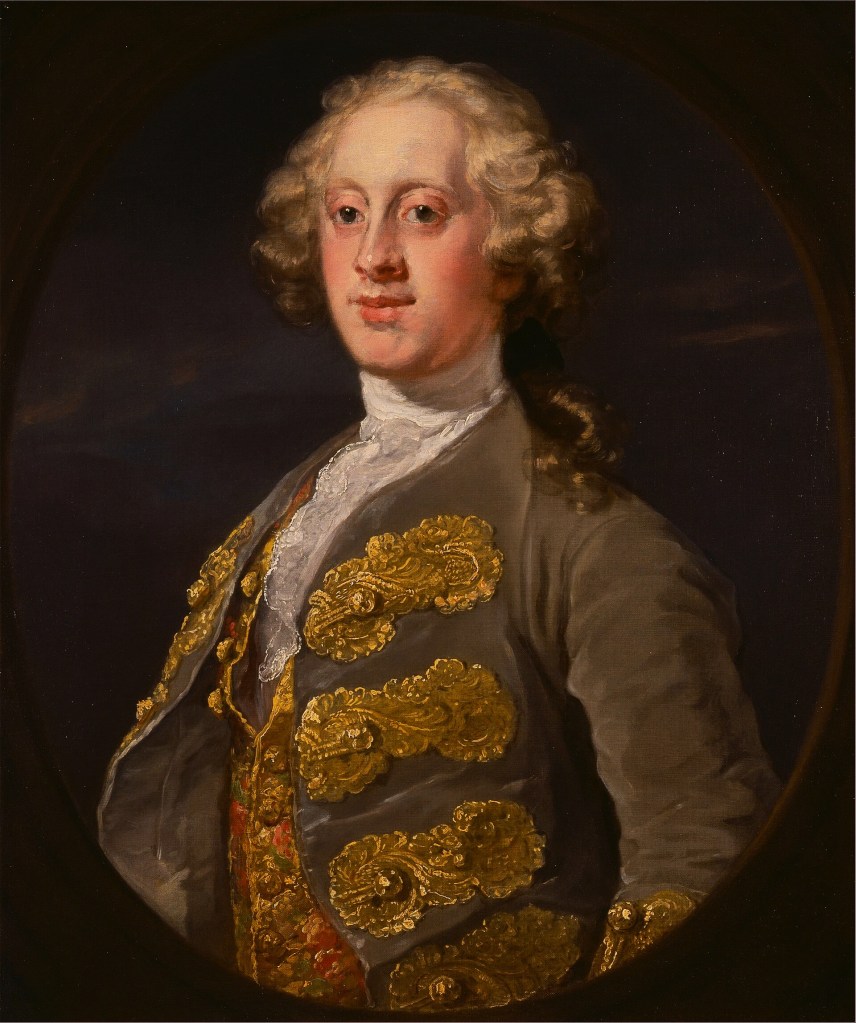
William Cavendish, Marquess of Hartington, later 4th Duke of Devonshire (1741)
Oil on canvas (76 x 63 cm)
Yale Centre for British Art, New Haven, Connecticut, USA
To enlarge the image, right-click on it and “Open in a new tab”
William Cavendish, 4th Duke of Devonshire (1720 – 1764), styled Lord Cavendish before 1729, and Marquess of Hartington between 1729 and 1755, was one of the shortest-serving British Prime Ministers in history. He held the position for only seven months and two weeks, from 16 November 1756 to 29 June 1757. The German historian Karl Wolfgang Schweizer said of him: “Devonshire was a man of solid if not outstanding abilities. He was endowed with the qualities—devotion to friends and duty, patriotism, and unswerving integrity—which made him the ideal sounding board and factotum among the prominent politicians of his day. Unlike Pitt or Fox, he lacked a brilliant mind, and his diary provides evidence of devotion to king, country, and duty rather than quickness of intellect.” (1)
Hogarth portrayed the handsome young nobleman when he was 21 years old, and he had just been elected MP for Derbyshire. This picture belongs to Hogarth´s first period as a portraitist, which goes from 1738 to approximately 1745. Portraiture was a genre deeply disliked by Hogarth, who entertained great hopes of succeeding as a painter of historical subjects. Unfortunately for him, neither English art lovers nor English institutions were interested in the so-called “grand manner” or “great style”; therefore, he started painting group portraits known in England as “conversation pieces” and, later on, portraits, usually of friends or their relatives. The latter are not very numerous because, as I said, Hogarth mostly painted them out of necessity and never ceased to speak with contempt of this tremendously popular genre. Here is an example: “As to portrait painting, the chief branch of the art by which a painter can procure himself a tolerable livelihood, and the only one by which a love r of money can get a fortune; a man of very moderate talents may have great success in it, as the artifice and address of a mercer is infinitely more useful than the abilities of a painter.” (2)
The young Marquess of Hartington was a very unusual sitter for an artist who never courted the favour of the high and mighty; in fact, out of the 62 persons portrayed by Hogarth, only 6 were of noble rank: William Augustus, Duke of Cumberland (YCBA), the Marquess of Hartington (YCBA), Lavinia Fenton, Duchess of Bolton (Tate Gallery), Gustavus Hamilton, 2nd Viscount Boyne (Private coll.) Edward Montagu, son of the 4th Earl of Sandwich (Mapperton House) and James Caulfeild, Earl of Charlemont (Smith College Museum of Art, Northampton, Mass., USA).
As the late Julia Marciari-Alexander wrote: “When he undertook portraits himself, it was in a spirit of defiance and competition, challenging his foreign rivals like van Loo and those who did not consider him capable of face painting” (3). Hogarth recorded his feelings about this situation, writing with justifiable bitterness: “(…) the current remark was, that portraits were not my province; and that I was tempted to abandon the only lucrative branch of my art, for its practice brought the whole nest of phizmongers on my back, where they buzzed like so many hornets, (…) This so much disgusted me, that I sometimes declared I would never paint another portrait, and frequently refused when applied to.” (4)
The “Marquess of Hartington” is an excellent example of Hogarth’s natural talent as a portraitist. Like all gifted portrait painters, he worked quickly, applying the paint in swift strokes and usually finishing the portrait in just one sitting. This method is known as “alla prima”, an Italian expression that means “at the first attempt”. This means working with wet paint and not letting the layers dry before applying the next layer. It is a technique that demands great skill and an excellent eye for colour. Other English painters who excelled at this practice were Gainsborough and Sir Thomas Lawrence.
William Cavendish appreciated Hogarth´s talent and did not forget the painter. In 1757, when he was appointed Lord Chamberlain, he obtained for Hogarth the post of Serjeant Painter to the King, a highly lucrative position which was welcomed by the ailing painter. The post of Serjeant Painter to the King carried with it the prerogative of painting and gilding all of the King’s residences, coaches, banners, barges, etc. Hogarth did not carry out the job personally; instead, he employed another artist who acted as his deputy and several assistants. After paying the workmen and his deputy, he reckoned five years later that he was making a £ 200-a-year profit as a Serjeant Painter. That was a fairly respectable sum in those days; its equivalent today (2026) would be £ 52.420
1= “Cavendish, William, 4th Duke of Devonshire” Oxford Dictionary of National Biography, Oxford University Press, 2004.
2= “Anecdotes of William Hogarth” J. B. Nichols & Son, London, 1833 (p. 14)
3= “This Other Eden” Catalogue of the exhibition of British paintings from Yale that toured Australia in 1998 (Yale University Press, p. 44)
4= “Anecdotes of William Hogarth” J. B. Nichols & Son, London, 1833 (p. 22)
 Old Masters