
SIR THOMAS LAWRENCE (1769-1830)
Lieutenant-General Charles Grey, 1st Earl Grey (1794-5)
Oil on canvas (127 x 101 cm)
Howick Hall, Northumberland, England
To enlarge the images, click on them and “Open in a new tab”
The sitter to this beautiful portrait was an excellent soldier who, unlike many of his contemporaries, fully deserved the promotions and honours bestowed on him by the British government and the King. Charles Grey (1729-1807) was born at his family estate, Howick Hall, 30 miles north of Newcastle upon Tyne. Since he had two older brothers, Charles did not expect to inherit his father’s titles and estates, so he pursued a military career. However, his two older brothers, Sir Henry and Thomas, both died without issue, leaving him as the viable heir.
He began his military career in 1744 when he joined the 6th Regiment of Foot (later the Royal Warwickshire Regiment) as an ensign. When the War of the Seven Years (1756-63) began, he was a lieutenant-colonel and served in the staff of the Duke Ferdinand of Brunswick. He retired on half-pay at the end of the war, but in 1772 he received a promotion to colonel and served as aide-de-camp to King George III.
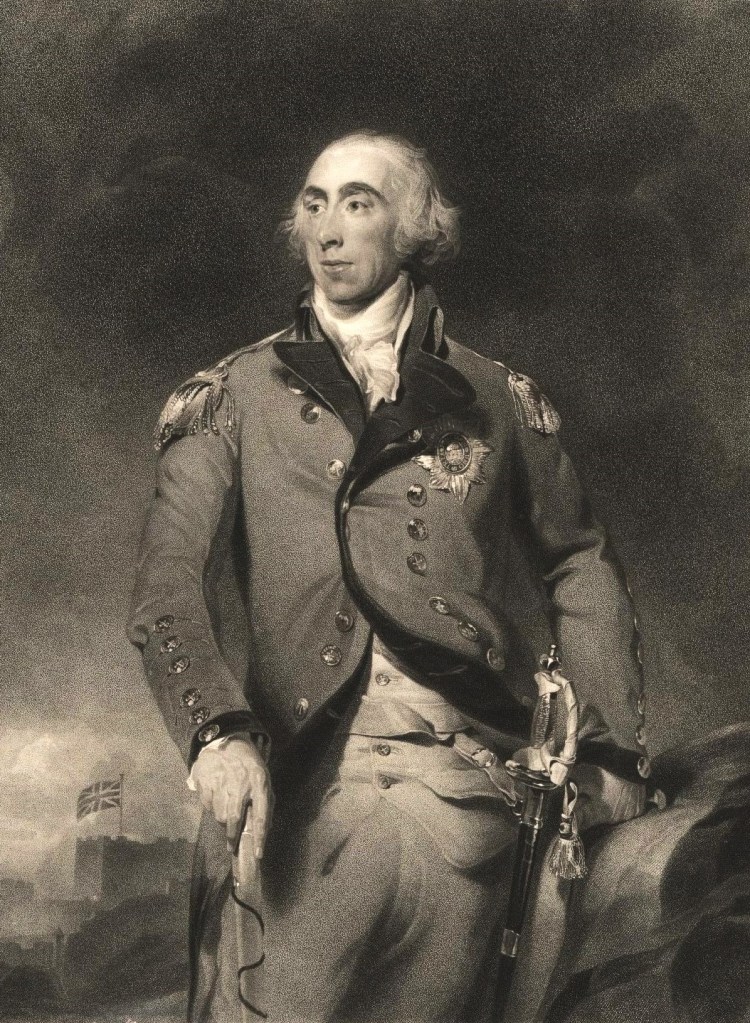
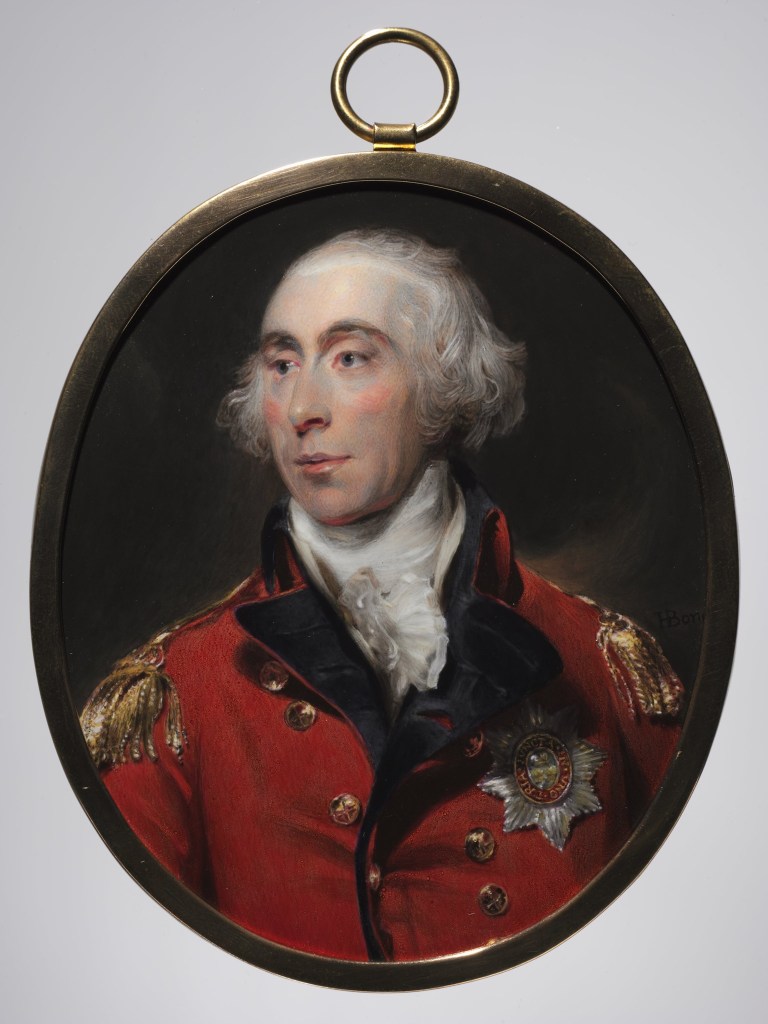
He became a highly respected and popular military leader during the American War of Independence (1775-83) when he was promoted to major-general and given the command of a brigade. He earned the nickname “No-flint Grey” after the Battle of Paoli in the same campaign when, allegedly, to ensure surprise in the night attack on an American encampment, it was said he ordered the infantry of his command to remove the flints from their muskets (to prevent accidental shots) and use only their bayonets. Other historians said that he simply ordered his men not to load their muskets; something easier and more sensible. Charles Grey returned to England in 1794. I assume he sat for Lawrence that year because, according to Kenneth Garlick, his portrait was exhibited at the RA the next year (1). Unfortunately, it is practically impossible to obtain a high-quality colour image of the original painting, which remains at Howick Hall. The Cleveland Museum of Art possess a beautiful miniature (9.6 x 8 cm) painted by Henry Bone in 1794. The only high-quality reproduction of the full picture that I could obtain is a photo of an engraving executed in 1797 by Joseph Collyer the Younger, in possession of the Anne S. K. Brown collection in Providence, Rhode Island, USA
Regarding the engraving, produced by Joseph Collyer Jr (2), there is a rather weird and confusing story in connection with the man who commissioned it. He was William Austin (1721-1820), a drawing master and a mediocre engraver, who, for some time, ran a print shop on Hanover Square, where he also sold artists´ materials. Here are some fragments of the advertisement published by Austin announcing the sale of Joseph Collyer´s print after Thomas Lawrence´s painting. In it, Austin claims to be the proprietor of the painting.
“For the Benefit of the Widows and Children of the brave Men who have lost their Lives during the War.
THIS DAY IS PUBLISHED
A Portrait of Sir Charles Grey, K. B., late Commander-in-Chief in the West Indies; from a capital picture painted by Mr. Lawrence, R. A., Portrait Painter in Ordinary to his Majesty; engraved in a most finished style by Mr. Joseph Collyer, Engraver to her Majesty; and published by the proprietor, W. Austin, Drawing Master, Turnham Green. Proof prints: 2 guineas, Prints: 1 guinea each.
Mr. Austin respectfully solicits the patronage of the public to an undertaking he has the pleasure of submitting to them; the profits of which, he pledges himself, shall be applied to the fund established for the relief of the widows and children of the brave Britons who have lost their lives in their country’s cause, in the expedition under the joint command of those gallant officers, Sir Charles Grey, K. B. and Vice-Admiral Sir J. Jervis, K. B….Mr. Austin assures the public that every exertion has been used by the artist, whose abilities are universally acknowledged, to render the print deserving that consideration which is so justly due to the merits of the brave General it is intended to represent. The painting from which it is taken has long been acknowledged as a production which reflects the highest credit on Mr. Lawrence’s pencil…” (3)
I have highlighted the words “and published by the proprietor” because it is strange and quite misleading. Lawrence worked closely with engravers to ensure high-quality reproductions of his portraits, often supervising proofs and maintaining control over how his works were translated into print. He would never have relinquished his copyright. Perhaps he gave Austin exclusive rights to reproduce this particular portrait, and when the latter said “published by the proprietor”, he implied he was the proprietor of the rights to its reproduction. Austin must have paid a substantial amount to Lawrence to secure the exclusivity of the reproduction´s rights. As I mentioned before, unfortunately, there are no decent digital images of the portrait of the 1st Earl Grey by Lawrence.
NOTES
1= Kenneth Garlick: “A catalogue of the paintings, drawings and pastels of Sir Thomas Lawrence”, The Walpole Society, 1964 (p. 90)
3= D. E. Williams: “The Life and Correspondence of Sir Thomas Lawrence”, Colburn & Bentley, 1831 (Vol. I, p. 188-189)
 Old Masters