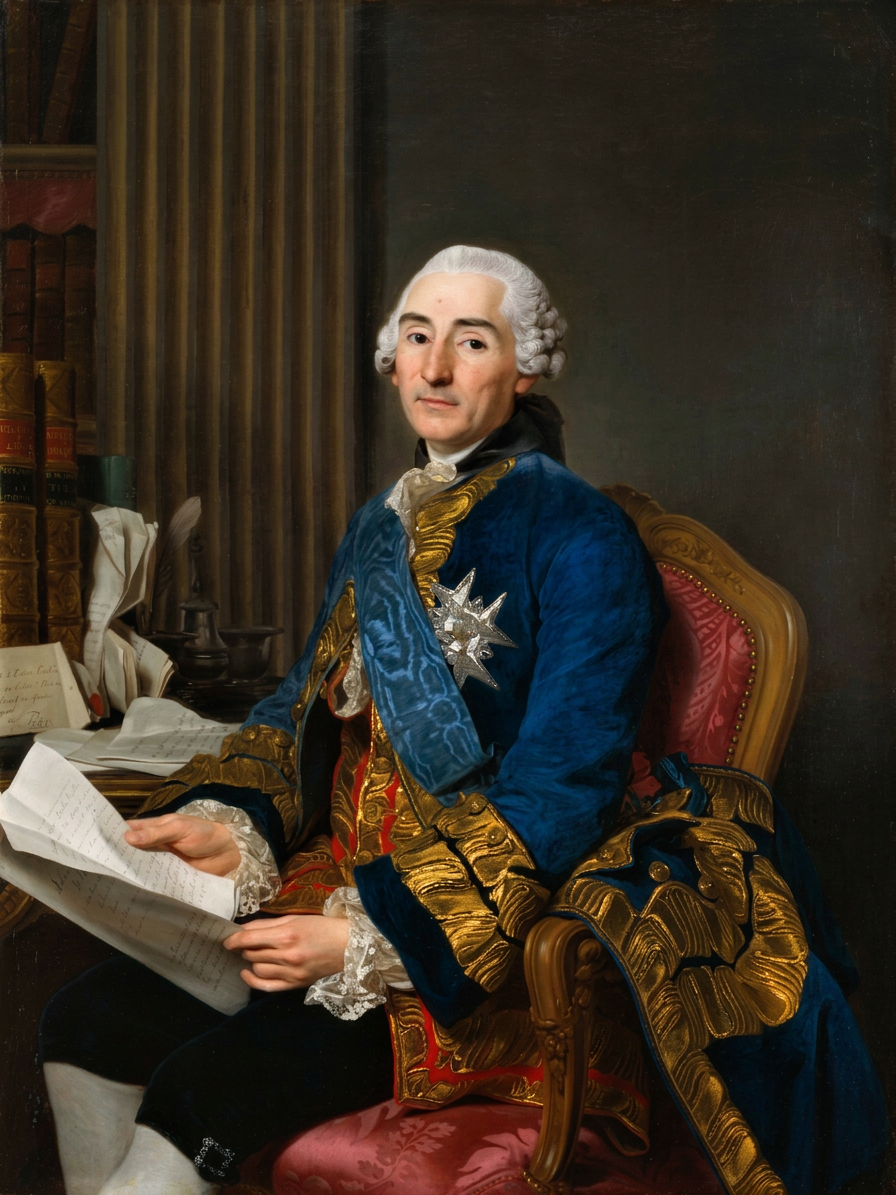
ALEXANDER ROSLIN (1718-1793)
César Gabriel de Choiseul-Chevigny, Marquis de Choiseul (1763-66)
Oil on canvas (130 x 100)
National Museum, Stockholm, Sweden
To enlarge the picture, click on it and open it in a new tab
César Gabriel de Choiseul-Chevigny (1712-1785), Marquess of Choiseul and later duke of Praslin was a soldier and a statesman who belonged to an illustrious family which provided a large number of servants to the kingdom of France, five marshals, a cardinal, two bishops, and several statesmen.
He was a lieutenant general of cavalry before leaving the service due to his poor health. In 1758, he was appointed French ambassador in Vienna, replacing his cousin Étienne François de Choiseul, count of Stainville and later duke of Choiseul, when the latter was called to the Ministry of Foreign Affairs.
Two years later, he returned to France, where he succeeded his cousin as Minister of Foreign Affairs; as such, he was responsible for the much criticised Treaty of Paris of 1763 that put an end to the Seven Years War. Although France lost its possessions in North America, Canada, Acadia and part of Louisiana, which could not be reconquered, this abandonment was compensated by the restitution of the richest French colonies, those in the West Indies.
On 8 April 1766, he returned the Ministry of Foreign Affairs to his cousin and received the Ministry of the Navy. He spread a strong desire for education among the officers and demanded from them a thorough knowledge of their profession. The students were subjected to severe examinations. Under his direction, the design of warships improved greatly, harbours were enlarged, great arsenals built, and when he left in 1770, France had a more powerful navy than ever before.
This was one of the very few portraits by Roslin that was not destroyed by Diderot’s poisonous pen. As strange as it seems, he even considered it was quite nice: “…of all the portraits that he (Roslin) has exhibited this year, the one of the duke of Praslin is the best one” (Patricia Lemonnier: “Alexandre Roslin: Un portraitiste au siècle des Lumières”, L’Objet d’Art, No. 234, p. 82, 1990)
However, the entire paragraph from his Observations on the Salon of 1767 demonstrates his hateful hostility towards Roslin: “Roslin is Swedish. He is the most employed portraitist, but he is cold, graceless and lifeless. He should be forced to paint fabrics, dresses, lace, etc., as he takes care of every detail, and leave the painting of faces to others. Of all the portraits he is exhibiting this year, the one of the Duke of Praslin seems to me the best”
The duke wears the insignia and the band of the order of the Holy Spirit, which was awarded to him on January 1st, 1762. Once again, Roslin demonstrated his extraordinary skill in rendering textures in the beautiful blue moiré silk band. This kind of silk that has a unique wavy pattern is the result of a special process known as “calendering”, where the fabric is passed between heavy ribbed rollers called calenders and pressed at high temperatures.