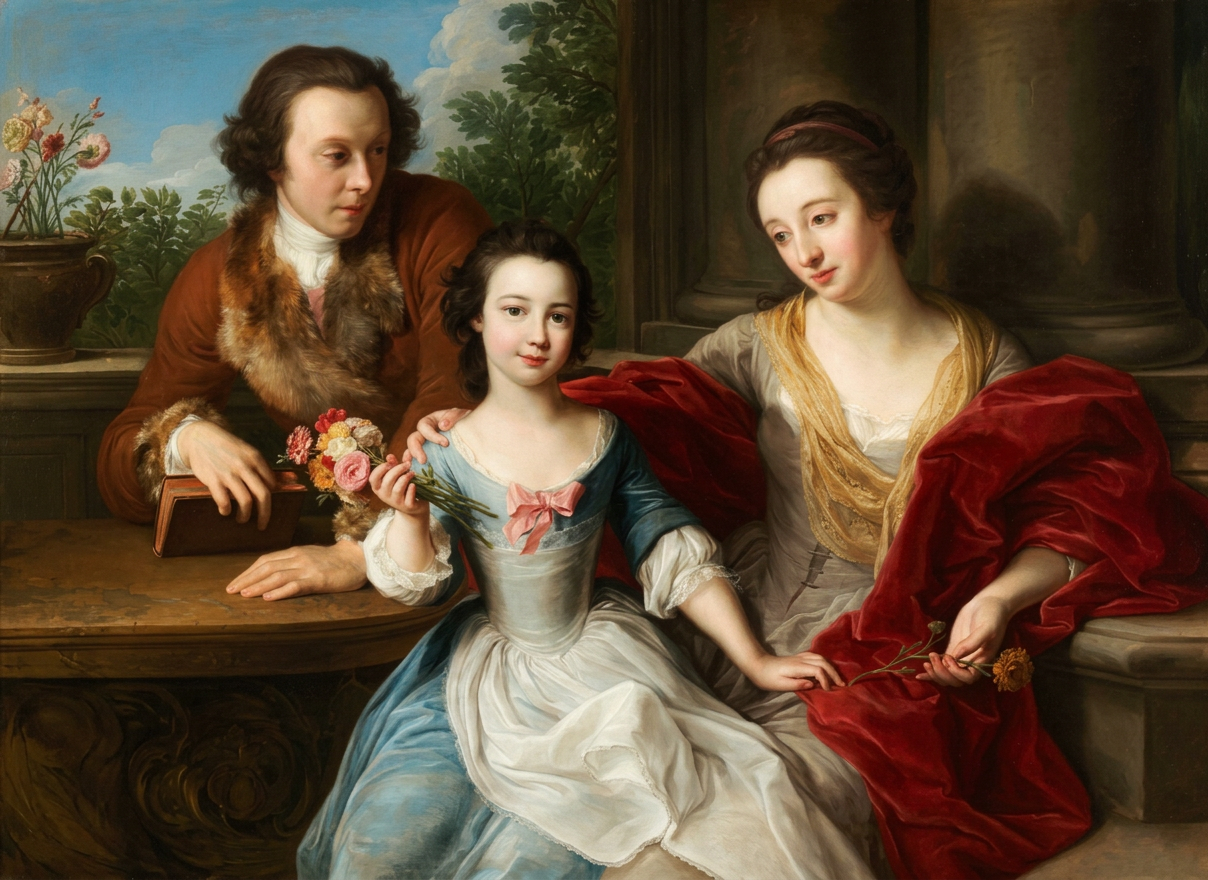
POMPEO BATONI (1708-1787)
The Barrett-Lennard Family (1750)
Oil on canvas (39 x 53 cm)
Essex Record Office, Chelmsford, UK
To enlarge the picture, click on it and “Open in a new window”
This beautiful family portrait had a sad origin. Thomas Barrett-Lennard, 17th Baron Dacre (1717-1786) was the son of Richard Barrett and Anne Lennard, later 16th Baroness Dacre. On 15 May 1739, Thomas married Anne Marie Pratt in London. Anne was the daughter of Elizabeth Wilson and Sir John Pratt, an MP for Midhurst who served as Lord Chief Justice of England between 1712 and 1725.
The couple had one daughter, Barbara Anne, who died tragically and suddenly at the age of nine in March 1749. Shortly afterwards, a mutual friend (Sir Edward Turner) wrote to the architect Sanderson Miller: “I am just returned from poor Barrett, who talks of going with Mrs Barrett to Italy. England has at present no attractions to them, for that charming little girl (who had not one jarring atom in her composition) was on Sunday last snatched from her inconsolable parents by a stroke so sudden that it scarcely allowed them time to hope for her recovery” (1)
The features of little Barbara are based on a miniature that her parents gave the painter. The expression of the little girl is, as to be expected, charming and sweet. Her father looks at Barbara in a rather contemplative mood, as if wondering what her future may be, whereas his wife’s expression is clearly sad, telling us that the painting is not a conventional family portrait but a memorial to her dear late daughter.
As time went by, Thomas Barrett-Lennard and his wife began to recover and to enjoy Rome. Almost a year later (April 1750) Thomas wrote to his friend Sanderson Miller apologising for not writing earlier because: “I spent the winter in Naples and came to Rome about six weeks ago and I don´t think I have had one hour´s leisure, so much we have been taken up in running up and down to see curiosities and antiquities here (…) My spirits are sometimes better, sometimes worse; you must imagine that it requires a longer time than has already intervened to recover them so as to have one’s mind well settled again after the cruel stroke my wife and I have received and upon which I will not enlarge for ’tis a subject I cannot bear to touch upon.” (2)
Barbara Anne was the couple’s only child, although Thomas had two illegitimate children with a mistress who were brought up by the couple as their own. The eldest, Thomas FitzThomas, inherited the estate, and in 1786, he was granted the right to adopt his father’s surname and titles, becoming Thomas Barrett-Lennard. He became an MP for Essex South and was created a baronet of Belhus in 1801.
The painting remained in the possession of the Barrett-Lennard family until 1923, when, due to the family’s critical financial situation, the contents of the house were sold over eight days. Batoni´s painting, together with many others, was given by the family to the Essex County Council. The family´s ancestral home, Belhus, was demolished in 1957.
Note: Since the original image´s quality was rather mediocre, the picture has been enhanced with AI.
NOTES
1 = “An Eighteenth-Century Correspondence”: Edited by Lilian Dickins & Mary Stanton, London, 1910 (p. 139-40)
2 = “An Eighteenth-Century Correspondence” (p. 166)