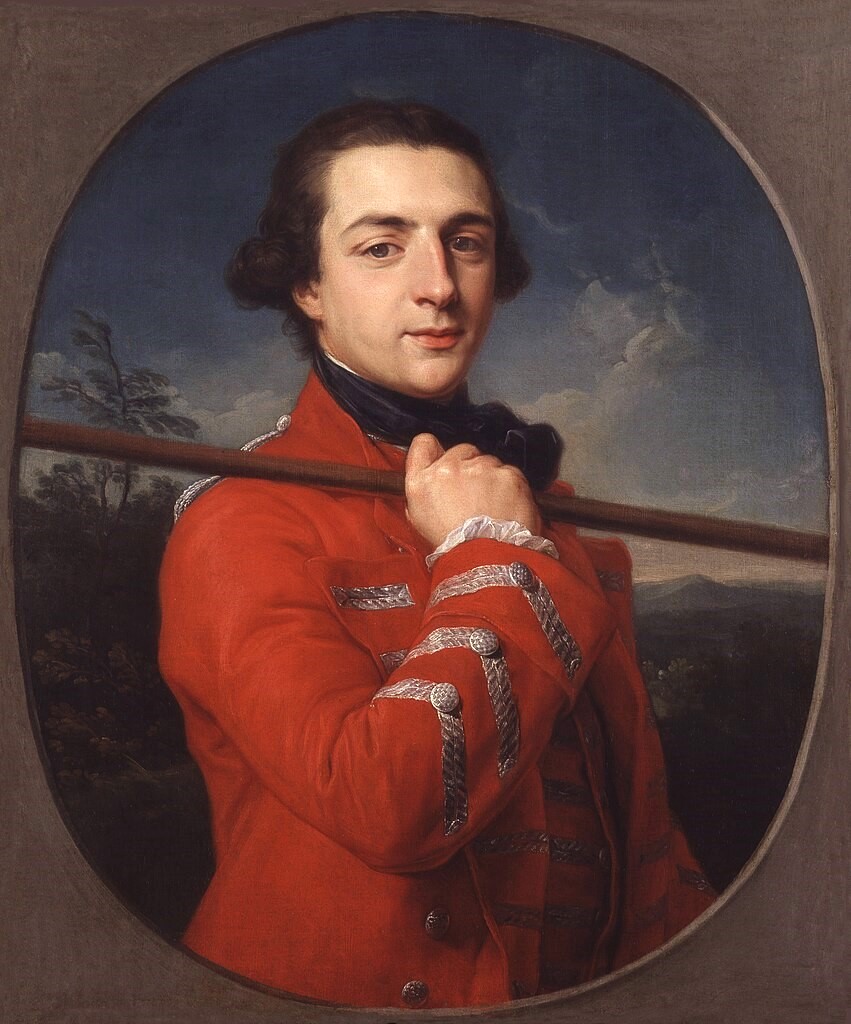
POMPEO BATONI (1708-1787)
Augustus Henry FitzRoy, 3rd Duke of Grafton (1762)
Oil on canvas (76 x 61 cm)
National Portrait Gallery, London
Augustus Henry FitzRoy, 3rd Duke of Grafton (1735-1811), styled Earl of Euston between 1747 and 1757, was a British Whig statesman of the Georgian era. He was one of the very few dukes who served as Prime Minister. He became Prime Minister in 1768 at the age of 33, leading the supporters of William Pitt, and was the youngest person to hold the office until the appointment of William Pitt the Younger 15 years later. However, he did not show great ability in foreign affairs and was harshly criticised for allowing the French to occupy Corsica. As a consequence of this, he resigned in January 1770 after being Prime Minister for only a year and three months.
Augustus FitzRoy visited Italy twice. The first trip took place in 1753, after finishing his studies at Cambridge. Although it sounds very strange, he does not mention visiting Rome, which he did; in fact, he visited, in this order, Turin, Florence, Rome and Naples. In his memoirs he described his itinerary in the following manner: “In this tour, we stretched down as far as Naples, and passing through the South of France, making a second stay at Geneva, we visited Switzerland, a very small part of Germany, and turned, through Holland, back by Flanders to Paris, with the intention of making a longer abode in that city, than we were afterwards enabled to accomplish.” (1)
On the 29th January 1756, Augustus married The Hon. Anne Liddell, daughter of Henry Liddell, 1st Baron Ravensworth. The marriage was an unhappy one, both being notoriously unfaithful to each other. The Duke of Grafton returned to Italy in 1761-2, allegedly for the sake of his wife’s health, but the motive was more likely an attempt to retrieve his marriage. After a quick visit to Paris, the couple reached Turin, where they stayed for six weeks. As the King of Sardinia was ill, Augustus and his wife were entertained by his son, the Duke of Savoy, who was very kind to them.
“I was invited to H.R.H.’s private dinner, where the company consisted of no other than the Duke, his lords and equerries, military men. At coffee, I was much flattered and surprised at the Duke of Savoy’s coming up and telling me that he should expect to see me in the same manner every hunting day, until his royal father’s recovery. (…) Another particular favour was offered to me, that of wearing the royal hunting uniform, which was looked up to as an uncommon distinction, and which I found would have been of great use if I had had to travel much in Piedmont.”(2)
In his autobiography, the Duke does not mention sitting to Pompeo Batoni. However, he goes into great detail describing his lengthy stay: “From Milan our course was along the Adriatic coast to Rome. Here we made a longer stay (1st February-11th April 1762), and found a very pleasing society. Many of the English who were there were very agreeable young men, and we were particularly recommended by Comte Firmian to Monsignor Piccuolomeni [sic] (3), governor of Rome, and by the Marquis de Breigle [sic] to his own son, who was ambassador from Malta to Rome. Lord Tavistock lived much in our society, as did Messrs. Crewe, Hinchcliffe, Crawford, James, and others.
The governor and the ambassador I have just mentioned were both of an amiable disposition; men of the world, and well-informed. Piccuolomeni became a cardinal afterwards. We were much gratified by the frequent opportunities we had of enjoying their company, both at their houses and at ours.”(4)
Batoni´s portrait of Augustus FitzRoy, 3rd Duke of Grafton, is very unusual. To begin with, the oval format was rarely employed by the Italian master; secondly, the Duke of Grafton chose to be portrayed in the uniform of the West Suffolk Militia, of which he was its commander; that is not unusual, but to be portrayed holding a spontoon (5) instead of a rifle or sword it is.
NOTES
1) “Autobiography and Political Correspondence of Augustus Henry, 3rd Duke of Grafton” Edit. by Sir William R. Anson, London, 1898 (p.4)
2) Sir William R. Anson: Op. cit. (p.17)
3) The person that the Duke of Grafton is referring to is Enea Silvio Piccolomini (1709-1768) an extremely important and influential member of the powerful Piccolomini family that gave the Church two Popes and four Cardinals. At that time Enea was also Director of the Vatican Archives and Vice Lord of the Bedchamber of the Pope.
4) Sir William R. Anson: Op. cit. (p.18)
5) A spontoon, sometimes known by the variant spelling espontoon or as a half-pike, is a type of European polearm that came into being alongside the pike in the 17th century. In the British army, commissioned officers carried the spontoon until 1786 as a symbol of their rank and used it like a mace, in order to issue battlefield commands to their men, whilst sergeants generally carried the halberd until 1792, when it was replaced by the sergeant’s pike. The word derives from the Italian spontone which describes this kind of weapon.