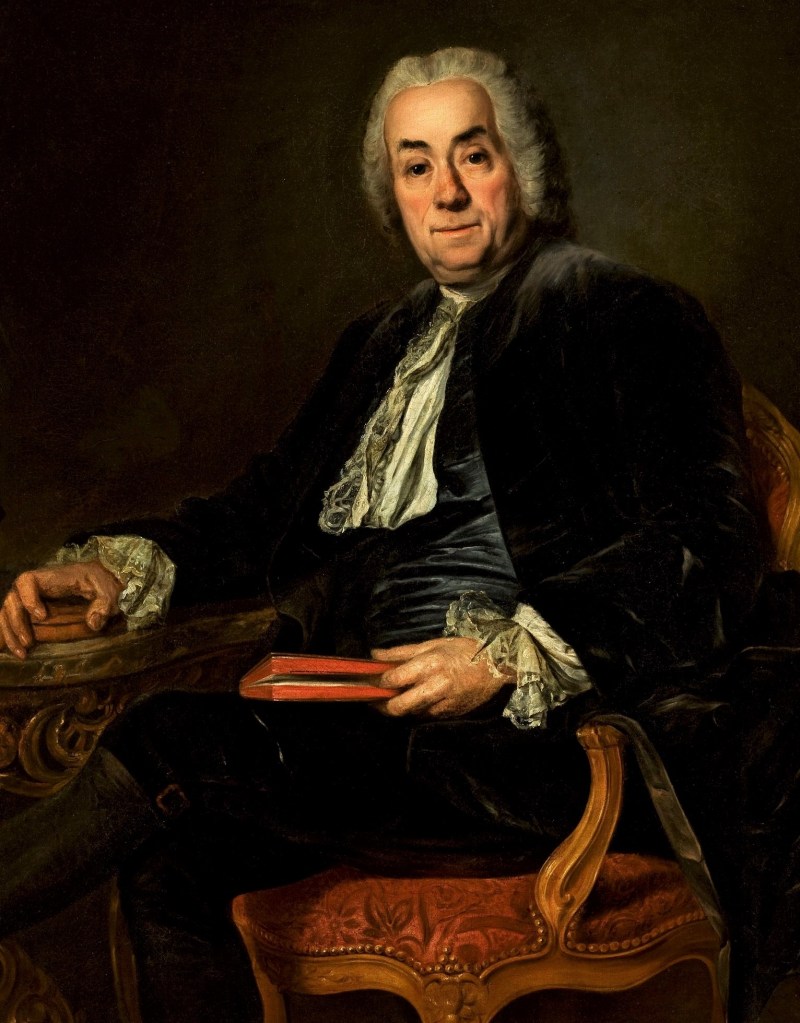
ALEXANDER ROSLIN (1718-1793)
The Count of Caylus (1753)
Oil on canvas (190 x 93 cm)
National Museum, Warsaw, Poland
To enlarge the picture, click on it and “Open in a new window”
Among the paintings exhibited by Roslin at the Salon of 1753 was the portrait of Anne-Claude-Philippe de Tubières, better known as the Count Caylus (1695-1765). He was a man of letters, an amateur archaeologist, antiquarian and an excellent engraver. After leaving the army in 1714, he spent some time travelling in Italy, Greece, the Levant, England and Germany, and devoted much attention to the study and collection of antiquities. Chief among his antiquarian works is the profusely illustrated Recueil d’antiquités égyptiennes, étrusques, grecques et romaines = Anthology of Egyptian, Etruscan, Greek, Roman and Gallic Antiquities (6 vols, Paris, 1752–1755).
Caylus was a prolific etcher. He worked chiefly from drawings by Italian and French masters, including examples from the collection of Pierre Crozat and the collection of the King; he also made many etchings from drawings by his friend Antoine Watteau and the sculptor Edmé Bouchardon. His extraordinary knowledge of Classical literature inspired his works Nouveaux sujets de peinture et de sculpture = New Subjects for Painting and Sculpture (1755) and Tableaux tirés de l’Iliade, de l’Odyssée, et de l’Enéide = Pictures taken from the Iliad, the Odyssey and the Aeneid (1757), which consist of descriptions of subjects from classical literature for the inspiration of contemporary artists and their patrons.
Caylus was 58 years old when Roslin painted his portrait; it is a rather rare, if not unique work, and it is closer to a sketch than the usually highly detailed and polished pictures produced by Roslin. Perhaps, and we will never know, Caylus was a short-tempered man, and as such, he did not like to spend a long time posing. Nevertheless, the portrait is a lively likeness that suggests a man of strong character, but kind and courteous. The unique, sketchy nature of the portrait sets it apart from the rest of Roslin´s works, because out of the nearly 90 portraits by Roslin, which I had the opportunity to examine, it is the only one that looks as if it was painted in a couple of sessions.