
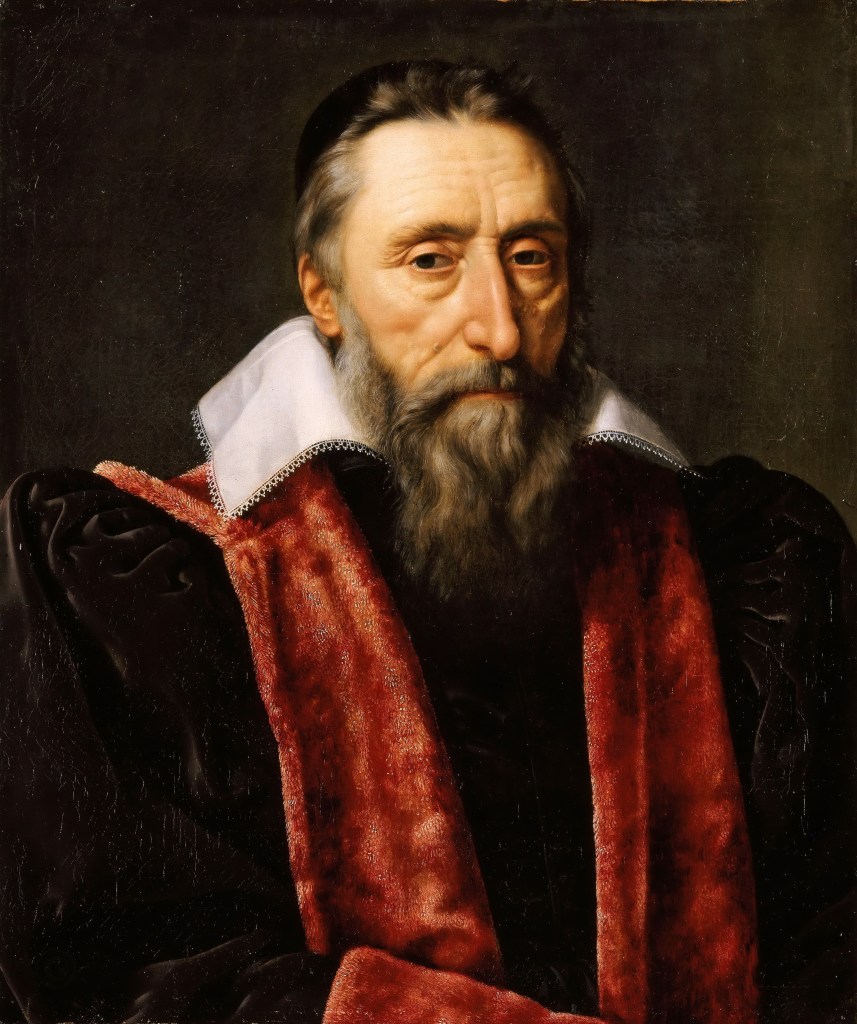
FRANS POURBUS THE YOUNGER (1570-1622)
Portrait of Guillaume du Vair (1616-1620)
Oil on canvas (61 x 51 cm)
Musée du Louvre
To enlarge the picture, click on it and open it in a new window
Some painters escape a clear categorisation; this is due to the fact that their works show an uneven quality that makes it very difficult to judge their artistic merit. The painter who concerns us in this case is a very good example of the aforesaid. Frans Pourbus “The Younger” (1570-1622) was the son of an equally named and famous Flemish painter, Pourbus “The Elder” (1545-1581). Like his father, he produced historical and religious paintings, but he is mostly remembered for his portraits. Despite the uneven quality of his works, he was a highly successful court painter, very much in demand. The people in his portraits tend to look fairly wooden. As a kind of compensation for the stolid appearance he gave his sitters, Frans Pourbus depicted with extraordinary skill and precision the fine garments and jewellery worn by them. The picture I selected is one of his best works, and it was painted during the last years of his life.
Guillaume du Vair (1556-1621) was a French clergyman, lawyer, high-ranking civil servant and the author of several works about ethics, religion and philosophy. Considered by many of his contemporaries to be the most eloquent magistrate of the century, Guillaume Du Vair was one of the characteristic representatives of his time, whose Latin and Greek culture led them to develop a philosophy of law. The offices he held placed him all his life halfway between the legal and the political: councillor in the parliament of Paris, master of requests to Henry IV, president of the parliament of Provence, he ended his career under Louis XIII as Guardian of the Seals (1), and was, in addition, consecrated bishop of Lisieux in 1617.
Guillaume du Vair was a man who hated violence and religious fanaticism; these sentiments led him to join the party known as “the politicians”, a group of enlightened and patriotic Catholics who opposed the persecution of Protestants and put the maintenance of civil peace and the unity of the kingdom before religious questions and confessional logic.
It is considered that Frans Pourbus painted the portrait of Guillaume du Vair between 1617 and 1620, most probably to celebrate the sitter´s appointment as Keeper of the Seals or bishop of Lisieux. As a consequence of the influence of the humanistic education, with its emphasis on Classical Greek and Roman ideals and values, most men, when portrayed, assumed a serious or even severe expression in line with the Roman concept of gravitas (2). In the case of Guillaume du Vair, it seems he took the Roman ideal very seriously; to be honest, he looks quite miserable. Pourbus portrayed the French statesman with a minute attention to detail worthy of Hans Holbein. It seems that every hair of his beard and the red stole he is wearing has been recorded with almost microscopic precision.
NOTES
1 = The care of the royal seals was a prerogative of the Chancelier de France (Chancellor of France), who was, in practice, the Minister of Justice. In 1551, Henri II created the position of Garde des Sceaux de France (Guardian of the Seals of France) as a special honour for a loyal nobleman who would stamp the royal documents in case the Chancellor was not available. In 1791, the titles of Chancellor of France and Guardian of the Seals of France were combined, and the post of Minister of Justice and Keeper of the State Seal was created. Garde des sceaux de France — Wikipédia
2 = Gravitas was one of the ancient Roman virtues that denoted seriousness. It is also translated variously as weight, dignity, and importance, and it implies restraint and moral rigour. It also conveys a sense of responsibility and commitment to the task. Gravitas – Wikipedia
 Old Masters