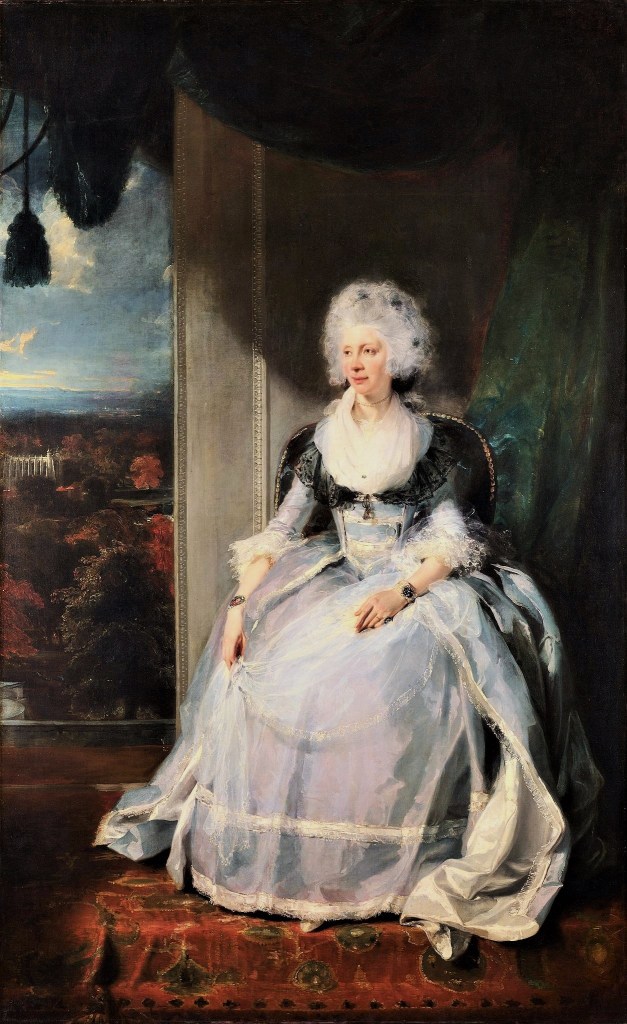
SIR THOMAS LAWRENCE (1769-1830)
Portrait of Queen Charlotte (1789)
Oil on canvas (239 x 147)
National Gallery, London
To enlarge the picture, click on it and “Open in a new window”
Over the centuries, some paintings, mainly portraits, have been rejected by the people who commissioned them despite their excellent quality. Eventually, time and fine taste proved the enraged patrons wrong, vindicating the artist and his work. The painting analysed here belongs to this category. In September 1789, Thomas Lawrence received a letter from the Palace ordering him (although, of course, in a very polite manner) to go to Windsor to portray the Queen. Here is the full text of the letter, reproduced by Douglas Goldring in his biography of Lawrence:
“Sir: I am commanded by Her Majesty to desire you will come down to Windsor and bring your painting apparatus with you.
Her Majesty wishes you to come down on Sunday next the 27th to be ready for Her to sit to you on Monday morning.
She likewise desires you will bring some of your pictures with you in crayon and in oil.
I am, Sir your most obedient and humble Servant.
H. Compton” (1)
Any other young painter, summoned to portray his sovereign, would have been, understandably, very nervous; however, Thomas Lawrence Jr was made of sterner stuff and was not in awe of the royal family as might have been expected. According to Goldring, the King questioned him for flirting with Mrs Papendiek, the young wife of a German court musician, and he quickly became popular with the royal children. Lawrence’s portrait of the Queen is rightly considered a masterpiece, yet neither the Queen nor the King liked it. In her very interesting memoirs (“Court and Private Life in the Times of Queen Charlotte”, 2 Vols. London, 1887), edited by her granddaughter, Charlotte Papendiek gives us a detailed description of what happened that day at Windsor Castle:
“Her Majesty was rather averse to sitting to him (Lawrence) saying that she had not recovered sufficiently from all the trouble and anxiety she had gone through to give such a young artist a fair chance, more particularly as he saw her for the first time. (…) The first difficulty arose about the dress, the Queen choosing a dove colour which, with her sallowish complexion, was most unbecoming. Secondly, the headdress. Neither the bonnet nor the hat she proposed were to his taste, and this ended in her deciding upon not having any covering at all upon her head.
Lawrence requested the Queen to converse now and then with the Princesses to give animation to her countenance, but her Majesty thought that rather presuming and continued to listen to one of them reading.” (2)
There are two details worth pointing out, one with regard to the Queen’s unwillingness to sit to Lawrence, and the other, the latter’s inflexible attitude regarding the choice of his sitter’s garments and accessories.
The Queen had been through a very painful and traumatic experience. It was in that year that the first manifestations of the King’s mental illness took place. He became manic, suffered hallucinations and violent convulsions and sometimes swore and screamed at his family and servants. She only consented to sit to Lawrence to please her friend Lady Cremorne, who admired the young artist and kept asking the Queen to sit to him. Lawrence’s exquisite taste and eye for detail led him to choose the garments and accessories that, according to him, his sitters should wear. The fact that a 20-year-old painter dared to tell the Queen what to wear speaks volumes about his strong character and his artistic integrity. Considering that the Queen gave Lawrence only one sitting, the superb quality of the portrait is even more noteworthy.
In the entry about this portrait written by Judy Egerton, the author of the volume dedicated to British painting from the series of catalogues that record all the paintings in the National Gallery, there is an interesting detail that explains why the Queen appeared bareheaded:
“The Queen had arrived to sit wearing a bonnet; since Lawrence objected to the bonnet and her proposed alternatives, a cap or a hat, she decided to sit to him bare‐headed. In this, she knew exactly what she was doing. She was perfectly aware that she was a plain woman; she also knew that (as Mrs Papendiek records) her hair was ‘really beautiful’. Her favourite hairdresser, Sonardi, had evolved a style of dressing her hair in a manner which was kind to her face; and she sat to Lawrence with her hair thus dressed, piled high over a false hair‐piece which Mrs Papendiek calls a ‘toupet’ (and the English a rat), adorned with tiny black bows.” (3)
According to Mrs Papendiek, when the King saw the portrait he was furious, although it is not clear why since the lady-in-waiting employed a cryptic language to describe the scene. It may have been the gown that the Queen chose to wear or the lack of a headdress that infuriated the mentally unbalanced monarch:
“When the King came to look at the portrait, this disgusted him, as her Majesty had never been so seen (?). West suggested a light scarf to be thrown over the shoulders, which broke the stiffness and plainness of the gown, but the difficulty about the head still remained” (4)
Apart from being mentally ill, George III was devoid of good taste in everything to do with paintings. Considering how plain Queen Charlotte was and her sad demeanour, a consequence of her understandable depression, Lawrence achieved a miraculous transformation, turning a plain, frumpy and sad middle-aged woman into a good-looking, elegant and dignified lady. We have two important testimonies about Charlotte´s plain appearance and her highly depressed condition. The first one is from Horace Walpole and the second from the famous diarist Fanny Burney, who later called herself Madame D´Arblay:
“She is not tall, nor a beauty; pale, and very thin, but looks sensible and is genteel. Her hair is darkish and fine, her forehead low, her nose very well, except the nostrils spreading too wide; her mouth has the same fault, but her teeth are good…” (5)
‘…pale, ghastly pale she looked; she was seated to be undressed, and attended by Lady Elizabeth Waldegrave and Miss Goldsworth; her whole frame was disordered, yet she was still and quiet… I gave her some camphor julep, which had been ordered for her by Sir George Baker. “How cold I am”, she said, and put her hand on mine; marble it felt! and went to my heart’s core!’(6)
The Queen refused to give Lawrence another sitting, something quite rude and unforgivable, even taking into consideration her mental condition, and it fell to the loyal Charlotte Papendiek to sit to Lawrence, wearing the dress and the jewellery of her royal employer. To add insult to the injury, Lawrence did not receive any payment; not only that, the King told him to take the painting back to London and have it engraved. The King´s idea was to send the portrait to his relatives in Hanover; a clear sign that neither him or the Queen liked the painting. Since Lawrence could not afford the expense of engraving the royal portrait, he kept it in his studio, where it remained until his death.
When the painting was exhibited next year at the Royal Academy, the critics were unanimous in their praise. The critic of “The World” considered that “the best portraits in the Room are Sir Joshua’s Lady & Dog, Lawrence’s Head of Mr Locke, Miss Farren, and the Queen”; the latter portrait, in his opinion, was “a performance of which VANDYKE would have been proud”. (7)
The critic of “The English Chronicle” said: “He is a youth of extraordinary genius, who has not only outstripped all junior artists but, in portraiture, may at this moment stand in competition with the President himself. The Queen of this young artist is an admirable portrait, and independent of the strong likeness, has a multitude of beauties. Criticism could scarcely point out a fault in this picture. Her Majesty’s nose, indeed, appears sore from taking snuff, but that is not the fault of the painter” (8)
As I mentioned before, Lawrence kept the Queen´s portrait until the day he died. The picture was bought by Sir Matthew White Ridley, 3rd Bt, MP, during the sale of the artist´s studio contents carried out by Christie’s on 18th June 1831. The portrait remained in the possession of the Ridley family until July 1927, when it was auctioned by Christie´s and purchased by the Trustees of the National Gallery.
NOTES
1) Douglas Goldring: “Regency Portrait Painter: The Life of Sir Thomas Lawrence, PRA”, (1951) p. 77
2) Charlotte Papendiek: Op. cit., Vol. II, p. 133-134
3) Judy Egerton: “The British School”, (1998), p. 196-197
4) Charlotte Papendiek: Op. cit., Vol. II, p. 134
5) Judy Egerton: Op. cit., p. 196 (Letter from Walpole to Horace Mann dated 10th September, 1761)
6) Judy Egerton: Op. cit., p. 196 (“Diary and Letters of Madame D´Arblay”, Vol. IV, p. 133)
7) “The World”, 28th April, 1790
8) Douglas Goldring: Op. cit., p. 81-82