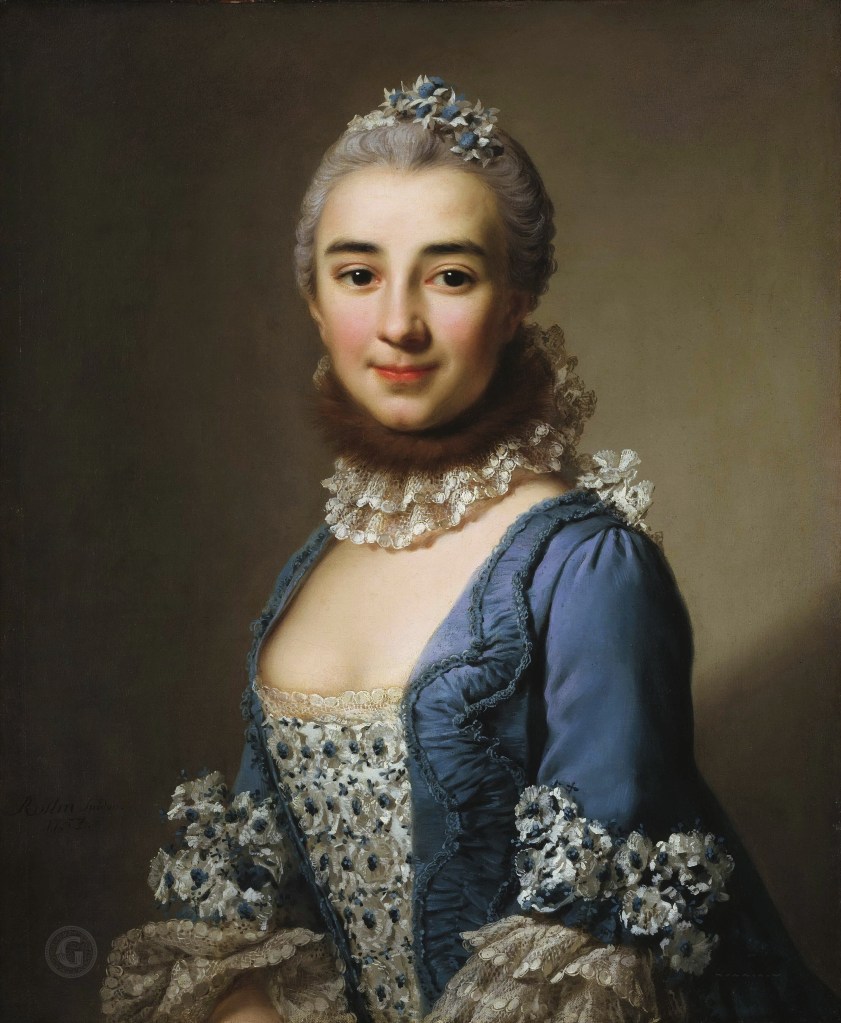
ALEXANDER ROSLIN (1718-1793)
Portrait of an unknown lady (1753)
Oil on canvas (65 x 54 cm)
National Museum, Stockholm, Sweden
To enlarge the image, click on it and “Open in a new window”
The identity of this pretty young lady is not known; according to the museum’s website, she is described as “An unknown lady, possibly Mme. Deshanges”. I have tried to find information about Mme. Deshanges or her family, but it seems they never existed. This painting was one of the five that Roslin showed at the Salon of 1753, when, in theory, he should not have been allowed to do so. This magnificent portrait shows us a talented, mature artist (Roslin was 35 years old) in full command of his craft but also a sharp observer capable of capturing the predominant traits of his sitter’s personality. In this case, we are looking at a charming and very elegant young lady. She is wearing the fashionable style of dress in vogue between 1750 and 1770; a low-necked gown worn over a petticoat. If the bodice of the gown was open in front, the opening was filled in with a decorative stomacher, pinned to the gown over the laces or to the stays beneath. A stomacher (1) was a decorated triangular panel that filled in the front opening of a woman’s gown or bodice. The stomacher could be boned, as part of a stays, or could cover the triangular front of a corset. If simply decorative, the stomacher rested over the triangular front panel of the stays, being either stitched or pinned into place.
In this, the earliest available image of the portrait of a lady by Roslin, we can see clearly how brilliant he was at reproducing the textures of different fabrics. Very few of his contemporaries could rival him; in fact, I can only think of two: Pompeo Batoni (1708-1787) and Anton Raphael Mengs (1728-1779). The exquisite embroidery of the stomacher matches the ruffles on the sleeves. At her neck, the young lady is wearing an object known in England as a choker (it sounds horrible, I know); the French word for it is much nicer: ras-de-cou, basically necklace. As the latter expression suggests, it was an ornament worn at the neck. Wealthy women wore very elaborate and expensive ones made of the finest lace, and sometimes, as our lady in the picture, they combined them with collars made of fur, usually mink.
The marvellous rendering of the lace and the fur around the neck is almost unbelievable. Roslin was not a mediocre painter who only excelled at reproducing fine fabrics, as the spiteful Diderot suggested when he wrote: “Roslin est aujourd´hui un aussi bon brodeur que Carle Vanloo fut autrefois un grand teinturier” = “Roslin is today as fine an embroiderer as Carle van Loo used to be a great dyer” (2). The sensitive modelling of the young woman´s features, her charming smile and the beautiful, delicate colouring of the flesh tones indicate we are in the presence of a superb portrait painter. Only a blind person or an imbecile cannot help but be seduced by this elegant, lovely young lady immortalised by Alexander Roslin.
The beautiful, high-resolution image is courtesy of http://www.gallerix.ru
NOTES
1) The information related to this particular garment comes from a wonderful website that is a treasure trove of portrait paintings, historic houses, and famous and not-so-famous historical characters. Here is a link to the article in question: Magnificent stomacher in a series of paintings from 18th century
2) Diderot: “Le Salon de 1765” (Oxford University Press, 1957, p. 126)