ALEXANDER ROSLIN (1718-1793)
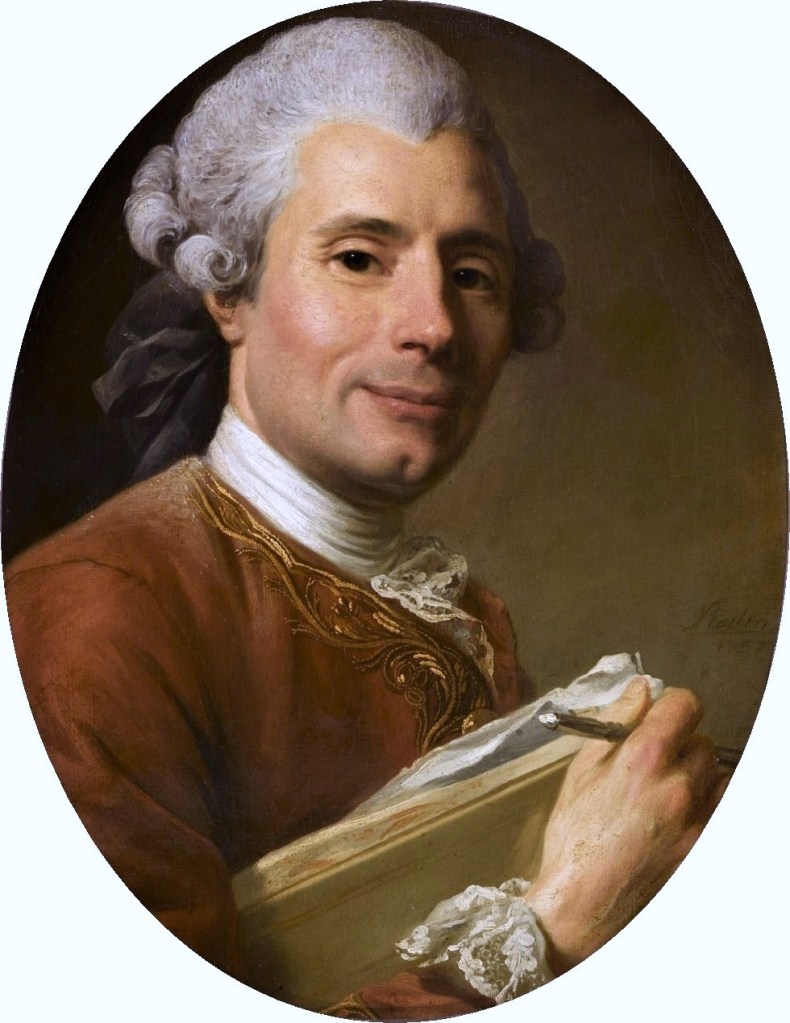
The painter Joseph-Marie Vien (1757)
Oil on canvas (50 x 39 cm)
Château and National Museum of Versailles
To enlarge the image, click on it and “Open in a new window”
Joseph-Marie Vien (1716-1809) was Roslin’s closest friend. He was one of the witnesses to his marriage in 1759 and helped him to catalogue his paintings and appraise them in 1772 before moving to the Louvre when Roslin obtained the coveted honour of lodging there, a privilege awarded only to the most prestigious artists.
It is important to make an observation regarding the nature and purpose of the portraits in the second half of the 18th century. Around that time, a growing number of persons, particularly those who did not belong to the nobility, began to request simpler, smaller portraits, usually known as “head and shoulders”, although sometimes they showed the figure down to the waist. In France, these more intimate portraits began to be known as “portraits de caractère”, opposed to the larger “portraits d’apparat”, which could be translated as “grand official portraits” or “portraits in the grand manner”.
As the title implies, the former were portraits that aimed to reflect the character of the sitter, and they were usually commissioned as a present for a very dear friend or relative. In this case, Roslin obviously painted this small portrait as a token of friendship. Its size is very unusual; the standard or more popular sizes used at that time in France for head and shoulders portraits were 15 sols (65 x 54 cm), 20 sols (74 x 60 cm) and 25 sols (80 x 65 cm)
In 1743 the young Joseph-Marie Vien won the Prize of Rome, a highly coveted distinction that gave the winner a scholarship of three to five years at the French Academy in Rome. There, discovering the ancient paintings released from the ruins of Herculaneum, he became passionate about ancient art and, modifying his ideas on painting, began to paint pictures in a more severe style than those then made, which was not appreciated by the public then accustomed to the manner of Boucher then in fashion.
In 1750, he presented several paintings, expecting to be accepted as a member of the Royal Academy of Arts, but they were rejected. The academicians disliked his work so much that they rejected him again in 1754; on that occasion, Boucher, who knew how to appreciate an art different from his own and in a gesture that honours him, declared that he would not set a foot in the Academy if Vien were not admitted. (Roger Raymond Peyre : « Histoire générale des Beaux-Arts », Paris, 1895, p. 805)
By the 1760s, as the taste for the work of Fragonard and Boucher declined, the rather severe and moralising art of Vien and Greuze became very much appreciated. Vien became director of the Académie de France in Rome from 1775 to 1781, and was appointed first painter to the king on May 17, 1789, shortly before the abolition of this title. The last years of Vien were full of vicissitudes because the Revolution ruined him, but, although octogenarian, he was not discouraged and took part in a competition opened by the government in 1796, winning the prize. The advent of the Empire improved his situation, and he was showered with honours by Napoleon. He was appointed senator in 1799, Count of the Empire in 1808 and Commander of the Legion of Honour. On his death in 1809, Napoleon honoured him with a national funeral at the Panthéon, where he is the only painter buried there.
The portrait is an affectionate image of a dear friend painted by a great artist. The little piece visible of the cravat, as well as the beautiful flesh tones, shows Roslin’s extraordinary skill. Vien´s portrait entered the national French collections in 1863 when it was donated to the Louvre by his last owner, Germain Etienne Coubard d´Aulnay; since 1922, it has been on a long-term loan in the Château of Versailles.