
JEAN-BAPTISTE MARTIN (1658-1735)
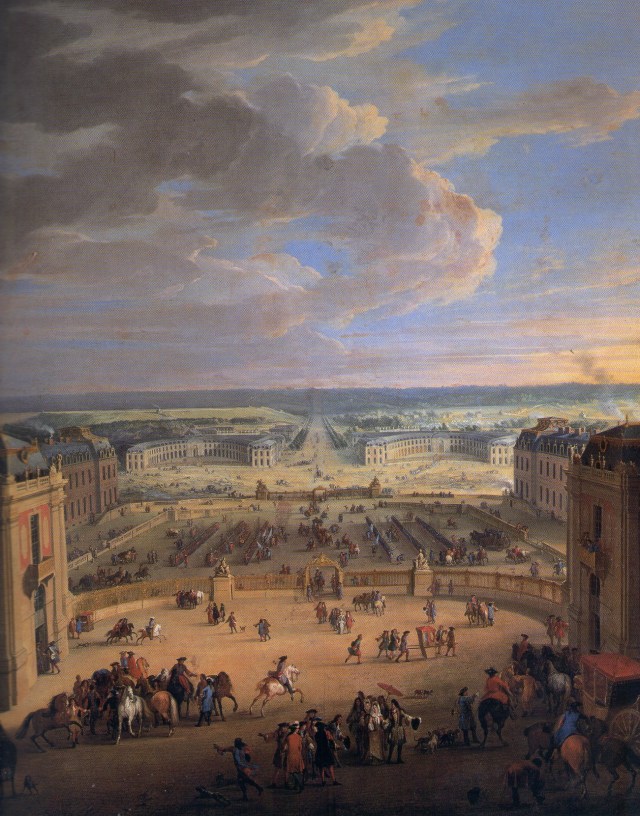
View of the Forecourts of the Chateau de Versailles and the Stables (1688)
Oil on canvas (260 x 184 cm)
Chateau de Versailles
Leading onto the Gallery, the Cool Room at Trianon linked the King’s apartments, of which it was part, to those of Mme de Maintenon. The painting over the mantelpiece, Zephyrus and Flora, was by Jouvenet, who also executed two small pictures featuring putti for the overdoors. The most important works in the room, however, were four views of Versailles, which prefigured and completed the works hung in the Gallery and the Garden Room at the far end.
The major commission of 1688 included not only the works by Jouvenet but also paintings by Martin, charged with the View of Versailles from Montbauron Mound and this View of the Forecourts of the Chateau de Versailles and the Stables, and Cotelle who was to paint a View of Marly and a View of the Apollo Fountain. For reasons unknown, the last two pictures were never finished and were replaced by a View of the Orangery and a View of the Waterfall of the Dragon and Neptune Pool, also by Martin. The commission took a long time to be completed. Payments were made in 1689 and 1696, though two canvases had still not been completed by 1700. This delay understandably aroused the King’s impatience, and the remaining paintings were put in place shortly afterwards.
The view in this painting is most unusual. Like Aveline’s engraving after Chevotet, it constitutes an extremely rare example of a painter consciously turning his back on the Chateau. To make his deliberately descriptive vision as comprehensive as possible, Martin chose a double viewpoint. The elevated view from the rooftops enabled him to give an accurate picture of the buildings, while the lower one, taken from the King’s first-floor Drawing Room meant that he could include his meticulously described figures which would otherwise looked too tiny.
Divided by a horizon line halfway up the canvas, leaving plenty of room for sky effects, the composition is bathed in a pale, golden light with alternating patches of light and shade. It boasts rigorous symmetry on the other side of the vertical median line described by the Avenue de Paris running from east to west, along which Versailles was built. Rather than the townhouses, which are almost absent from this view, it is the stables which seem to provide a transition between the whirl of feverish activity of the Court on one hand, and on the other, the tranquillity of the surrounding countryside that we can make out on the horizon.
A splendid set of buildings matching the Chateau, the Royal Stables had been erected by Hardouin-Mansart in 1679-82. With symmetrical elevations and layouts, they housed up to 700 horses by the time Louis XIV died (1715), together with all the departments required for their upkeep. Placed under the authority of the First Equerry, the two stables had each a different purpose. The Great Stables, on the left of the picture, were reserved for saddle horses, which were ridden for hunting, battles, parades and carrousels, while the Small Stables, from which a team of horses is emerging, housed carriage horses and carriages.
In the courtyards in the foreground, separated by a railing that has since disappeared, we can see the so-called people of quality taking the air, servants preparing horses, getting carriages ready, or carrying sedan chairs and soldiers on parade. This spectacle gives us some idea of the size of the Court, which came to number 10.000 when the seat of government was transferred to Versailles in 1682.


The seat of infamy.
But also of triumph, Heil Hitler!
LikeLike