ALEXIS-SIMON BELLE (1674-1734)
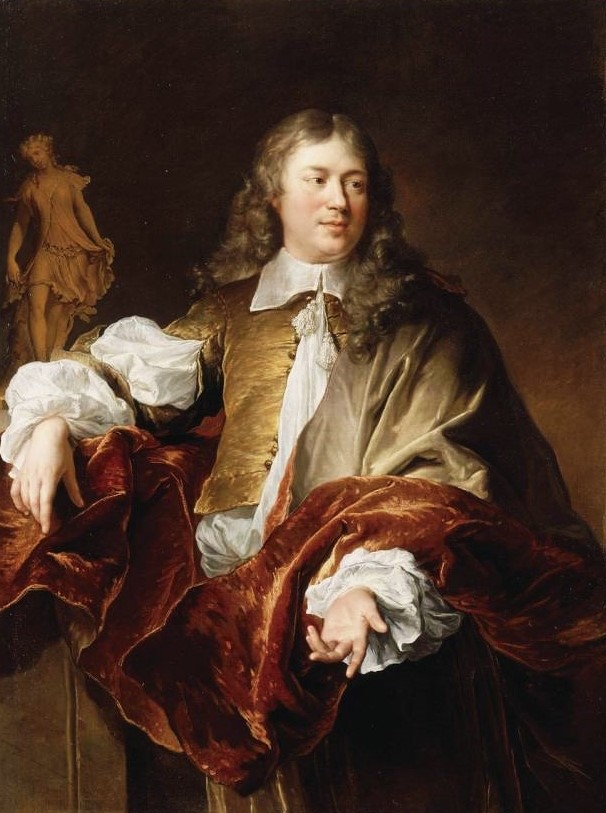
Portrait of Louis Lerambert
Oil on canvas (130 x 99 cm)
To enlarge the image, right-click on it and choose “Open in a new tab”
Born into a family of artists Alexis-Simon Belle trained under Francois de Troy. He followed the teaching dispensed by the Royal Academy and won the Prix de Rome in 1700. He did not, however, travel to Italy as “the great occupations he had for the public did not let him go”. He was, indeed, quite successful as a portraitist working for the exiled Stuart Court. By the time he became an Associate of the Academy in 1701, he already held the title of Painter to His Britannic Majesty. In 1703 he became a member submitting portraits of Pierre Mazeline and François de Troy (both, Chateau de Versailles)
For some unexplained reason, the Board of the Academy requested a third painting from him. This Portrait of Lerambert was therefore executed between August 4th, 1703, and December 31, 1704, when the artist submitted his work. The sculptor’s identity is confirmed by the presence in the background of a model for a Dancing Nymph (destroyed) executed in 1665 for the Neptune Pool at Versailles.
While Belle’s first two sitters, Mazeline and de Troy, were still Members of the Academy, Lerambert (1638-70) had been dead for more than 30 years. The painter, therefore, had to work from a portrait that since has disappeared. It is a mystery why the Academy should have decided to acquire the portrait of a man who had been admitted to its ranks back in 1663. One possibility is that Coysevox, the institution’s Director since 1702, may have wished to pay tribute to his uncle by marriage.
The recourse to an existing portrait undoubtedly helped to set this work apart from Belle’s mainstream production. It certainly explains the presence of natural hair, instead of a heavy wig, as well as the elegant, but very old-fashioned style of the sculptor’s attire. Moreover, in contrast with the practice the artist had followed ever since his earliest portraits, the sitter looks away from the spectator. The intrusion into the foreground of a heavy velvet drapery reveals Rigaud’s influence. The light falls on the sitter and his surroundings showing to an advantage the delicately modelled face and the superb rendering of the draperies. There is a beautiful chromatic harmony consisting of warm tones from madder red to pale honey that shows the artist’s delicate sense of colour.