PHILIPPE MERCIER (1689-1760)
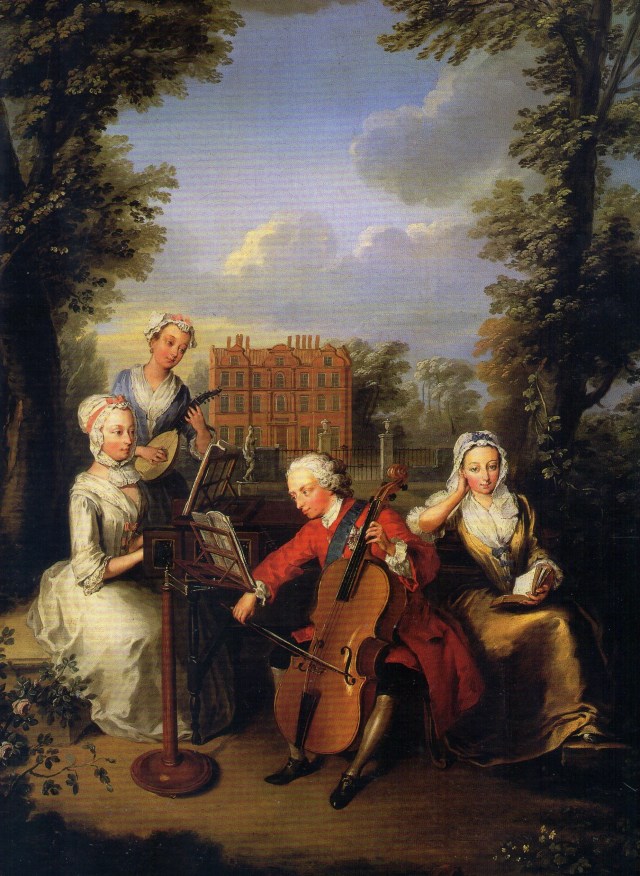
Frederick, Prince of Wales and his Sisters making Music at Kew (c.1734)
Oil on canvas (77,5 x 57 cm)
Cliveden, Buckinghamshire, UK
To enlarge the picture, right-click on it and “Open in a new tab”
Philippe Mercier was born in Berlin, the son of a French Huguenot tapestry worker. He studied painting at the Academy of Painting and Architecture and later under Antoine Pesne who have been appointed painter to the King of Prussia. After a short stay in Italy, he arrived in England around 1716. He was appointed Principal Painter (1729) and Library Keeper (1730) to Frederick Louis, Prince of Wales (1707-1751); these appointments were most likely due to the letters of recommendation he brought from the court of Hannover. He also taught Frederick’s sisters to draw and paint.
Philippe Mercier was a mediocre painter and the only reason I included this painting in the blog is due to its importance as a historical document. This is one of the most interesting informal portraits of a royal prince ever painted in the 18th century. Frederick had begun to learn the bass-viol only around 1733, but by the summer of 1734, he was regularly to be seen at Kensington Palace “with his violoncello between his legs, singing French or Italian songs to his own playing for one hour or two together, while his audience was composed of all the underling servants and rabble of the Palace” (1). The spiteful and insulting reference to the audience must not be taken seriously since by that time, Lord Hervey and Frederick had fallen out because of their mutual mistress, Anne Vane and Hervey was well-known for his vindictive nature.
Frederick sisters depicted must be the Princess Royal, Princess Anne (1709-59), Princess Amelia (1711-86) and Princess Caroline (1713-57). However, it is not possible to identify them, as their likenesses are scarcely differentiated enough to tell, another proof of Mercier’s mediocre talent. Ellis Waterhouse summed him up correctly when he said:“Never a first-rate artist, he had a flair for novelty in the French manner, and he seems not only to have been responsible for the introduction of the French genre style into English painting, but to have played a considerable part in popularising the ‘conversation piece'” (2)
The opera in London was particularly fashionable throughout the Georgian era. People had their favourite singers – usually Italian – as well as composers and grew so heated over their respective merits that great quarrels ensued. Politics entered into music too. George II was a devotee of Handel (1685-1759), so Frederick, who detested his father and opposed him out of principle, or spite, supported Giovanni Bononcini (1670-1747). Broadly speaking the Tories would stick to Handel whereas those supporting the Prince of Wales’s politics (like the elder Pitt) would follow Bononcini.
The figure of the Princess at the right shown looking up from reading with an amused expression on her face is of particular interest. Could it be the Princess Royal, who, according to her contemporaries, was politically and musically opposed to her brother? That would explain the fact that she remains aloof without participating in the familiar concert.
(1) Lord John Hervey: “Memoirs of the Court of George II” (ed. by John Wilson Crocker) Vol. 1 (1848)
(2) Ellis Waterhouse: “English Painting and France in the Eighteenth Century” Journal of the Warburg and Courtauld Institutes, Vol. XV, No.3-4, p. 122-135 (1952)