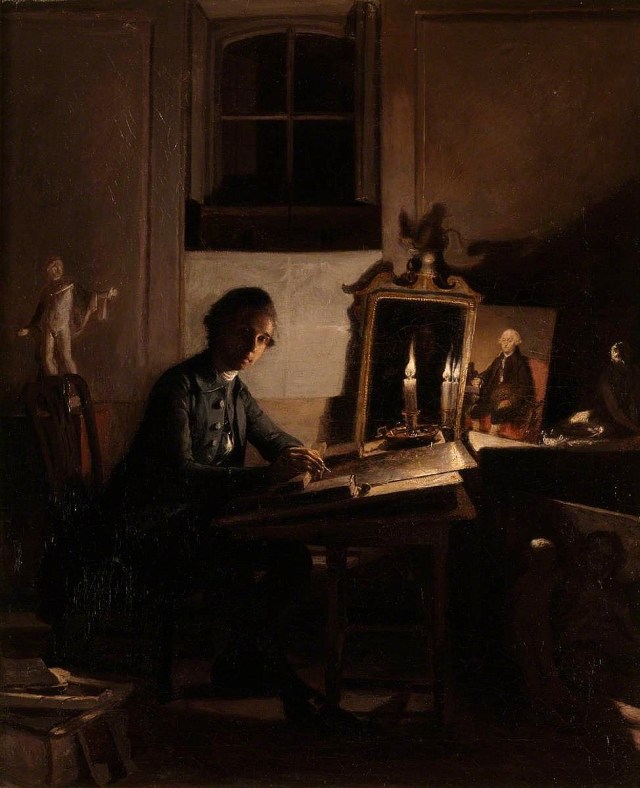
RICHARD MORTON PAYE (1750-1821)
Self-portrait of the Artist Engraving (1783)
Oil on canvas (73,5 x 60,5 cm)
Upton House, Warwickshire, UK
To enlarge the picture, right-click on it and “Open in a new tab”
Richard Morton Paye was a painter, engraver and modeller. His name first appeared in 1773 when he sent two oil paintings and two models in wax at the Royal Academy’s yearly exhibition. He continued to exhibit there during the following years up to 1798, sending portraits, miniatures and models in wax or clay. Paye excelled at painting children, both as single portraits and in groups. He was greatly helped in his early life by the Rev. Joseph Holden Pott, vicar of Kensington and archdeacon of Middlesex, who purchased many of his works. Subsequently, he was patronized by Dr John Wolcot (better known as Peter Pindar) who did much to promote Paye’s success as a painter, until a breach took place between them. Left to his own resources Paye quickly sank into poverty and neglect; he received help from the Artist’s Benevolent Fund but died quite forgotten and neglected in December 1821.
Paye exhibited this painting at the Society of Artists in 1783 under the title An Engraver at Work. The details of the engraver’s craft are carefully depicted: the reduced version of the original picture to engrave from; the mirror to produce a reversed image that he can copy directly onto his plate, which will print in the same direction as the original; the use of the block to steady his hand; and the screen to diffuse light from the window during daytime.
The portrait he is engraving is not one painted by himself but a reduced version of a lost picture by Nathaniel Dance (1735-1811). It depicts Dr Percival Pott, FRS (1714-1788) the famous surgeon and eponymous victim of “Potts fracture” of the leg, which he cured without amputation. The engraving was also published by Paye himself on 21 October 1783, The most plausible reason for this is that he had done it as a form of thanking the sitter’s third son, the Rev. Joseph Pott, for his support and patronage. We do not know what caused the end of their relationship. Paye’s second patron, the satirist and art critic known as Peter Pindar, began his relationship with Paye in 1782 and ended around 1785 when Pay exhibited at the Royal Academy a Portrait of a Sulky Boy (reputedly an illegitimate son of Wolcot’s) and then painted a satirical image of Wolcot himself.
At this period (1783) Paye seems to have made a speciality of pictures displaying candlelight effects, for which his inspiration was evidently Joseph Wright of Derby, however, he did not pursue this genre because he was compelled by the demands of the market to concentrate increasingly on sentimental fancy pictures and portraits of children.