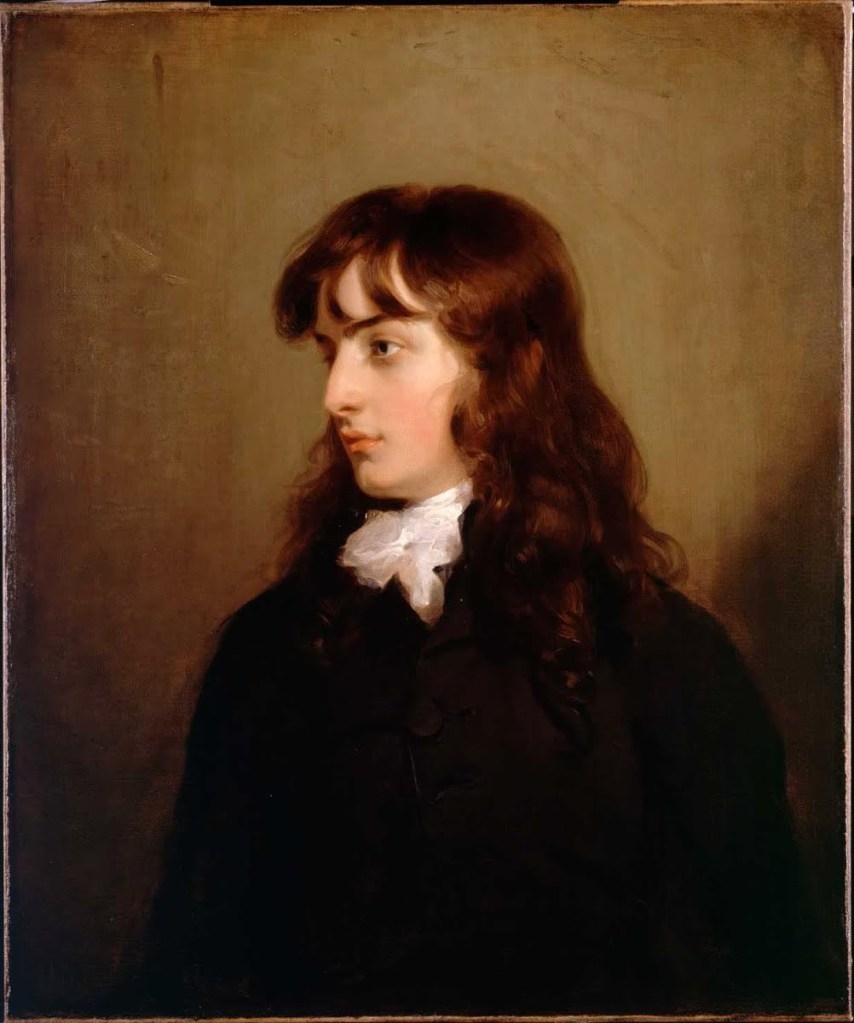
SIR THOMAS LAWRENCE (1769-1830)
Portrait of William Linley (1787-89)
Oil on canvas (76 x 63 cm)
Dulwich Picture Gallery, London
To enlarge the picture, click on it and “Open in a new window”
William Linley (1771–1835) was one of seven musical siblings born to Thomas Linley the elder and his wife Mary Johnson. He was educated at Harrow and then St Paul’s School and received additional tutoring in musical disciplines from his father and the renowned German composer Carl Friedrich Abel (1723-1787)
He joined the British East India Company and was in India from 1790 to 1795, working as a clerk in the Company´s College in Madras. On his return to England in 1795, he produced several musical works and was appointed composer at Drury Lane theatre by his sister’s husband, Richard Brinsley Sheridan, in 1796. His compositions proved only moderately successful, which may explain why he returned to India in 1800, where he obtained various positions as paymaster and treasurer, which enabled him to restore his finances and return to England around 1807. He retired from the company in 1810 and devoted himself to singing, composing songs and writing literature. He bequeathed his beautiful collection of family portraits, mostly by Gainsborough, to the Dulwich Picture Gallery.
William Linley and Thomas Lawrence were childhood friends who grew up next door to each other in Bath. Lawrence, who was two years older than William, portrayed his friend between 1787 and 1789. It has been suggested that William Linley´s portrait was one of the paintings sent by Lawrence to be inspected by George III, who was considering giving him a commission. However, I do not believe this to be true for two very good reasons: A) In his excellent biography of Sir Thomas Lawrence, Douglas Goldring does not mention any request for samples of Lawrence´s work by George III. B) In his book, Goldring quotes in full the letter sent to Lawrence in September 1789, ordering him, in the politest manner possible, of course, to go to Windsor to portray the Queen. Here is the above-mentioned letter:
“Sir: I am commanded by Her Majesty to desire you will come down to Windsor and bring your painting apparatus with you. Her Majesty wished you to come down on Sunday next, the 27th, to be ready for Her to sit to you on Monday morning. She likewise desires you will bring some of your pictures with you in crayon and in oil.
I am, Sir, your most obedient, humble servant. H. Compton.” (1)
As we can see, it is very clear that King George III saw Linley´s portrait during Thomas Lawrence´s visit to Windsor Castle and not before. According to the late Lady Jane Roberts (1949-2021), the King said: “Why doesn´t the blockhead his hair cut?” (2). Obviously, the old-fashioned sovereign did not like the long hair favoured by the young dandies at the end of the 18th century. Neither did his sister, Jane Linley (1768-1806), who, when William finally cut his long locks in 1790, recorded the event as “a wonderful metamorphose” (!!!) (3)
William Linley’s portrait shows that at the age of 20, Lawrence was already an accomplished painter. Although the pose of the sitter is rather awkward, the glowing colours and the splendid cravat, executed with rapid brush strokes, show the talent of a highly gifted artist.
NOTES
1) Douglas Goldring: “Regency Portrait Painter: The Life of Sir Thomas Lawrence, PRA”, London (1951) p. 77
2) Lady Jane Roberts: “George III and Queen Charlotte: Patronage, Collecting and Court Taste”, Royal Coll. Trust (2004) p. 159
3) William Linley — Dulwich Picture Gallery