
NICOLAS DE LARGILLIERE (1656-1746)
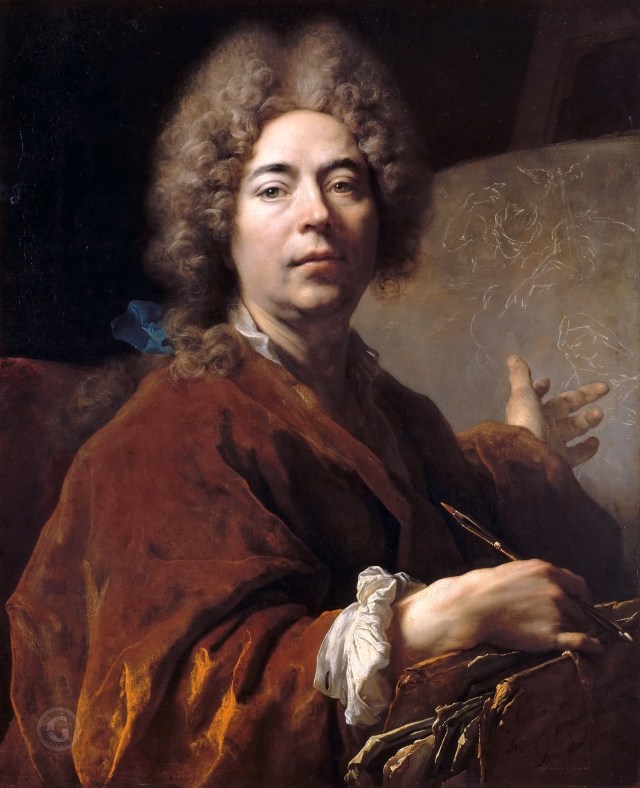
Self-portrait (1711)
Oil on canvas (80 x 65 cm)
Chateau de Versailles
To enlarge the image, right-click on it and choose “Open in a new tab”
Largillière painted several portraits of himself: in 1699 (Tours, Musee des Beaux-Arts), 1711 (Versailles, Chateau), 1724 (Montpellier, Musee Fabre) and 1729 (Florence, Uffizi). These works expressed both, the mature and ageing man’s questioning of his destiny and the famous artist’s questioning of his art.
The reasons why a painter captures his own image are many and various. Here Largillière presents himself as an accomplished artist, for while he stares out at the spectator, he holds a portfolio and points to an unfinished work with his left hand, in a movement which lends depth to the perspective. On a canvas with a light brown ground, we can see the beginnings of an Annunciation sketched out in white chalk. In his Abrégé de la vie des plus fameux peintres published in Paris in 1752, Dezallier d’Argenville confirmed that Largillière “cast his ideas upon the canvas without doing any study; the likenesses of the heads and hands being the sole exception to this rule”
We know of no extant Annuciation by Largillière. The inventory drawn up on March 20th, 1746, following his death, lists two pictures on this theme, though it is impossible to establish whether either of them is the picture placed on the easel here. Amidst countless sketched and finished portraits, the same document itemizes numerous history paintings as if Largillière, despite his brilliant career as a portraitist, had nourished different ambitions. Largillière’s presentation piece for the Royal Academy, the Portrait of Charles Lebrun (1686, Musee du Louvre) in which the First Painter to the King is glorified in an official portrait containing imagery worth of a royal portrait, had already revealed his soaring ambition. In this Self-portrait, where the spectator’s gaze is directed from the portrait to the historical composition, Largilliere expresses his desire to be recognized as a history painter as well.
The portrait shows clearly why Largillière is considered (at least by me) the greatest portrait painter of his generation. Fine draughtsmanship and a vigorous, rich sense of colour in the Rubensian tradition are characteristics of his style. His superb technique in rendering fine fabrics is shown here in his splendid velvet robe. The smooth paint of the flesh tones, rendered by subtle gradations of colour, recalls his Flemish training. The extraordinary right hand that holds the pencil and the portfolio is almost a painting in itself, and a testimony to Largillière’s unique skill
 Old Masters