
PETER PAUL RUBENS (1577-1640)
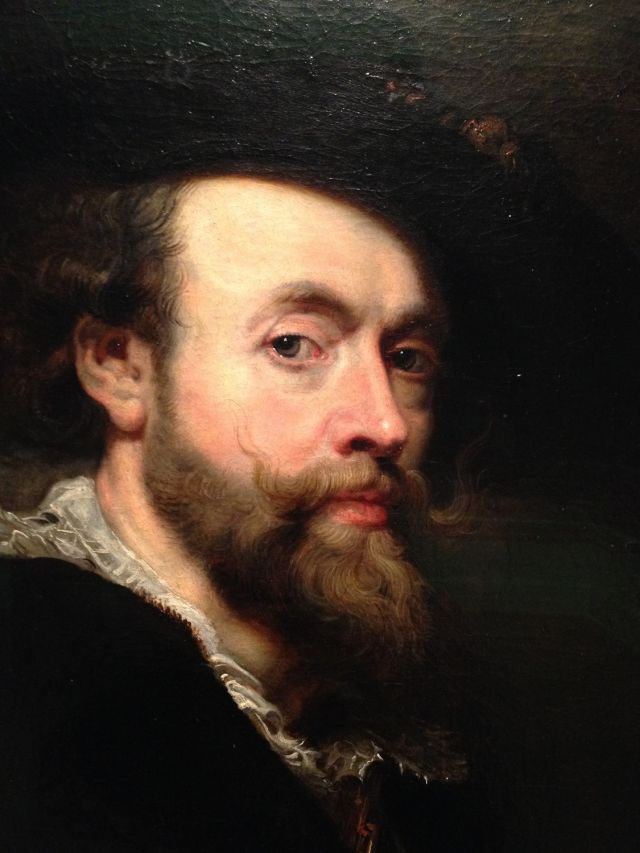
Self-Portrait (1622)
Oil on canvas (80 x 60 cm)
Australian National Gallery, Canberra
To enlarge the picture, right-click on it, then “Open in a new tab”
This self-portrait was painted by Rubens in 1622 as a present for his friend, the lawyer and collector Nicolas Claude Fabri de Peiresec (1580-1637). Rubens did not make many self-portraits. In 1604 he painted a group portrait known as Peter Paul Rubens in a Circle of his Friends (Wallraf-Richartz Museum, Cologne) in which he is seen in the company of some of his friends in Italy. In 1609, to celebrate his recent marriage, he painted a portrait (now at the Alte Pinakothek, Munich) with his wife Isabela Brant. Two years later, in 1611, he appeared in a painting (now at the Palazzo Pitti, Florence) commemorating his deceased brother Philip and the Flemish scholar Justus Lipsius.
It was not until 1622, however, that he was to paint an independent self-portrait for public presentation. There are two versions of the 1622 painting: the canvas in the collection of the National Gallery of Australia, and a second version, on a wood panel, the latter work was requested by and sent to Charles, Prince of Wales (later King Charles I of England) and is still in the Royal collection at Windsor Castle. Rubens went on to produce a series of images of himself with his second wife Helena Fourment, during the 1630s, when he also executed his only other finished self-portrait, a painting now at the Kunsthistorisches Museum (Museum of Art History) in Vienna.
The inventory of Rubens’s estate reveals that he had in his own collection a self-portrait by Tiziano (now at El Prado, Madrid), as well as one by Tintoretto (probably the likeness now in the Victoria and Albert Museum, London). Rubens must have been aware of the tradition of artists’ portraits to which these pictures belonged, and both the Canberra/Windsor image and the Vienna Self-Portrait self-consciously acknowledge the Venetian legacy.
Curiously, however, the painting technique in the Canberra picture is only superficially Venetian, even though the work was executed not on a panel but canvas, a favourite support of the artists in the lagoon city. The delineation of sky and clouds in a few broad strokes is Venetian, as is the confident white brushwork on the collar, but the face is very tightly composed and is less reminiscent of Tiziano than of Frans Pourbus, another Flemish painter who worked for the Mantuan and French courts. The two other portraits that Rubens is known to have painted in 1622 – the likenesses, now in El Prado, Madrid of Queen of France, Anne of Austria, and her mother-in-law, Marie de Medici – also resemble the portraits of Pourbus, Rubens’s predecessor at the French court.
The portraits of Anne of Austria, Marie de Medici, the Canberra Self-portrait and a fourth painting, Lady Arundel and Her Servants (Alte Pinakothek, Munich), are Rubens’s only universally accepted canvas likenesses from this period. These portraits all share a fine-modelled surface, which contrasts with the much more painterly approach characterized by stronger contrasts in light and tones in works such as The Earl of Arundel ( https://wordpress.com/post/oldmasterspaintingscom.wordpress.com/726 ) and the Portrait of a Young Lady. Both these works were painted around 1630 after Rubens had had the opportunity to look again at the work of Tiziano during his visits to great royal collections of Spain and England, and after he had begun to use canvas much more frequently.
Note: Unfortunately, the image reproduced here (taken from Pinterest) is a cropped one. I refused to go through the ridiculous, cumbersome and demeaning 6-step process demanded by the National Gallery of Australia to download a copy of the full picture. Strangely enough, they did not ask for a copy of my passport!
 Old Masters
Can a photo-portraite come close for sheer realism?
Nay.
This a pure icon, Peter Paul Rubens, the subtle irritation of sorrow in his eyes mere “portal” for empathy, an invitation for those thus caught to – soar…
,,.and climb the firmaments of wrath, commune with God “in whose hands the Sun is as a sword and the Moon as a through-trusting fire, who measured our garments in the midst of His vestures and trussed us together as the palms of His hands, who beautified our garments with admiration…”
Yes, beautified our garments with…admiration.
LikeLiked by 1 person