
PETER PAUL RUBENS (1577-1640)
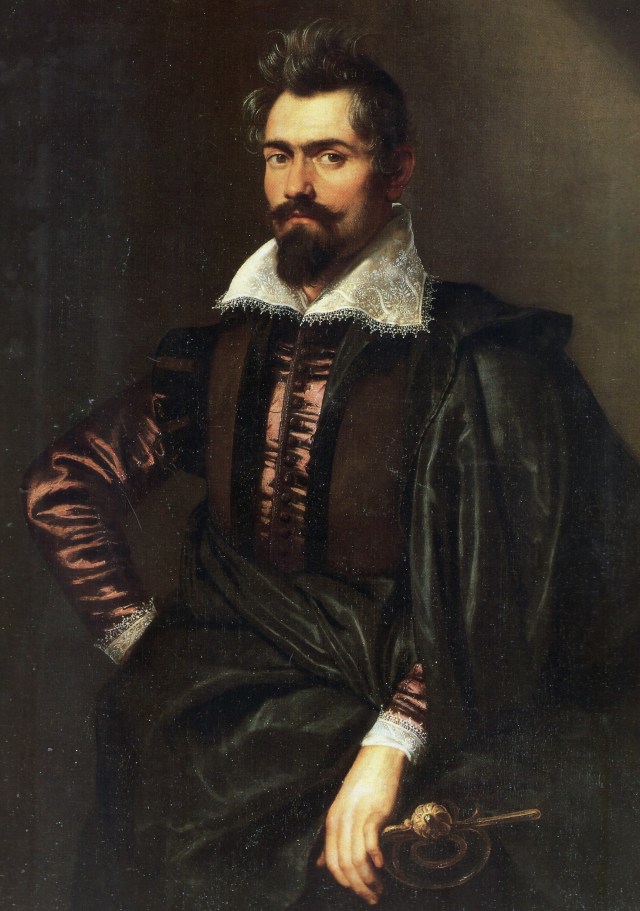
Portrait of Gaspard Schoppius (c. 1604-05)
Oil on canvas (116 x 88 cm)
Palazzo Pitti, Florence
To enlarge the picture, right-click on it, then “Open in a new tab”
This portrait has only recently received acceptance as an early work by Rubens, and this attribution, together with the painting’s resemblance to an engraved portrait by Adriaen Claesz de Grebber, has encouraged the identification of its subject as the German scholar Gaspard Schoppius (1576-1649). Schoppius was a pupil, together with Rubens’s younger brother Philip, of the Flemish scholar Justus Lisipus. He was living in Rome during Rubens’s residence there and has been proposed as one of the subjects in the artist’s group portrait Peter Paul Rubens in a Circle of His Friends (Wallraf-Richartz Museum, Cologne)
It is clear that Schoppius was well acquainted with Rubens. In 1607, in his book Scaliger Hyperbolimaeus (1) praises Rubens’s skill as a painter, declaring him to have obtained perfection in his art, and commends him for his learning and judgement (Praise of Rubens’s painting was one thing, but Schoppius’s other observations are a tribute to the artist’s knowledge and tact, as very few scholars received anything but abuse from the German philologist). Four years later, in his Responsio ad Satyram, Schoppius describes a “pub crawl” at Tivoli with the artist. This intimacy suggests that the present painting may well be a friendship portrait, like the Canberra Self-Portrait.
Although Schoppius’s argumentative texts reveal something of his vain and combative personality, our knowledge of his appearance rests with the Greber engraving and with the present picture. The fiery manner of painting in this work, apparent in the depiction of the hair and the swelling green cloak, as well as the vigorous highlights on Schoppius’s jacket, points to Rubens’s early Italian period. The pose owes much to Tiziano and to the artistic tradition that produced Caravaggio’s Portrait of a Knight of Malta (Palazzo Pitti, Florence). Schoppius’s proud, almost arrogant, bearing is reinforced by the hilt of the sword, cocked casually towards the viewer. The delicate handling of the lace on the sitter’s sleeve and collar, so carefully crafted, is a particular Flemish display of virtuosity.
In Rubens’s time, portraits were in much demand from collectors engaged in setting up what was known as “famous men” picture galleries. However, these galleries tended to contain images of rulers or noted historical figures and hardly explain why a young scholar such as Schoppius would have been immortalized by both the engraver’s burin and the artist’s brush. It is, therefore, possible that the picture was executed for display in a library where images of scholars and philosophers were thought to be a source of inspiration for readers.
The Grebber engraving might possibly explained in terms of another practice, one of them seems to have had a longer history, dating from c. 1550. The engraving of portraits of young scholars can be seen perhaps as an extension of the concept of Album amicorum (Book of Friends), a tradition whereby the devices and autographs of one’s teachers and fellow students were gathered and assembled in books or albums. That engraved portraits were collected in the same way is suggested by Abraham Ortelius’s correspondence of 1574-96, which reveals that such images were frequently exchanged with learned letters.
(1) Joseph Justus Scaliger (1540 – 1609) was a Franco-Italian Calvinist religious leader and scholar, known for expanding the notion of classical history from Greek and Ancient Roman history to include Persian, Babylonian, Jewish and Ancient Egyptian history. Schoppius’s book Scaliger Hyperbolimaeus was an exalted tribute to Scaliger since the word “hyperbole” means: a figure of speech that is an intentional exaggeration for emphasis or comic effect.


Pingback: Portrait of a Young Knight – Old Masters
Magnificent.
LikeLiked by 1 person