
JEAN BAPTISTE TUBY I (1635-1700)
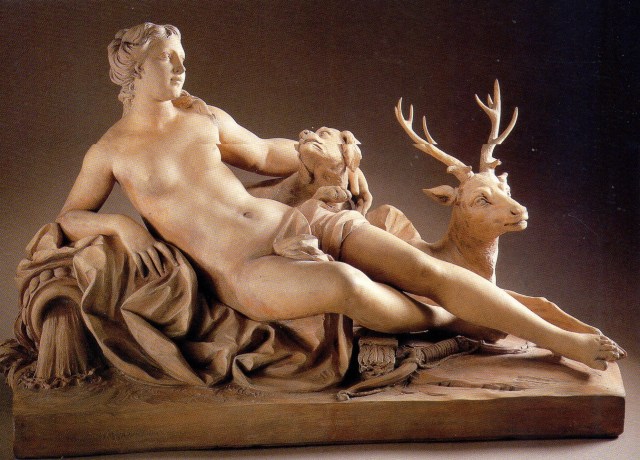
Diana with a Stag and a Dog (1687)
Terracotta (26 x 43 x 21 cm)
Los Angeles County Museum of Art
To enlarge the picture, right-click on it and then “Open in a new tab”
Tuby was born Giambattista Tubi in Rome in 1635, and first trained as a sculptor in Italy, before coming to France sometime after 1660. His talent was recognised by Louis XIV’s unofficial Minister of Fine Arts, Charles Le Brun who employed him as a designer and sculptor. Between 1664–65, he was working on sculptures for the grottoes and terraces of the chateau of Saint-Germain-en-Laye. This led to major projects for the fountains and gardens of the place of Versailles, including the gilded lead sculpture of Apollo and his chariot for the Basin of Apollo. He was elected to the Royal Academy of Painting and Sculpture just three years later. In 1662 he married Marguerite Cocurel with whom he had six children, one of them, Jean-Baptiste Tuby II (1665-1735), became also a sculptor.
In 1672 Tuby became a French subject. In 1680 he married Suzanne Butay, niece of Charles Le Brun. For nearly twenty years he served as officier des Bâtiments du Roi (1) teaching at the Royal Academy and establishing an atelier for bronze casting at the Gobelins. Tuby was a member of the talented group of artists and architects who decorated Versailles. He also collaborated with Antoine Coiysevox on the tombs of Jean-Baptiste Colbert and Jules Mazarin.
Although no large-scale version of the Diana is known, it might have been a project for the garden of Versailles, where, in an elaborate sequence of fountains and sculptures, the symbolic identification of Louis XIV with the sun-god Apollo was played out. Apollo’s twin sister was the moon-goddess Diana, who also was the goddess of the hunt.
It is rather odd that Tuby chose to include a living deer as if it was a pet or an animal consacrated to Diana. The dog also looks more like a pet than a hunting dog. The graceful and elegant composition announces the style known as “rococo” that will flourish nearly fifty years later.
(1) The Bâtiments du Roi (the King’s Buildings) was an institution or branch of the French royal household that was in charge of the maintenance, restoration and decoration of all royal residences. It was one of the most important and prestigious posts under the Ancien Regime.
 Old Masters
Exquisite! Thank you.
The toe on the left foot of the goddess….curiously sculpted, a matter of perspective.
Truly beautiful.
LikeLiked by 1 person