
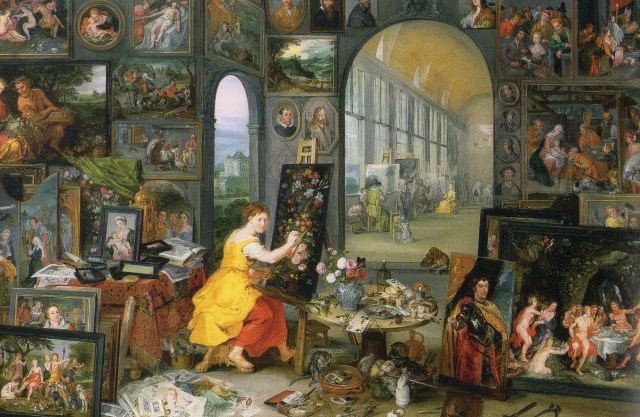
Welcome to this virtual museum where famous artists rub shoulders with little-known or even unknown masters. The wonderful world of the Old Masters is worth visiting, as it provides us with a fascinating view of our past, a link with the world of our ancestors.
The traditional hierarchies of the old academies do not apply here, there are no high or low genres. It does not matter if the subject is a simple still-life or a grandiose mythological composition; they all share the same value: their formal beauty.
There is a misconception about Old Masters paintings (i.e.: works of art produced between the years 1500 – 1800) According to it we are supposed to be knowledgeable about History, Theology, Mythology and other disciplines in order to be able to “understand” the Old Masters. Art appreciation is not about knowledge but emotion. Renoir used to say: “Art does not need explanations, if it has to be explained, it is not art”.
It does not matter what we do know or do not know. The painting or sculpture we are looking at will elicit from us an emotional response, and that will be based on purely aesthetical values; whether we will like it or not. If we happen to be knowledgeable about History or Mythology that would certainly enhance our enjoyment of it, but it will never replace the reaction we had at first glance. We have to trust our instincts.
We live in a dark age that has seen the destruction of the old values of Grace, Beauty, Grandeur and Dignity that paintings and sculptures were expected to inspire. Since the beginning of the XXth century, we have been subjected to a series of abominable creations that were and are, lauded as “wonderful”, “original”, and “exciting” by the so-called experts. Modern art was born and with it the cult of vulgarity, ugliness, and obscenity. It only takes a few minutes strolling through an art gallery or museum dedicated to these “masterpieces” to realize what a sham this phenomenon known as “modern art” is.
The Oxford Dictionary defines art as: “The expression or application of human creative skill and imagination, typically in a visual form such as painting or sculpture, producing works to be appreciated primarily for their beauty or emotional power”. I have highlighted Beauty and Skill because I do believe that is what real, classical European art is all about.
A word must be said regarding portraits and paintings depicting historical events or religious and mythological allegories. To fully appreciate their meaning and historical importance, it is vital to have a sound knowledge of these matters; that is why I provide as much information as possible about the subject treated by the artist. As I said before, our first impression will be an aesthetic one, we may like the painting or sculpture we are looking at or not, but there is much more beyond the image. Some paintings and sculptures are also extremely valuable historical documents, and they should be appreciated and understood as such.
We are living in a sick society that has turned its back on everything noble and beautiful. Moreover, there is a conscious and relentless effort to disfigure and therefore to misrepresent historical events as part of an agenda to destroy Western civilization and to make the White man feel guilty and ashamed of his forefathers’ alleged “crimes”. This perverse trend has also poisoned the history of Western art which is now seen through “politically correct” lenses. The aim of this blog is to fight this vile phenomenon. We do not owe apologies to anyone! If you do not like what you see or read here, move on. I shall not waste time arguing with obnoxious trolls. Insulting comments will be deleted.
The artistic creations (Painting, Sculpture and Architecture) produced between 1500 and 1800 represent the pinnacle of our glorious European civilization. Enjoy the beautiful masterpieces that our ancestors have bequeathed us and be proud of your heritage.
 Old Masters