
POMPEO BATONI (1707-1787)
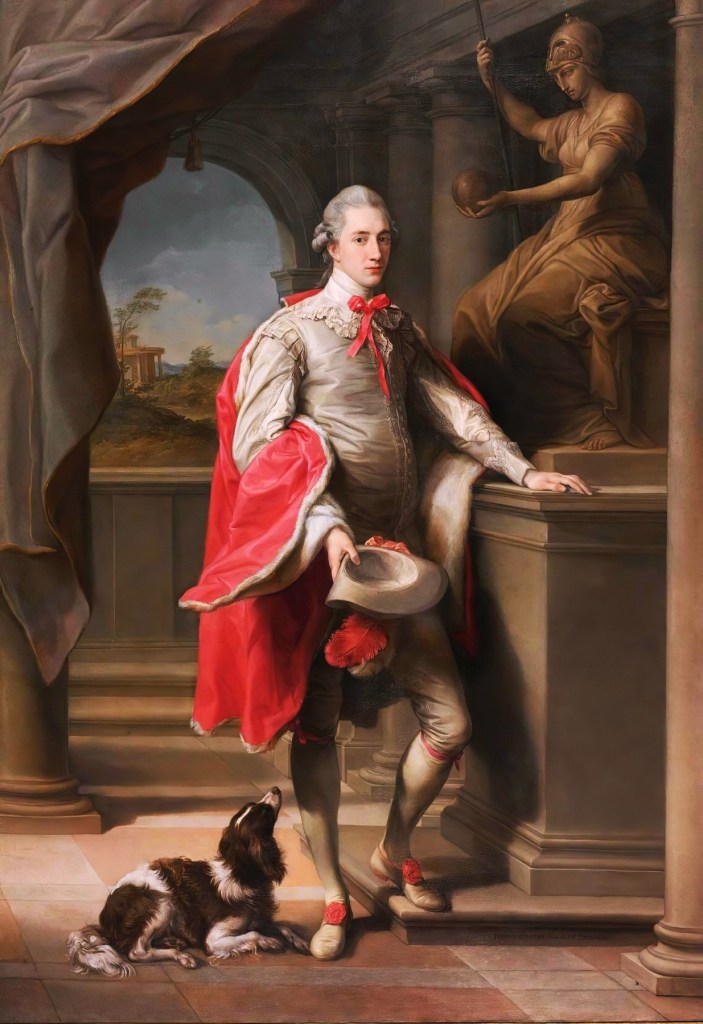
John, 3rd Baron Monson of Burton (1775)
Oil on canvas: 249 x 175 cm
Private collection
To enlarge the picture, right-click on it and open it in a new tab.
The only claim to fame this handsome and very elegant young gentleman would have had was to have been portrayed by Pompeo Batoni. In fact, John, 3rd Baron Monson (1753-1806), is not remembered for anything else. Even his grandfather, John (1693-1748), the first Baron Monson of Burton, did not distinguish himself in any field; the baronetcy (1728) was given to him as a reward for his political support to the Duke of Newcastle.
As the son of a very wealthy and well-connected member of the gentry, John went to Eton. Between 1772 and 1776, he undertook a lengthy Grand Tour in the company of his cousin Lewis Thomas Monson, later Lewis Watson, 2nd Baron Sondes (1754-1806). Dr John Moore, physician to the Duke of Hamilton, who was also on route to Italy in the company of his master, met them in Geneva in 1772 and, as it was to be expected, criticised their rather frivolous nature, lamenting that their time “is passed in complete idleness”, and that they spent their days “sauntering and gaming when they can get anyone to play with them” (1)
Gaming was an endemic vice among the European nobility; however, it is quite logical that people who never had to do anything to earn a living would not give a thought to squandering huge sums of money that meant nothing to them.
While in Rome, John Monson met his future brother-in-law, Henry Peirse (1754–1824), who also sat to Batoni the following year for his own portrait, today in the Galleria Nazionale d’Arte Antica in Rome. Together, the three young men travelled to Naples with Lord George Cavendish, arriving there on 10 January 1775. Monson’s gambling got worse; by March, it is recorded that, together with Cavendish and Lord Tynley, he had lost above two thousand pounds at cards, mostly to the King of Naples. (2)
The young English lord is shown wearing a pearl grey Van Dyck costume with an ermine-trimmed scarlet cloak. Judging by his choice of dress, as well as the architectural setting in a columned portico, it is very likely that Monson may have seen Batoni’s earlier portrait of Thomas William Coke, later 1st Earl of Leicester, painted in 1774, in which the sitter not only is similarly dressed but also has a dog sitting at his feet. Indeed so similar are these magnificent costumes, down to the intricate lace collar, the ostrich feather plumed hat and the Stuart ‘rose’ shoe buckles, that they must have been part of the outfits that Batoni kept in his studio as props.
The only significant difference between the portraits of Thomas William Coke and John Monson is that in the former, the statue chosen by Batoni, or the sitter, is “The Sleeping Ariadne”, while in the latter, the chosen statue represents the goddess “Rome”.
The virtuosity of Batoni´s handling of paint and his talent at capturing his sitters´ personality is exemplified by this portrait. The Van Dyck costume allowed Batoni to show off his unique skill in rendering the different textures of the garments, be they made of silk or velvet. The lace of the collar and the ostrich feathers in the hat are fine examples of Batoni’s technical virtuosity.
Upon his return to England, John married Lady Elizabeth Capell, daughter of William Anne Capell, 4th Earl of Essex and Frances Hanbury-Williams, on 13 July 1777. The marriage may have restored his finances, assuming he stopped gambling, which I doubt.
John Monson´s portrait by Batoni was sold in London on 8th July 2015 by Sotheby´s. As incredible as it may seem, the painting did not reach the minimum expected. It had been valued between £2.000.000 and £3.000.000 and it was sold for £1.685.000.
NOTES
1= J. Ingamells: A Dictionary of British and Irish Travellers in Italy 1701–1800, New Haven and London 1997, p. 668.
2 = To give an idea of how much money £2.000 represented in 1775, let´s say that its value today (2026), adjusted to the cumulative inflation rate over the years, would be around £420.000. However, this does not tell the whole story. In 1775, a skilled tradesman earned £78 a year; therefore, £2000 represented 25.5 years of wages. In 2025, a skilled tradesman in the UK was earning approximately £35.700 a year; if we multiply this amount by 25.5, the result would be £910.350. Still, if we take the lesser amount of £420.000 and divide it by 35.700 it will represent 11 years and 7 months’ worth of wages. One way or the other, the amount of money lost at gambling by these useless drones was obscene.
 Old Masters