
ANTON RAPHAEL MENGS (1728-1779)
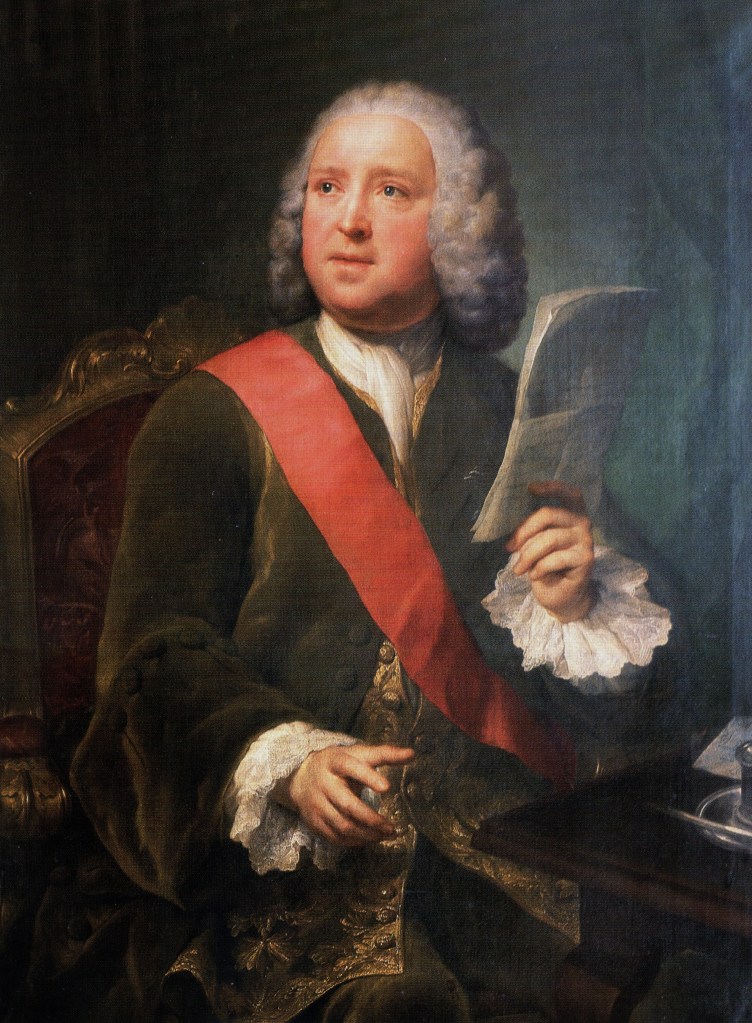
Sir Charles Hanbury Williams (1757)
Oil on canvas: 110 x 83 cm
Warsaw, National Museum.
To enlarge the picture, right-click on it and open it in a new tab.
Sir Charles Hanbury Williams (1708-1759) was already a well-known and highly-regarded poet, writer and satirist when he decided to embark on a second career as a diplomat. Hanbury was the son of a very wealthy Welsh ironmaster and Member of Parliament, John Hanbury (1664-1734), and his second wife, Bridget Ayscough, the eldest daughter of Sir Edward Ayscough of Stallingborough and South Kelsey. With his father’s marriage to Bridget came a fortune of £10,000 (1) and connections with established political families. His mother was a close friend of Sarah Churchill, Duchess of Marlborough.
Charles went to Eton, where he befriended the novelist Henry Fielding. In 1720, he assumed the name of Williams, under the terms of a bequest from his godfather, Charles Williams of Caerleon.
Williams made his Grand Tour in 1730. Upon his return to England, he entered Parliament in 1734, representing the Monmouthshire constituency as a supporter of Robert Walpole, and held the seat until 1747. In 1754, although he was serving as the British envoy to the Russian court, he was returned to the Commons as a member for Leominster, holding the seat until his death.
On 1 July 1732, he married Lady Frances Coningsby (1707/8–1781) at St James, Westminster, London. Lady Frances was a daughter of Thomas Coningsby, 1st Earl Coningsby, and Lady Frances Jones (the second daughter and sole heiress of Richard Jones, 1st Earl of Ranelagh, and the Hon. Frances Willoughby, a daughter and heiress of Francis Willoughby, 5th Baron Willoughby). The man had a fantastic eye for sound investments.
Hanbury Williams was a born diplomat; he was witty, extroverted and had impeccable manners, as the anonymous author of a biographical article dedicated to him said: “Sprightliness of conversation, ready wit, and agreeable manners, introduced him to the acquaintance of men of the first talents: he was the soul of the celebrated coterie, of which the most conspicuous members were, Lord Hervey, Winnington, Horace Walpole, late Earl of Orford., Stephen Fox, Earl of Ilchester, and Henry Fox, Lord Holland, with whom, in particular, he lived in the strictest habits of intimacy and friendship.” (2)
According to the German scholar Steffi Roettgen, the leading authority on the life and work of Anton Raphael Mengs:“In view of the dates that have been verified, Meng´s portrait must have been painted in the brief time between February 1751 and the painter´s departure from Dresden in September of that year.”(3)
Sir Charles Hanbury-Williams must have been one of those persons who, although very nice and charming, are rather possessive and bumptious. As a result, they become a nuisance, and people tend to avoid them. The Italian doctor, antiquarian and multi-faceted scholar Giovanni Lodovico Bianconi (1717-1781), who was the personal physician of Frederick Augustus II, knew Mengs very well and left us a very revealing description of the relationship between Hanbury-Williams and the Austrian artist:
“Amato da tutti, Anton Raffaele concepì, starei per dire per sua disgrazia, una caldissima amicizia per lui il Cavaliere Hambury Williams Ministro allora d’Inghilterra alla corte di Dresda. Uomo di maggior ingegno, ma nello stesso tempo più impetuoso di lui non abbiamo mai veduto (…)
Violento nelle sue passioni lo era anche nell’amicizia d’Anton Raffaele, e pareva che egli non potesse più vivere senza di lui. Quello importuno affetto distraeva non poco il nostro occupatissimo giovane, e lo inquietava”
“Beloved by all, Anton Raphael conceived, I would say to his misfortune, a very warm friendship for the Cavalier Hanbury Williams, then Minister of England at the court of Dresden. A man of great ingenuity, but at the same time, the more impetuous man we have ever seen (…)
Violent in his passions, he was also violent in his friendship with Anton Raphael, and it seemed that he could no longer live without him. That importunate affection distracted our busy young man not a little and disturbed him.”(4)
The painting I have reproduced here has been taken from the beautiful and excellent catalogue of the 1993 exhibition “Anton Raphael Mengs and his British Patrons” written by Dr. Steffi Roettgen. This is an excellent copy after the original, lost during WW2.
“Bianconi says that Meng´s portrait was never in fact finished, because Sir Charles unexpectedly had to leave for St. Petersburg. However, he must be mistaken, for Lord Essex, later Sir Charles´s son-in-law, already mentions that Mengs´s portrait is in his possession in a letter to Horace Walpole in July 1752. Lord Essex was in Germany in 1751 and he must have taken the picture back to England with him after a visit to Dresden” (5)
“The Warsaw painting certainly cannot be the version that was in the possession of Sir Charles´s heirs, as we known from the well-documented history of the original, which was in the possession of Sir John Hanbury-Williams from 1922 and that was lost in an air raid during the Second World War” (6)
According to the accounts of those who saw it, the likeness of Sir Charles Hanbury-Williams painted by Mengs was excellent. Here is the opinion of Lodovico Bianconi:
“Chi ha conosciuto quel singolare Inglese e veduta la pittura, dirá, se è possibile il fare testa più somigliante . A me pareva che fosse bollente e viva, com’era l’originale”
“Those who have met that singular Englishman and seen the painting will say if it is possible to make a more lifelike portrait. It seemed to me that it was as hot-blooded and lively as the original.”(7)
Although Hanbury-Williams do not come across as the hot-blooded, pushy fellow he was, the man was clearly mentally unbalanced. He was under a great deal of stress during the negotiations with Russia between 1752 and 1757. According to a biographer:
“In the midst of this arduous business his health rapidly declined, his head was occasionally affected, and his mind distracted with vexation; the irregularities of his life irritated his nerves, and a fatiguing journey exhausted his spirits. Soon after his arrival at Hamburg, in the autumn of 1757, he was suddenly smitten with a woman of low intrigue, gave her a note for £2.000 and a contract of marriage, though his wife was still living: he also took large doses of stimulating medicines, which affected his head, and he was conveyed to England in a state of insanity. During the passage, he fell from the deck into the hold, and dangerously bruised his side; he was blooded four times on board, and four times immediately after his arrival in England. In little more than a month he recovered, and passed the summer at Coldbrook-house. But towards the latter end of 1759, he relapsed into a state of insanity, and expired on the second of November, aged fifty.”(8)
According to some sources, Sir Charles Hanbury-Williams killed himself and the Coldbrook estate passed to his brother George.
NOTES
1 = That amount would be equivalent to £5.740.000 in 20
2 = Alexander Chalmers´ General Biographical Dictionary (Vol. XXXII, p. 99, London, 1812)
3 = Steffi Roettgen: Anton Raphael Mengs and his British Patrons (Zwemmer, London, 1993) p. 80-81.
4 = Lodovico Bianconi: Elogio storico del Cavaliere Anton Raffaele Mengs (Pavia, 1795) p. 43-44. The first and more popular edition is the one printed in Milan in 1780, which was rapidly translated into French (1781) and German (1781).
5 = Steffi Roettgen: Op. cit., p.80
6 = Steffi Roettgen: Op. cit., p.81
7 = Lodovico Bianconi: Op. cit., p.44
8 = William Coxe, AM, FRS: “An Historical Tour in Monmouthshire” (London, 1801) Vol. II, p. 278-9.
 Old Masters
How refreshing to see you come up for air and post another great article here, Claudius.
LikeLike
Thank you very much! It is a pleasure to be back “at work”. I have been spending too much time lately reading about political affairs. It is not very good for your health. Have you changed your email address? I wrote to you twice a couple of months ago, but I did not receive a reply. Regards.
LikeLike