
JACOB FERDINAND VOET (1639-1689)
Agostino Chigi, Principe di Farnese (c.1670)
Oil on canvas (size unknown, probably 76 x 62 cm)
Museum of Fine Arts and Lace, Alençon, France
To enlarge the pictures, right-click on them and choose “Open in a new tab”
When you look at a portrait by Jacob Ferdinand Voet, chances are that you will ask yourself: “Why did I never hear about this man?” or “Why is he not famous?”. I am afraid there are no simple answers to these questions. Why indeed? What makes theses questions even more puzzling is the fact that the brilliant Flemish artist born in 1639 in Antwerp enjoyed a highly successful career.
Jacob Ferdinand was the son of the painter Elias Voet of which very little is known; he must have been trained by his father. By 1663 he was in Rome where he stayed until 1679. His talent was quickly recognised by the Roman aristocracy who frequented his studio; to give the British reader an idea of his popularity and the quality of his clientele, he can easily be compared to Anthony van Dyck or Sir Joshua Reynolds in their heyday. Such was his reputation that many foreign noble visitors to Rome also sat to him. It can be said, without exaggeration, that Voet was the predecessor of Pompeo Batoni (1708-1787)
I find his work so beautiful and admirable that I am thinking to dedicate a blog to him or, perhaps, to write a book about him. For the moment let’s say that after a triumphal career in Italy he returned to Antwerp in 1684; a year later he was in Paris where he also became a favourite of the nobility. He died there in 1689 at the age of 50.
The handsome young man who was portrayed by Ferdiand Voet around 1670 was a member of one of the wealthiest families in Italy during the XVI and XVII centuries. The Chigi family originated in Siena, Tuscany, where they still own large estates. One of the most famous members of the family was the powerful banker Agostino Chigi (1465–1520) who built the palace and gardens afterwards known as “La Farnesina” and was noted for the splendour of his entertainments. He was a close friend of pope Julius II who made him his unofficial finance minister.
The most illustrious member of the family was Cardinal Fabio Chigi (1599-1667) better known as pope Alexander VII (1655-67). It was him who awarded to the young Agostino (1634-1705), his favourite nephew, the principality of Farnese. It was also thanks to the mediation of the pontiff, that, in 1658 he married the Roman noblewoman Maria Virginia Borghese (daughter of Paolo Borghese and Olimpia Aldobrandini, and descendant on the paternal line from Pope Paul V and on the maternal line from Clement VIII), who brought to the family of the Chigi a dowry of enormous value as well as great political power and influence.
Agostino Chigi, like his brother Cardinal Flavio Chigi (1631-93) dedicated himself to promoting and employing artists and architects to embellish his residences. He did not play any important political roles.
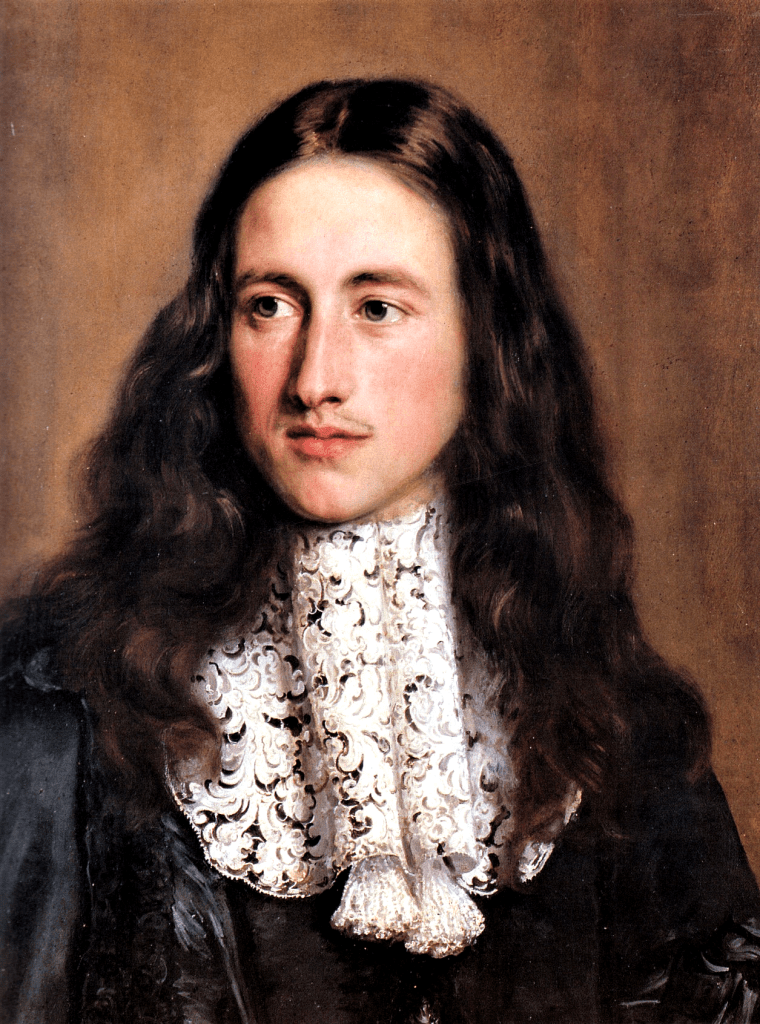
Like most portraits by Ferdinand Voet, this is “a head and shoulders”, also known in England as “a three-quarters”, the size was usually 76 x 62 cm. In this picture Agostino is looking away, something quite unusual in the production of Voet where most of his sitters look at the viewer. By far the most attractive detail of the portrait is the magnificent cravat made of the finest linen in the Italian style known as “gros point de Venise” (Venetian Raised Point).
There is another beautiful example of this kind of lace in my post about the splendid portrait of Jean-Baptiste Colbert by Claude Lefevre. The great French minister was responsible for the creation of the French lace industry in 1665 to compete with the famous and exquisite Venetian lace; here is the link: https://wordpress.com/post/oldmasterspaintingscom.wordpress.com/830
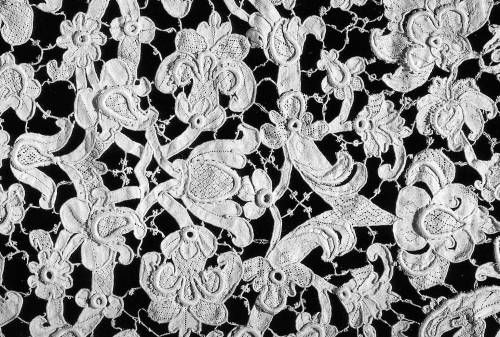
According to the relevant article (Point de Venice) in Wikipedia: “Beginning in 1620 it became separated into Venetian raised lace (which became known by the French term “gros point de Venise”) and Venetian flat lace (in French “point plat de Venise”). The former (now known in English as “Venetian Gros Point”) is characterized by having a raised pattern created through the use of cordonette worked over with buttonholing so that the curves achieved an elevated quality similar to a relief carving.”
This little picture will give you an idea of how intricate and beautiful this kind of lace was:
 Old Masters
Pingback: Le Grand Colbert – Old Masters