
POMPEO BATONI (1708-1787)
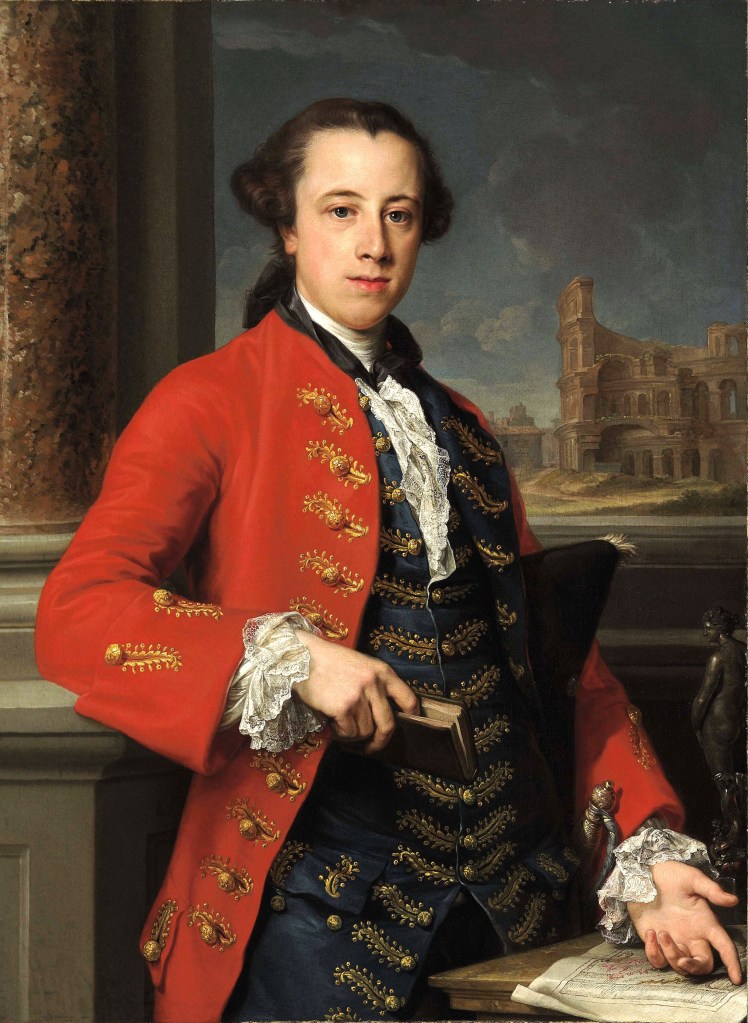
A gentleman in a red coat (1758-60)
Private collection
Oil on canvas (99 x 74 cm)
(To enlarge the picture, right click on it and chose “Open in a new window”)
Pompeo Batoni, one of the finest portrait painters in European history, is beginning to emerge from the darkness to which he was consigned by the “experts” and art historians for well over 150 years. In his heyday, the second half of the 18th century, his name was synonymous of portrait painting of the highest quality. He truly was the “Prince of Painters in Eighteenth-Century Rome”, an expression that serves as the subtitle to the beautiful catalogue written by Edgard Peters Bowron and Peter Björn Kerber for the magnificent exhibition dedicated to Pompeo Batoni in 2008.
His reputation was so great among the British aristocracy that coming home from the Grand Tour without a portrait by Batoni was almost unthinkable. “His virtuosity depicting British gentlemen on the Grand Tour was highly admired. James Bruce’s accclamation that he was “the best painter in Italy” and Lady Anna Riggs Miller’s declaration that he was “esteemed the best portrait painter in the world” are typical contemporary estimations of his talent” (1)
The art of Batoni presents a perfect blend of superb draughtsmanship, exquisite colouring, amazing realism and unique, casual elegance. Something extremely rare that can also be seen in two of his contemporaries: Anton Raphael Mengs (1728-79) and Alexander Roslin (1718-93).
Batoni’s tremendous popularity among the British ruling class of his day is clearly demonstrated “by the fact that of his approximately 225 known individual sitters, 175 were British” (2)
This rather young gentleman, whose identity remains unknown, was most probably British. I base my supposition on the factors: (A) The large number of Britons who made up most of his clientele (B) The scarlet coat wore by the sitter, which was favoured by most British gentlemen.
Following an established formula, the sitter leans against a column, behind him we can see the Colosseum. Batoni made use of props such as Roman monuments or buildings to make clear that their clients had been to Rome, something that in the 18th century was considered compulsory for every young British gentleman. Having said that, not all young gentlemen were interested in Roman architecture, monuments or antiques, as some of their tutors complained. The famous French writer, historian and scholar Charles de Brosses (1709-77) echoed those sentiments in one of his letters:
“The money the English spend in Rome and their custom of making a journey there as part of their education is of scant benefit to the majority of them” adding that there were some “who will leave the city without having seen anyone but other Englishmen and not knowing where the Colosseum is” (3)
This beautiful portrait was auctioned by Christie’s in January 2012 and it sold very well (U$S 866.500) for more than double its estimated value. The following are excerpts from the lot essay:
“The sitter gestures with his left hand to a map of Italy which lies on the table in front of him, suggesting that he has been diligently studying the history, geography and culture of this foreign land. Also present on the table is a bronze statuette of the Medici Venus, which at the time was one of the most famous antique sculptures in all of Italy (…) Dated by Clark and Bowron to circa 1758-1759 (loc. cit.), the present painting is the only known portrait in which Batoni chose to use this accessory.”
Notes:
(1) “Pompeo Batoni” = Edgard Bowron & Peter Kerber (p. 40-41)
(2) “Pompeo Batoni” = Edgard Bowron & Peter Kerber (p. 41)
(3) “Pompeo Batoni” = Edgard Bowron & Peter Kerber (p. 87)
 Old Masters