
SIR JOSHUA REYNOLDS (1723-1792)
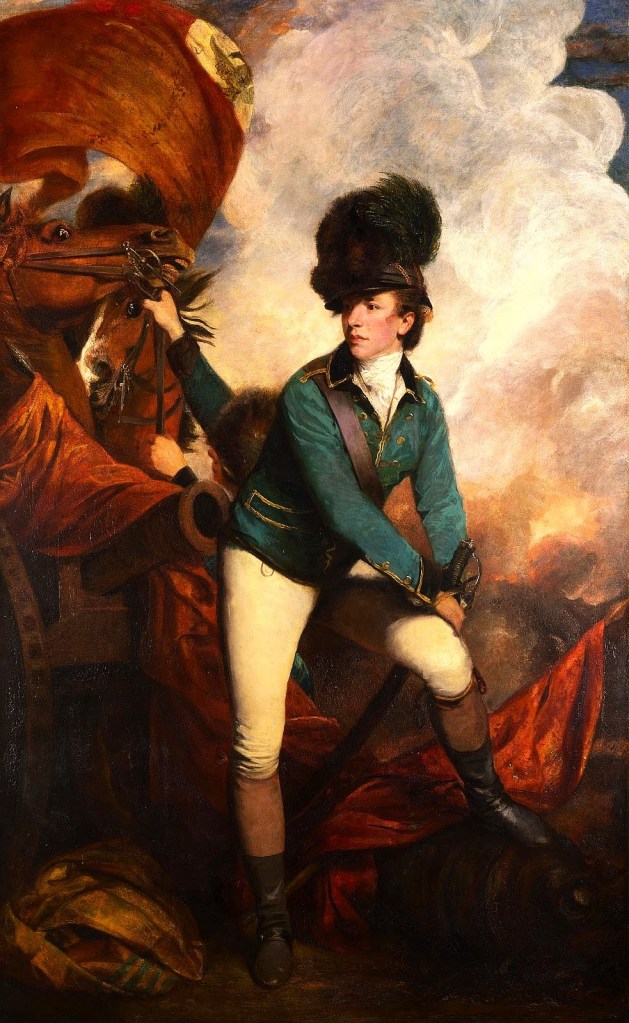
General Sir Banastre Tarleton (1782)
National Gallery, London
Oil on canvas (236 x 145 cm)
(To enlarge the picture, right click on it and chose “Open in a new window”)
The man portrayed here was considered by his countrymen as a dashing war hero, while his former enemies, the American rebels, believed him to be a criminal. As the purpose of this blog is to analize particularly important works of art and their impact on Western culture I shall stay away from the controversy that surrounds Banastre Tarleton’s name till this day. However, as I believe is extremely important to have some basic knowledge abouth the life and personality of a historical figure who was portrayed by an eminent artist to better understand his/her importance, I shall provide, as usual, some information about the sitter.
Banastre Tarleton (1754-1833) was the third of seven children born to merchant John Tarleton (1718–1773). A very wealthy man who owned several sugar plantations in the West Indias and also managed several slaving vessels. The family business also included trading with the American colonies.
Banastre attended University College at Oxford. In 1773, at the age of 19, he inherited £5.000 on his father’s death. To have some idea of the importance and value of that sum let’s say in today’s money it would be the equivalent of £10.420.000. As incredible as it may seem, Banastre managed to squander that fortune in a year, mostly on gambling and women.
In 1775 he managed to purchase a commission in the 1ts Dragoon Guards and by the end of the year he sailed to North America to join the British troops fighting the rebels. Tarleton’s image as a ruthless, almost sadistic war-criminal had its origin in the so-called “Battle of Waxhaw”. On May 29, 1780, colonel Tarleton, at the head of 149 cavalrymen intercepted a column of about 380 American soldiers. After sustaining serious losses the American commander surrendered; however, as the white flag was raised a rebel shot and killed Tarleton’s horse who fell pinning him down. The enraged British soldiers, believing his leader had been killed, murdered dozens of American prisoners before Tarleton managed to stop them. It was a tragic accident. Here is a link to an excellent article that deals with Tarleton’s military career:
https://allthingsliberty.com/2016/08/top-10-banastre-tarleton-myths/
Tarleton returned to England in 1782 with an excellent reputation. As John Knight mentions in the article quoted above:
“Most British senior officers returned to England after the war to severe criticism from their compatriots…[They] received varying degrees of blame and censure for the loss of the American colonies. But Tarleton was almost unique in attracting no such rebuke. …he was received home with universal acclaim, being feted at court and becoming an intimate friend to two future kings, George Prince of Wales and William Duke of Clarence.”
The beautiful portrait by Sir Joshua Reynolds was commissioned by Banastre’s brother. Reynolds had the brilliant idea of using the famous statue of Cincinnatus as a model. This enabled him to make a flattering analogy between the Roman hero and his British alter ego but also gave him a perfect excuse to hide Tarleton’s mutilated right hand, of which he lost two fingers to a musket ball at the Battle of Guilford Court House. Below there is a link to a picture of Cincinnatus’ statue and an explanation about his stance
https://www.schoenbrunn.at/en/about-schoenbrunn/gardens/tour-through-the-park/cincinnatus
 Old Masters