
SIR JOSHUA REYNOLDS (1723-1792)
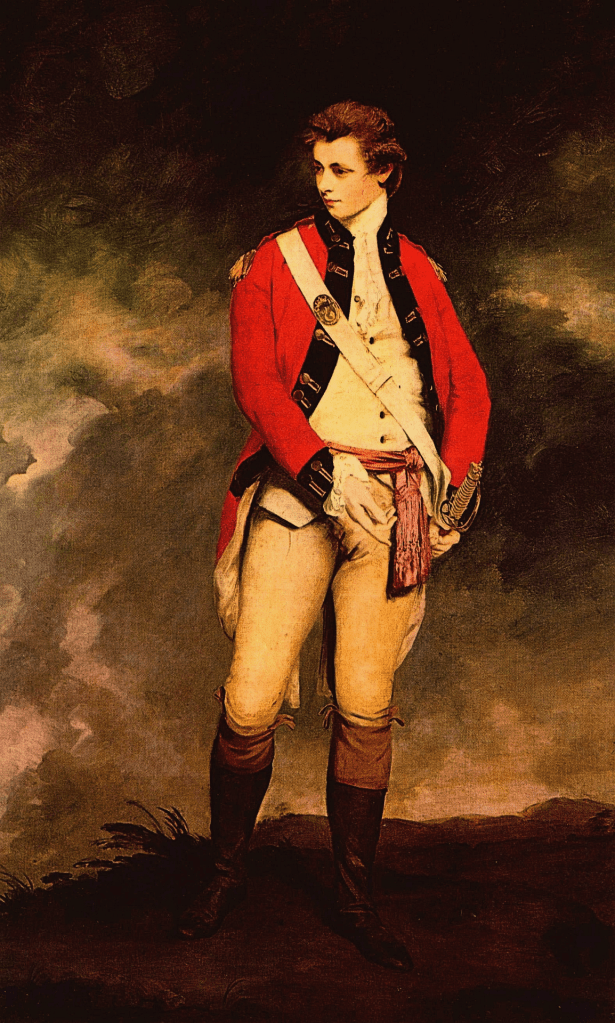
Captain John Hayes St. Leger (1778)
Waddesdon Manor, Buckinghamshire, Great Britain
Oil on canvas (240 x 147 cm)
(To enlarge the picture, right click on it and chose “Open in a new tab”)
John Hayes St. Leger (1756-1800) was a famous rake of the late 18th century. He was the son of Sir John St. Leger (1726-1769) a non-entity who seems to have been as useless as his father St. John St. Leger Snr. (1674-1743) an Irish barrister, politician and judge from an important and influential aristocratic family from county Cork, who was not highly regarded for his legal ability, and it was believed by his contemporaries that he owed his professional success to his influential family connections.
Being extremely good looking (he was known as “Handsome Jack”) and charming he soon became famous as a ladies’ man and joined the circle of rakes who made-up the Prince of Wales’ entourage. By the time Reynolds painted his portrait (1778) John St. Leger was a captain in the 55th regiment of Foot. Like many wealthy aristocrats he was not interested in a serious military career and joined the Army because it was considered the logical profession for a young nobleman; besides the uniform gave the young dandies a glamorous appearance that most young women found irresistible.
By 1784 his lavish expenditure caused him to escape to Ireland to flee his creditors. He returned to England in 1786 after he inherited his uncle’s estate which gave him a yearly income of £2.000 (the equivalent of £3.785.000 in today’s money). He used his money to buy a captaincy in the 1st Foot Guards which gave him the equivalent rank of lieutenant-colonel in a Line regiment. In 1790 he was appointed Adjutant-General, a charge of enormous importance and responsibility since it entailed the supervision of the recruitment, training and equipment of the British army. In 1796 he was sent to Trincomalee (Sri Lanka) to take the command of the British troops stationed there. He died there on 31st January 1800.
As it is very common nowadays, there are many “experts” who come with ridiculous theories to try to explain things that do not need to be explained, or who feel compelled to say or write things that only exist in their feverish minds. A good example of this regrettable tendency is a comment on the website of Waddesdon Manor regarding this painting. According to its author: “The pose appears to be a conflation of the antique statues known as the Apollo Belvedere, the Capitoline Antinous and the Meleager.” http://(https://waddesdon.org.uk/the-collection/item/?id=132
Well, if you look carefully at each of the above-mentioned statues you will notice that the ONLY thing, they have in common with our friend is their stance. St. Leger is standing with most of its weight on one foot, so that its shoulders and arms twist off-axis from the hips and legs. This posture is known as contrapposto, an Italian word that means “counterpoise”. The leg that carries the weight of the body is known as the engaged leg; the relaxed leg is known as the free leg. Usually, the engaged leg is straight, or very slightly bent, and the free leg is slightly bent. The idea behind this pose is to suggest potential or future movement.
The concept of contrapposto was born in Greece around the 5th century BC and it was the standard pose of ALL Greek and Roman statues for centuries; therefore, the idea that the figure of John St. Leger is the result of a “conflation” of three specific and famous statues is as false as ridiculous.
Perhaps because he was aware of St. Leger’s non-existent war record, Reynolds cleverly abstained to represent him as a dashing hero as he did with captain Orme (London, National Gallery) painted twenty-two years earlier and as he would do four years later when portraying colonel Banastre Tarleton (London, National Gallery). “Handsome Jack” stands on an imaginary landscape against a dark, stormy sky that off-sets his elegant, slim figure and his bright scarlet coat. St. Leger’s pose seems to say “This way, my lady” as if he was in a ballroom showing-off his impeccable manners.
The portrait of the handsome rake is, in my opinion, one of the finest pictures ever painted by Sir Joshua Reynolds and an earlier example of the exceptionally stylish manner that would become the hallmark of Sir Thomas Lawrence,
 Old Masters