
ANTON RAPHAEL MENGS (1728-1779)
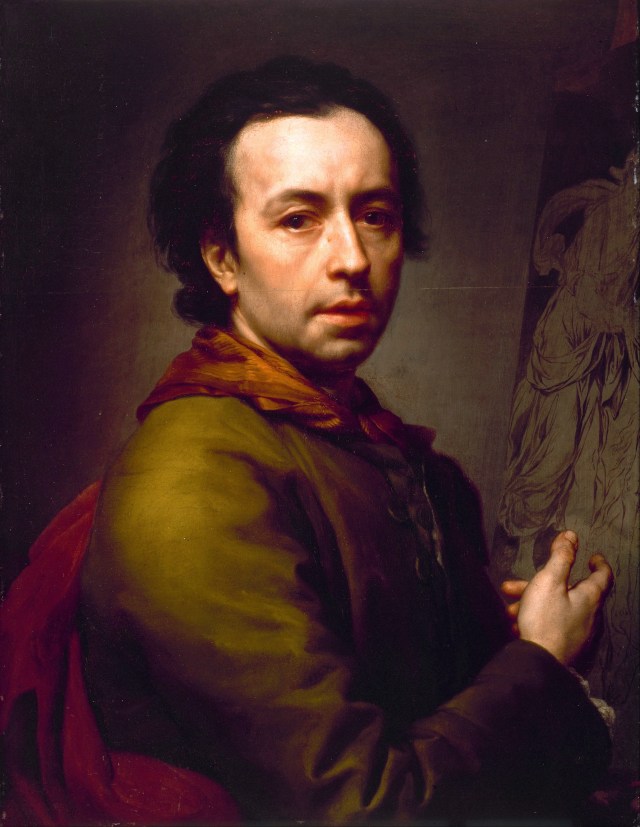
Self-portrait (1774)
Oil on canvas (73.5 x 56 cm)
Walker Art Gallery, Liverpool, UK
(To enlarge the picture, right-click on it and choose “Open in a new tab”)
Mengs was described by his contemporary Johann Winckelmann as “the greatest artist of his time and perhaps of succeeding times, reborn like a phoenix, from the ashes of the first Raphael, to teach the world beauty in art, and to achieve the greatest flight committed to human powers in the same”. In his own time, he was an international phenomenon, arguably the most famous and influential living artist in Europe.
Anton Raphael Mengs was born in Aussig, Bohemia, then part of the Austrian empire. Named after Antonio Correggio and after Raphael, he was predestined by his ambitious father for greatness. By his late teens, he was a Court Painter to the Elector of Saxony at Dresden. Moving to Rome, he became the only serious rival to Pompeo Batoni in the very particular field of Grand Tour portraiture, offering a more intellectual and restrained, although no less glamorous likeness for his wealthy patrons.
In Madrid, as Court Painter to King Charles III, he took charge of the decorations of the Royal Palace where Tiepolo and his sons were also working. It must be said that he made life difficult for the Venetian painter out of jealousy. A generation of artists studied at his studios in Rome and Madrid and his published ideas on art theory (Gedanken über die Schönheit = Reflections on Beauty) were translated into Italian, French, Spanish and English. And yet, within a decade of his death in Rome in 1779, Reynolds was attributing Mengs’s success (and that of Batoni) to mere prejudice in favour of the Roman School and accurately predicting his rapid descent into oblivion.
Modernist prejudice against academically inspired art has poisoned art history and condemned many artists, excellent and mediocre, to oblivion. About thirty years ago, some scholars began to reverse this still predominant conception. In 1998 British Heritage organized a superb exhibition dedicated to Anton Raphael Mengs and his British patrons which is the title of the beautiful catalogue written by Dr Steffi Roettgen, the foremost authority on Mengs. Practically all the information contained in this post comes from her book.
Anton Raphael Mengs, like his illustrious contemporary and rival Pompeo Batoni, was a brilliant portraitist who deserves a place among the finest painters of the XVIII century. Both were victims of the highly intellectual and pedantic art theory developed by Gian Pietro Bellori (1613-1696) in the late XVII century. This led them and countless other artists to build a style known as “neo-classical” that they applied to allegorical, mythological and religious works. The figures were idealized, based on Classical antiquity, and the expression of intense feelings was frowned upon. The result was a vapid art. Interestingly when Mengs and Batoni applied their talent to portray real people, they produced marvellous works of art. Free from the shackles of academic theory their innate skill came to the fore.
This portrait was commissioned and first owned by the Earl of Cowper, a close friend of Mengs, whom he met twice in Florence (in 1770 and 1773). Presumably, Cowper took the work to England on his brief trip to London in 1786. He offered it to King George III, but his gift was declined, something rather strange considering the monarch’s good taste.
“The painting can be dated to 1774 from the inscription on the reverse and from a dated drawn copy by Friedrich Hackert in Braunschweig. It was therefore painted during Mengs’s stay in Florence between April 1773 and May 1774, only a few months after the self-portraits for the Uffizi and the collection of Count Firmian (now in the Alte Pinakothek in Munich). It is closest to the latter in type and posture. The difference is thus, all the more striking. The face appears older and more flaccid, and the eyes look tired and disinterested. Thuis is a disillusioned, critical self-examination, and the portrait has that undercurrent of resignation and pessimism that was to be the characteristic of Mengs’s self-portraits from that point on”. (Steffi Roettgen = “Anton Raphael Mengs and his British patrons”, 1993, p. 46) He must have been depressed, although we do not know the reasons for this.
The artist had depicted himself with one of his own works, Perseus and Andromeda (Hermitage Museum, St. Petersburg). Mengs began to make concrete plans for the painting in November 1773, and this coincidence in time is probably the reason why he included the sketch of this composition in his self-portrait. The picture on the easel is shown in its first state, that is after the drawing has been transferred to the canvas, and the gesture of the pointing hand not only shows that is the painter’s own work but also indicates that he is still working on it.
 Old Masters