
PIER FRANCESCO MOLA (1612-1666)
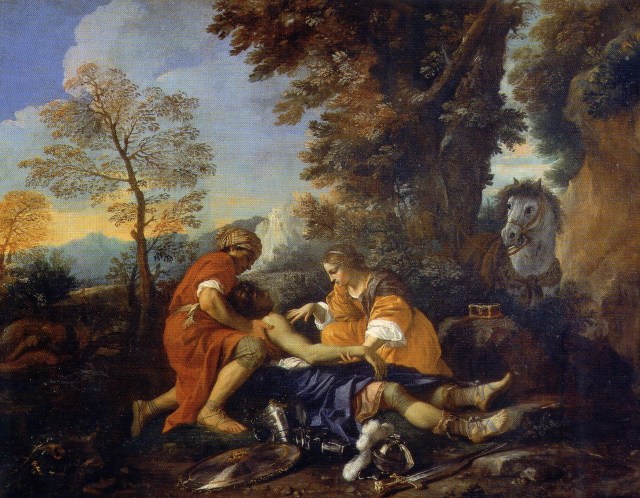
Erminia and Vanfrino tending the wounded Tancred (c.1653)
Oil on canvas: 69 x 92 cm
The Legion of Honor Museum, San Francisco
(To enlarge the picture, right-click on it and choose “Open in a new tab”)
Born in a small village near Lugano, Pier Francesco Mola moved to cosmopolitan Rome with his family in 1616. His father, a respected architect, was the author of an important guidebook about the art and architecture of Rome. Very little is known about his actual artistic education and early travels. Between 1633 and 1644 he travelled through the north of Italy, principally in the Veneto and Emilia. He spent several years in Venice and later in Bologna. Exposure to the artists of the High Renaissance, particularly those of the Venetian school like Tiziano, Veronese and the Bassano family, coupled with the study of his Bolognese contemporaries, especially Francesco Albani and Guercino, proved to be vital to both Mola’s style of painting and his choice of the subject matter.
When Mola returned to Rome in 1647, his style began to change, due in part to his new sources of patronage. Commissions for altarpieces and frescoes came from important families such as the Costaguti, Pamphili and Chigi, as well as from Pope Alexander VII. The public nature of these projects required a monumentality of scale and grandeur of design very different from Mola’s early works. By the 1650s Mola had achieved a harmonious blending of different artistic schools: Venetian colouring, Bolognese design and Roman monumentality. His figures became increasingly idealized and grew in relative scale at the expense of their natural setting.
Erminia and Vanfrino tending the wounded Tancred depict an episode from Torquato Tasso’s epic poem Gerusalemme liberata (Jerusalem liberated). One of the secondary plots within the narrative concerns the love of the pagan princess Erminia for the Christian knight, Tancred. Here Mola represents the moment when Tancred, bleeding from the wounds sustained during his combat with the giant Argante, is found by Erminia and Tancred’s squire Vanfrino.
With elegantly elongated fingers Erminia examines the knight’s wounds. The rich Venetian colouring is reflected in the garments of the figures; the deep red of Vanfrino’s robe, the dark blue of Tancred’s and the glowing dark yellow of Erminia’s dress. The Bolognese naturalism is evident in Mola’s depiction of Tancred’s skin which shows a pallor fitting to a dying person. Tancred’s shield and suit of armour are props that show Mola’s skill in rendering the effects light on them.
 Old Masters