
SIR JOSHUA REYNOLDS (1723-1792)
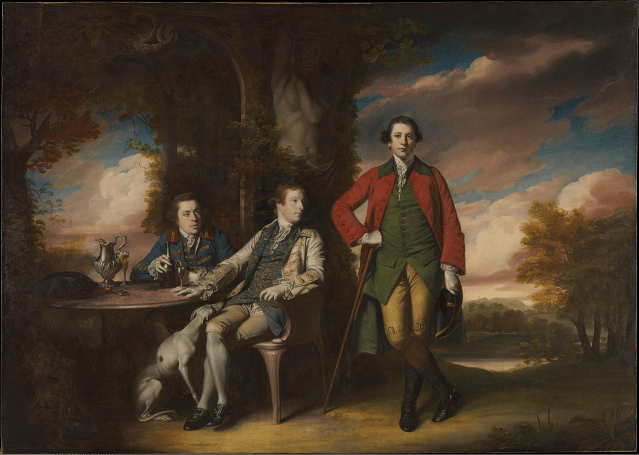
The Honourable Henry Fane with Inigo Jones and Charles Blair (1762)
Oil on canvas (254 x 360 cm)
Metropolitan Museum of Art, New York
Joshua was the seventh child of Samuel Reynolds, a schoolmaster, and his wife, Teophila Potter. He would have received a sound classical education under his father who had been a fellow at Balliol College, Oxford. Little is known of Reynolds’s life in the west in England before 1740 when he was apprenticed for four years to Thomas Hudson (1701-1779), a mediocre portrait painter from Devon.
After working in London and the West Country, Reynolds departed in 1749 for Italy where he lived for four years. Reynolds returned to England in 1753 to set up a studio. He earned a reputation as an accomplished portrait painter and began to attract the attention of London’s high society. His success enabled him in 1760 to move to Leicester Fields; that year Reynolds sent several portraits to London’s first major public exhibition at the Society of Artists. By then he was scheduling a half-dozen sittings a day, had raised his fees by a multiple of five and counted the Prince of Wales, later George III, among his clients.
Reynolds was appointed the first president of the Royal Academy when that institution was founded in 1768, and he was knighted the following year. On January 2, 1769, when the academy opened, he gave his initial Discourses on Art; with the publication in 1778 of the first seven Discourses, he achieved recognition as a man of letters. He continued to travel, mainly with the purpose of purchasing Old Masters, to Paris in 1768 and 1771, to the Netherlands in 1781, and, in 1785 to Brussels, Antwerp and Ghent. Despite suffering strokes in 1779 and 1782, he was appointed principal painter to George III. In July 1789 he complained of difficulty seeing and by October he had lost the use of his left eye; by the end of the year, he had ceased to paint.
This odd and flawed triple portrait is one of Reynolds’s largest pictures. The composition is really awkward since there is no conversation among the men in the painting, neither there is eye contact between them. It looks contrived and therefore, aesthetically unsatisfactory. What should have been a conversation piece turned out to be the portraits of three strangers, two of them sitting at a table and a third one looking at the viewer. The title is also misleading since the main character, who dominates the picture, is Charles Blair and not Henry Fane. The man on the left is Inigo Jones whose Welsh family claimed descent from the famous architect of that name. Jones, who lived in Bristol and at Fulbeck Lodge, was a commissioner for Guadeloupe (an island of the Lesser Antilles captured by the British in 1759) and an old friend of Henry Fane who is seated at the centre in a lavishly embroidered coat and waistcoat.
Henry Fane was the younger of two sons of Thomas Fane, merchant of Bristol, attorney and MP for Lyme Regis, who succeeded as 8th Earl of Westmorland upon the death of his distant cousin on August 26, 1762. Henry followed his father and elder brother to Parliament for Lyme Regis serving from 1772 until 1802. A clerk in the Treasury from 1757 to 1762, he held the title of Keeper of the King’s Private Roads from 1772.
The standing figure, Charles Blair, was born in the village of Blandford St. Mary, Dorset and married the youngest of Henry Fane’s two sisters, Mary Fane. Blair and Henry Fane died at Fullbeck, in the same house, in the summer of 1802. Blair is dressed informally in a loose red coat, neatly buckled breeches and boots. Mainly because he is standing and occupies so much space, he is usually confused with his brother-in-law.
The painting was clearly commissioned by Henry Fane as a memento of his affection for Jones and Blair and their friendship. According to Michael Gallagher, the author of the entry in the Metropolitan Museum of Art’s catalogue dedicated to this picture, the picture was painted between 1761 and 1762. As proof this he quotes Charles Brietzke’s Diary, who, on November 28, 1761 he wrote he went to “Mr. Reynolds in Leicester Field, to see Fane’s and Jones pictures there”
As strange as it may seem,this this enormous painting, by one of the most famous and admired British artists, fell into an incredible and shameful state of decay; as it was reported in 1829 by The Literary Gazette: “(the picture) was lying neglected among lumber of various kinds (…) in so a deplorable state of decay (the surface being in many parts cracked, and the whole obscured by dirt,) that the noble earl doubted the expediency of any attempt to restore it”
Luckily, on the recommendation of Sir Thomas Lawrence, the painting was sent to the excellent restorer John Dunthorn of Grafton Street, Fitzroy Square who did a magnificent job.
Bibliography: Katherine Baetjer = British Paintings in the Metropolitan Museum of Art, 1575-1875 (p. 64-70)
 Old Masters