
SIR JOSHUA REYNOLDS (1723-1792)
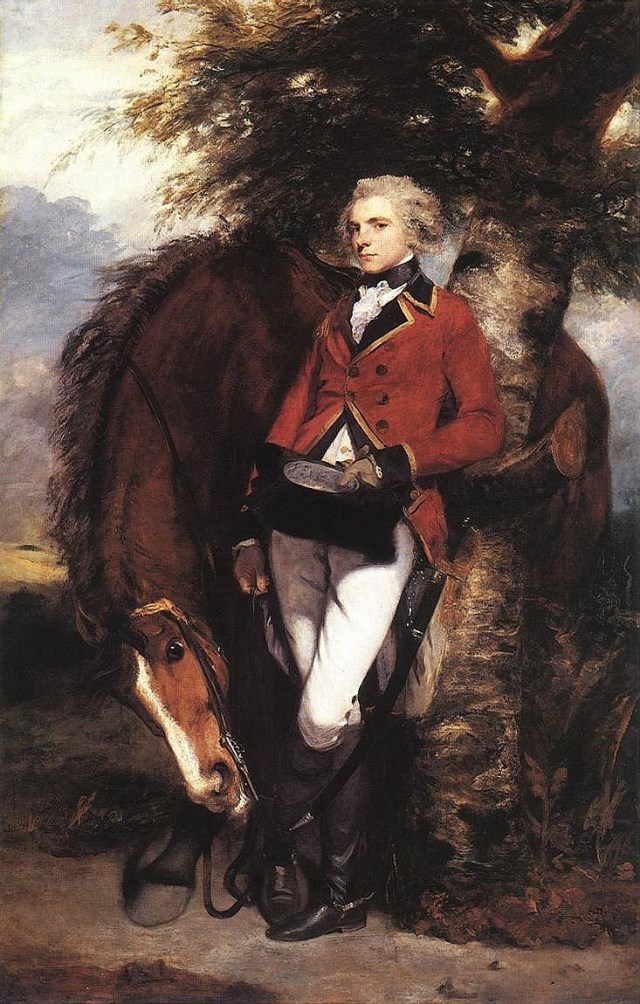
Captain George K. H. Coussmaker (1782)
Oil on canvas (238 x 145 cm)
Metropolitan Museum of Art, New York
To enlarge the picture, right-click on it and choose “Open in a new tab”
Painted in 1782, this is one of Reynolds’ finest works. He devoted an exceptionally large number of sittings to this portrait; he had twenty-one appointments with the young Coussmaker between February 9 and mid-April 1782, and perhaps as many as six or eight sessions with his horse.
The canvas, thickly impasted, is painted throughout with great freedom and variety of stroke, indicating, as does a large number of sittings, that Reynolds may well have executed it in its entirety, something rather unusual. Coussmaker must have spent many an hour in Reynolds’ painting room leaning on a pedestal, here transformed in the trunk and the stump of a branch of a tree. He wears the classic red coat of the British army, breeches, boots and spurs. In his left hand, he holds his tricorne hat crown down to reveal the lining. His expression is calm and relaxed. His hair is powdered as it was prescribed by the military regulations of the age. The captain’s legs are crossed, as apparently are the legs of the horse (only one is visible). The horse, head down, wide-open eye glinting, is wrapped around the trunk of the tree, and both animal and foliage enclose the elegant figure of the sitter.
George Kein Hayward Coussmaker was born in London on September 10, 1759. At sixteen George joined the 1st Regiment of Foot Guards in the lowest commissioned rank, ensign and lieutenant on February 1766. He was promoted to the rank of lieutenant and captain in December 1778, and to that of captain and lieutenant-colonel on April 1788. He never saw active service and retired from the military on March 18, 1795.
George Coussmaker was obviously a very well-off young man since he could afford a commission in the Foot Guards. It must be remembered that in the British army, until 1871, commissions were purchased and those in the Guards were the most expensive ones. The double-rank system was a peculiarity of the Guards where a lieutenant ranked the same as a captain in a line-infantry regiment and so on.
To prove that appearances may be deceiving, the apparently arrogant Coussmaker was a rather shy character, at least according to Fanny Burney who met him in 1778: “Mr Coussmaker stayed for supper. He is a very pretty sort of young man, but rather too shy and silent, which, though infinitely preferable to forwardness and loquacity, nevertheless may be carried too far, either for the comfort of the owner or pleasure of those whom he converses”
Bibliography: British Paintings in the Metropolitan Museum of Art, 1575-1875 by Katherine Baetjer (2009)
 Old Masters