
SIR PETER LELY (1618-1680)
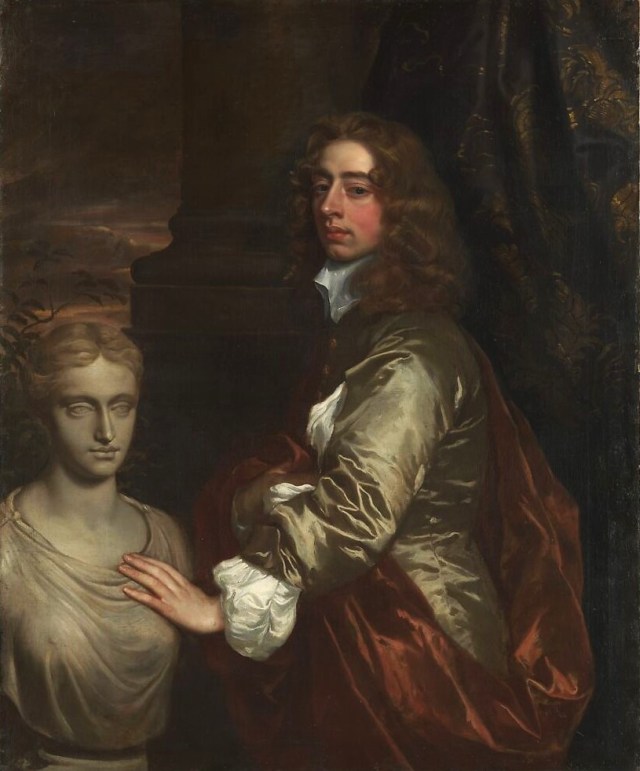
Sir Henry Capel
Oil on canvas (126 x 103 cm)
The Metropolitan Museum of Art, New York
To enlarge the picture, right-click on it and choose “Open in a new tab”
The artist was the son of a captain of infantry in the service of the Elector of Brandenburg. Born Pieter van der Faes, he adopted the pseudonym Lely. He arrived in England in the early or mid-1640s and, according to George Vertue, worked there with the portraitist and dealer George Geldorp. At first, Lely painted historical subjects and landscapes with small figures such as The Concert (Courtauld Institute of Art, London), but he was already known as a competent face painter and soon realised that was principally portraits that were wanted. Neutral in colour and contemplative in mood his early work in England reflected his Dutch training. From the beginning, however, he was influenced by the style of Sir Anthony van Dyck who had died in 1641. Lely proved to be a worthy successor of the great Flemish master and had a busy studio.
Although Lely became Charles II’s principal painter in 1660, his most important royal patrons were the Duke of York, later James II, and his first wife, Anne Hyde. It was she who commissioned the famous series of ladies of the court called “The Windsor Beauties”. To cope with a great many commissions he received, Lely employed numerous assistants, something that explains the rather dull character of many of his portraits. Notwithstanding the paintings by Lely’s own hand display a richness of colour, a vivid likeness and an elegance that recall the work of van Dyck. He was a major collector and connoisseur who amassed hundreds of paintings and as many as eight thousand drawings and prints.
The second son of Baron Capel of Hadham, Henry Capel was baptised on March 6, 1638. He served for more than twenty years as a member of Parliament for Tewkesbury and in 1692 was created Baron Capel of Tewkesbury. He was briefly First Lord of the Admiralty, a lord of the Treasury and both a lord justice and the lord deputy of Ireland.
At first, the painting was a source of some confusion, as it was labelled on the reverse of the frame as coming from the Cassiobury sale but did not match the description of lot 707: “Sir Henry Capell, second son of Arthur, Lord Capell, created Lord Tewkesbury, three-quarters length, flowing wig, left hand on a marble bust”. In 1947 Ellis Waterhouse suggested that the bust mentioned in the catalogue could be “lurking under some very modern repaint” which proved to be the case
Our portrait shows a handsome young man with a serious demeanour. His wavy hair with its bright highlights is set off by extravagantly painted blue and copper draperies. His high, starched collar was fashionable during the late Commonwealth period. A comparison with a miniature by John Hoskins, apparently several years earlier in date, suggests that Lely exaggerated the sitter’s more attractive qualities giving proof of the truth in the concept that a good portrait painter must also be a courtier.
 Old Masters