
JOHN WOOTTON (1682-1764)
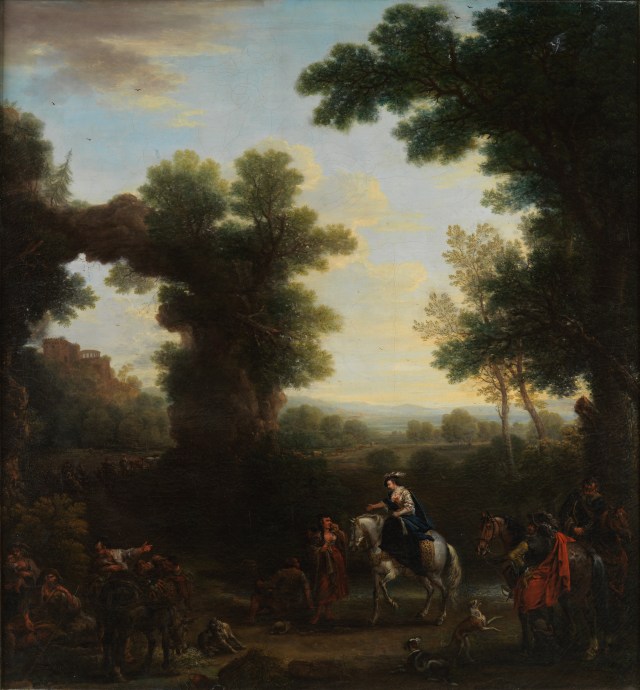
A classical landscape with gypsies (1748)
Oil on canvas (140 x 130 cm)
Metropolitan Museum of Art, New York
To enlarge the picture, right-click on it and choose “Open in a new tab”
Born in Snitterfield (Warwickshire) circa 1682, John Wootton is best remembered as a pioneer in the painting of sporting subjects and was considered the finest practitioner of the genre in his day. Wootton’s early work closely resembles that of the Anglo-Dutch painter John Wyck (1652-1702), who was patronised by the 1st Duke of Beaufort. It is thought that Wootton was a page to Lady Anne Somerset, daughter of the Duke of Beaufort, and is possible that through his noble patron, Wootton may have gained admission to Wyck’s studio in the 1690s.
By 1706 Wootton was established in London. His earliest dated work, from 1711, is a lifesize portrait of a horse: The Duke of Rutland’s Bonny Black (private coll.) A subscriber to the newly established Academy of Painting in 1711, Wootton was a steward of the Society of the Virtuosi of St. Luke by 1717. His role in the creation of a native English style of landscape painting is illustrated by the large topographical panorama View from Box Hill, Surrey (private coll.). He was very popular among the nobility as a sporting artist and was even patronised by King George II and the Prince of Wales. In pursuit of a more classical style, he studied the works by Gaspar Dughet and Claude Lorrain which were doubtless available to him in the collections of his titled patrons.
Wootton eventually found his work going out of fashion and ceased to paint about 1760. He died in London on November 3, 1764. His work can be seen at the Tate Gallery, the Virginia Museum of Fine Arts (Richmond, USA), the Yale Center for British Art and Longleat, the seat of the Marquesses of Bath.
On March 27, 1749, in the accounts for his new house, Kirtlington Park, Sir James Dashwood recorded a payment to Wootton. The sum was considerable, more than 50 pounds. Wootton, who was high in favour among the titled nobility could set his prices as he wished. The Dashwood family had moved into their house in 1746. This painting signed and dated 1748, was in a room that was sold in the 1930s and displaced from Kirtlington Park to the Metropolitan Museum of Art.
Staffage from the Dutch genre painting tradition is set here in an English landscape embellished with classical ruins on a hill, a Claudian motif inspired by the villa at Tivoli. As a dismounted companion looks on, a lady in a Van Dyck costume on a white horse with an exotic leopard skin as a saddle blanket, allows her fortune to be told by a gipsy woman. A servant cradling a weapon in his arms waits on the couple. Beyond a rocky arch, women camp beside a smoking fire and herders drive their cattle along a rutted pathway.
 Old Masters