
FRANCIS COTES (1726-1770)
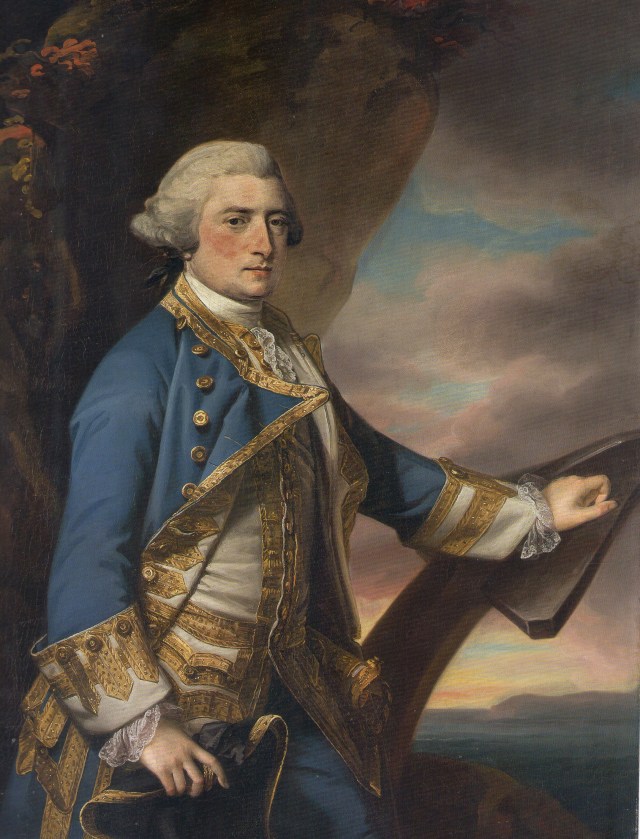
Admiral Harry Paulet, Sixth Duke of Bolton (1765)
Oil on canvas (127 x 102 cm)
The Metropolitan Museum of Art, New York
To enlarge the picture, right-click on it and choose “Open in a new tab”
The son of a prominent apothecary and the older brother of Samuel Cotes, the miniaturist, Francis Cotes was born in the Strand on May 20, 1726. According to Horace Walpole, he studied with George Knapton.
Cotes was skilled in the materials and techniques of pastel and became one of England’s most gifted practitioners in this spontaneous and demanding medium. In 1753 he was painting in oils, which from 1757 on outnumbered his pastels. Cotes exhibited works in both media at the Society of Artists between 1760, the year of its inauguration, and 1768.
Striving to compete with Reynolds, Cotes was successful enough by 1763 to buy the lease of a large house in fashionable Cavendish Square. He employed Peter Toms as a drapery painter and took pupils. Cote’s prices in the last ten years of his life were between those of Reynolds and Gainsborough.
In 1768 he was among the four petitioners who brought to George III the proposal, which the king accepted, to establish the Royal Academy. Cotes showed eighteen portraits in the first two exhibitions of the Royal Academy and was at the peak of his fame when, in 1770, he took a medicine that was supposed to cure him of stones in his kidney or gall-bladder, but instead killed him at the age of forty-four.
The second son of the 4th Duke of Bolton, Harry Paulet, or Powlett, born November 6, 1720, entered upon a naval career. Quarrelsome and litigious from an early age, Paulet was unflatteringly depicted in 1748 as Captain Whiffle in Tobias Smollett’s novel The Adventures of Roderick Random. According to Walpole, he was silly, brutal and proud. In my opinion, the artist, perhaps unwittingly, managed to convey these unpleasant qualities, since there is something disagreeable about Harry Paulet.
Captain Paulet was appointed in 1755 to the Barfleur, of 80 guns, attached to the fleet commanded by Admiral Sir Edward Hawke. In the course of a cruise, Paulet was ordered to chase a ship that had been sighted. He lost contact with the fleet, and, having been informed by his carpenter that the sternpost of his vessel was loose, returned to Spithead. A court-martial held in October of the same year demonstrated that the carpenter had exaggerated, and Paulet was acquitted of the charge of unjustifiably returning to port. Still, he was admonished for separating from the fleet and thereafter was referred to mockingly as Captain Sternpost. However, it was widely believed that the carpenter had served as a scapegoat and Paulet owed his acquittal to his father’s influence.
Paulet’s arrogance and rapid rise in the service were indeed the consequence of his family connections and influence. His father’s support of Walpole had made him a Lord of the Admiralty, a post which he held from 1733 to 1742. Even after leaving the Admiralty, the 4th Duke’s political connections enabled him to secure a swift promotion for his son. Despite the 1755 court-martial, he was promoted Rear-Admiral on 4th June 1756 and Vice-Admiral of the White on 14th February 1758. However, feelings ran strongly against him within the Navy, and he never again received a naval command.
Cotes, who painted in oils principally in the 1760s, was influenced by and tried to compete with Reynolds. An engraving by James Watson of Reynolds’s 1761 portrait of Admiral George Bridges Rodney was shown at the Society of Artists in 1762, and Edward Mead Johnson suggested that Cotes, who was also exhibiting, saw Watson’s print and adopted Reynolds’s composition. While there may be a connection, the formula has been popular since the 17th century. Perhaps Paulet commissioned the painting to celebrate his second marriage or his succession to the title, both in 1765.
Cotes under painted but never completed the face, yet the sitter apparently accepted the canvas. The outlines are carefully delineated, as was Cotes’s practice. Typical also are the legibility and delicate handling of the lace, buttons, and gold braid of the sitter’s splendid uniform.
 Old Masters