
GEORGE ROMNEY (1734-1802)
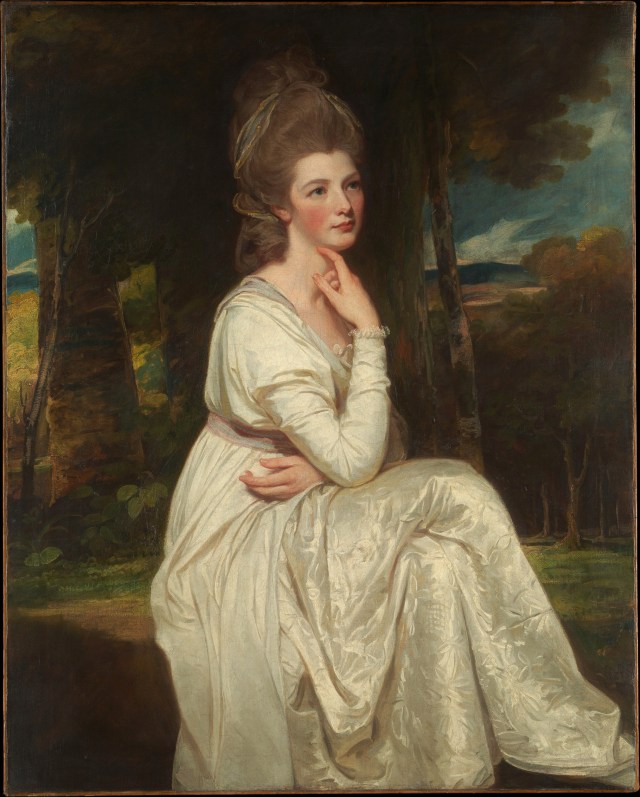
Lady Elizabeth Stanley, Countess of Derby (1778)
Oil on canvas (127 x 102 cm)
The Metropolitan Museum of Art, New York
To enlarge the picture, right-click on it and choose “Open in a new tab”
Romney received little formal education, having left school at an early age to train with his father, a skilled cabinetmaker. In 1755 he was indentured for two years to an itinerant painter, Christopher Steele, and afterwards established his own practice in Kendal. In 1756 he married his landlady’s daughter, Mary Abbot who was ten years older than he. Romney’s ambition led him to move to London in 1762, leaving his family behind. From 1763 he exhibited from time to time in London, though at venues other than the Royal Academy, which, strangely enough, he was never invited to join.
While Romney had a long-standing interest in the antique, it may have been his awareness of the inadequacy of his education that led him to abandon an established clientele in London to travel to Italy in 1773. There he became a highly accomplished draftsman and his style of painting showed a new boldness and breadth of handling. Upon his return to London in 1775, he leased a House in Cavendish Square that had belonged to Francis Cotes and became one of the city’s busiest, most successful portraitists, a position that, despite his misanthropic disposition, he maintained for more than twenty years.
Romney, who is generally ranked third as a portrait painter, after Reynolds and Gainsborough, worked harder and was more productive than either of them. His appointment books from 1776 through 1795 have been preserved and reveal that in the 1780s he often had as many as six sittings a day and sometimes worked even seven days a week. Given this staggering pace, it is not surprising that the quality of Romney’s output is uneven. He never abandoned his ambition to succeed outside the realm of portraiture and from 1782 onwards he produced many mythological and allegorical subjects featuring his muse, Emma Hart, later the wife of Sir William Hamilton and the mistress of Lord Nelson.
Lady Elizabeth Hamilton, born in 1753, was the only daughter of James 6th Duke of Hamilton and Brandon, and his wife, nee Elizabeth Gunning, one of the 18th century’s most famous beauties. In 1774 Lay Elizabeth married the wealthy and prominent Edward Smith Stanley, who in 1776 succeded his grandfather as the 12th Earl of Derby. In 1778 Lady Hamilton left her husband for John Frederick Sackville, 3rd Duke of Dorset, who is believed to have been the father of her youngest daughter.
Around 1776 the Earl commissioned a full-length portrait of her from Sir Joshua Reynolds, which must have been begun about the same time as Romney’s but was finished more quickly since it was exhibited at the Royal Academy in 1777. The Reynolds portrait, later destroyed by its angry owner after his wife left him, is known only by an engraving produced by William Dickinson.
Romney’s best portraits of women are very pleasing to the eye; he preferred delicate contours and smooth, softly modelled curves. Most of his sitters wear white dresses, which must have been his preference as well as theirs, but they do not wear jewellery or attributes of rank. Here the surface has a silky smoothness and slight transparency. Her hair is dressed very high and lightly powdered according to the fashion of its day. She wears a beautifully painted underskirt in a white damask.
 Old Masters