
JACOB WOUTER VOSMAER (1584-1614)
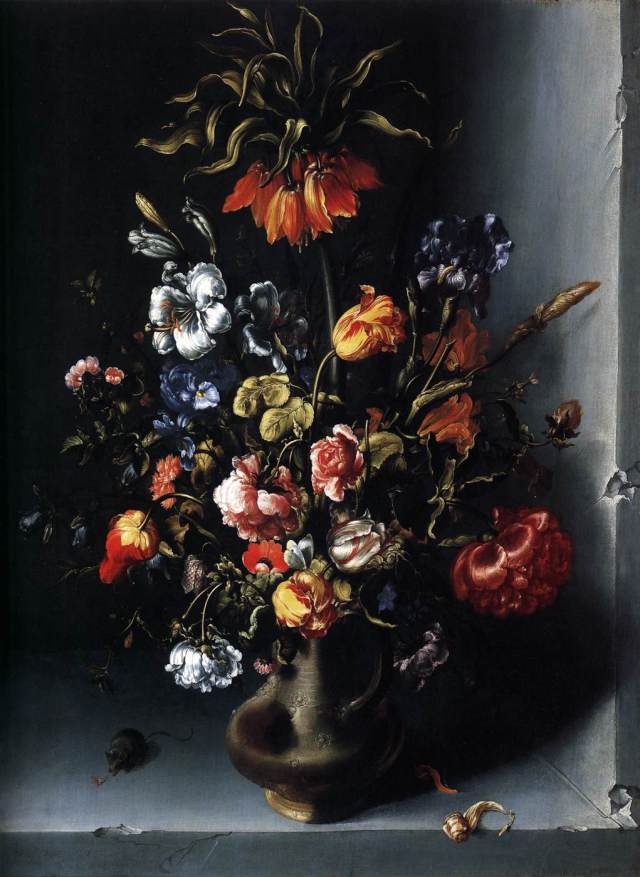
Still-Life of Flowers with an Imperial Fritillary in a Stone Niche (1613)
Oil on a wood panel (110 x 79 cm)
Rijksmuseum, Amsterdam
To enlarge the image, right-click on it and choose “Open in a new tab”
Jacob Wouter Vosmaer was born in the city of Delft. Very little is known about his life. He was the son of the gold and silversmith Wouter Vosmaer, and the brother of the silversmith Arent Woutersz Vosmaer. Around 1610 he joined the Guild of St. Luke of Delft where he studied under the great Flemish painter and engraver Jacob de Gehyn II (1565-1629). He started his career as a landscape specialist but switched to flowers, which brought him more success. He visited Italy as a young man and returned to Delft in 1608 at the age of 24, where he became and remained a respected citizen, and major in the local militia.
Although he was a famous and successful artist in his day, Jacob Vosmaer was forgotten quite quickly and most of his paintings have disappeared; this might be because he did not sign most of his paintings. In fact, no landscapes by his hand have survived and there are less than ten flower pieces that can be attributed with certainty to him.
This magnificent and large picture is, perhaps, the finest known painting by Jacob Vosmaer. The flower that gives its name to it is known as Fritillaria imperialis, the Crown Imperial or Imperial Fritillary; is a species of flowering plant in the lily family native to a wide stretch of land from the Anatolian plateau of Turkey, Iraq and Iran to Afghanistan, Pakistan, Northern India and the Himalayan foothills.
As with many, if not most flower paintings of that period, not all of the flowers depicted were in bloom at the time when the artist painted them. These paintings were usually the result of a clever combination of studies of flowers that the painter kept as a database. The same principle applied to the compositions that incorporated animals; the artist would sketch dozens of dogs, cats, horses, birds, etc and then, using his imagination, he would create, or recreate, an animal combining many of those studies.
 Old Masters