
PAUL BRIL (c. 1554-1626)
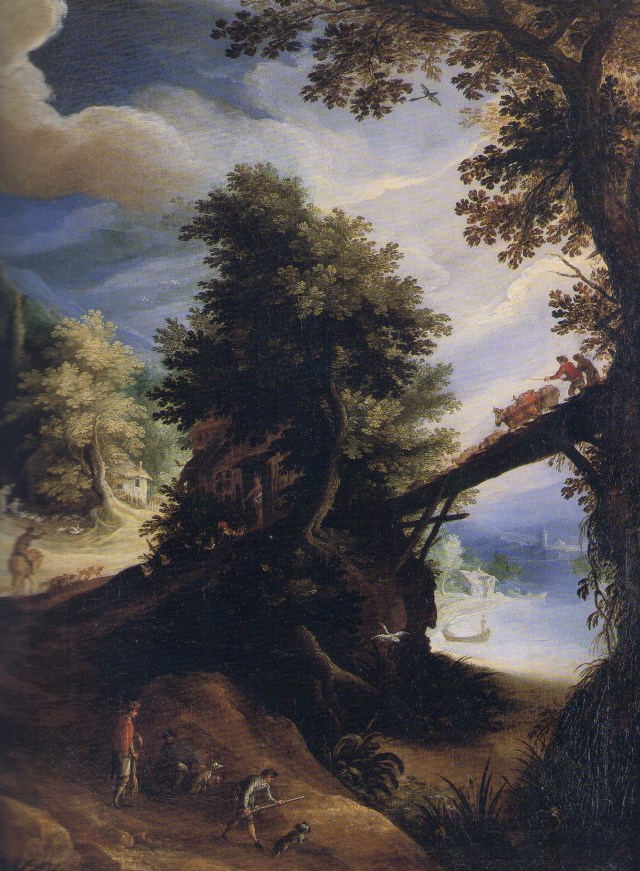
A Wooded Landscape with a Bridge and Sportsmen at the Edge of the River
Oil on canvas (86.5 x 66 cm)
Private Collection
The most influential Italianate landscape painter of his time, Paul Bril was born in Breda c.1554. He trained in Antwerp with Damiaen Ortelmans and, only 14 years old, supported himself by painting landscapes on harpsichords. He travelled to Rome in 1576, where he joined his elder brother Mathijs, who was involved in large-scale works. After Mathijs’ premature death in 1583, Paul succeeded him on many Papal commissions in the Vatican and in various churches in and around Rome. Paul Bril played not only artistically a vital role in the Eternal City, but also socially. He was president of the Accademia di San Luca as well as a member of the society called Virtuosi al Pantheon. Bril died in Rome in 1626, leaving an extensive oeuvre of wall decorations, etchings, drawings and paintings.
In the present landscape, a group of trees divides the scene into two sections: a forest and a river valley. A high wooden bridge crosses the river on the right-hand side. In the foreground, there are three hunters, one of them is about to aim at a bird while the others look on. Another hunting party is painted on the left. Standing in the doorway of her house a woman underneath the central tree is feeding chickens, and on the left, a woman and a child are tending geese. In the middle distance under the bridge, two small fishing boats with figures can be discerned. The flying spoonbill creates a sparkling accent against the dark background.
The way in which the composition is structured with dominant diagonals indicates that this canvas was painted in the 1590’s. There are several allusions to the work of Paul’s elder brother Mathijs. The central tree on the high bank covering a small farm, for example, can be seen in some works by Mathijs. The motive of the tall wooden bridge silhouetted against the sky also features predominantly in drawings by Paul Bril. This motive became popular among contemporary and later artists. Especially Esaias van de Velde, Philips Wouwerman and Adam Pynacker made this device part of their artistic stock in trade.
 Old Masters