
FEDERICO BAROCCI (c. 1530-1612)
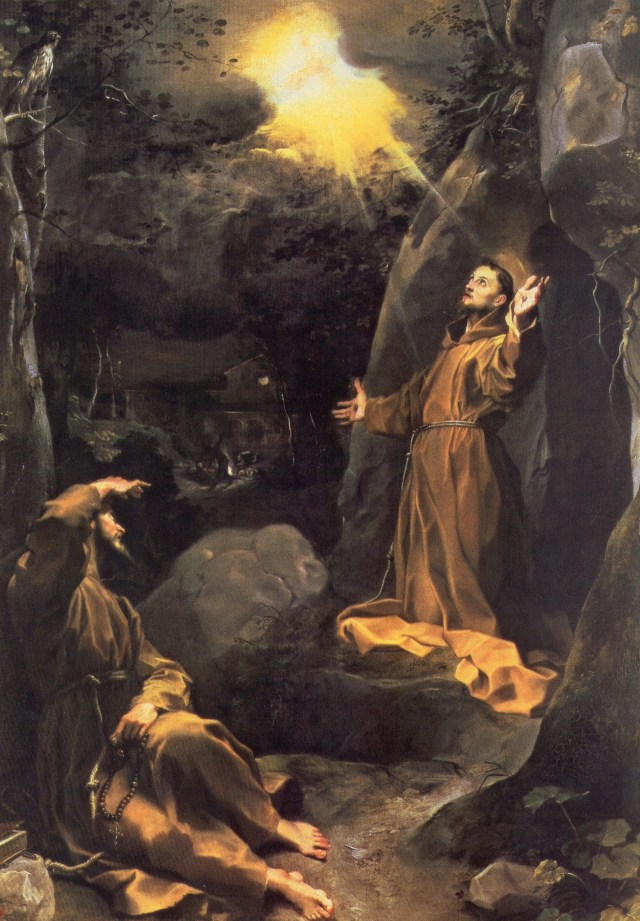
The Stigmatisation of St Francis (1594-95)
Oil on canvas (360 x 245 cm)
Galleria Nazionale delle Marche, Urbino
Throughout his late period, Barocci continued to be much occupied with ecclesiastical commissions. Unlike the whole of the 1580’s, during which he did not paint a single altarpiece for his native city, some orders were for pictures destined for churches ibn Urbino itself. One such is The Stigmatisation of St Francis, painted in 1594-95 for the church of the Capuchins and now in the Galleria Nazionale delle Marche, paid for by Duke Francesco Maria II. The composition was engraved in 1597 by Francesco Villamena, some two years after the picture’s completion, giving widespread diffusion to the image.
The Stigmatisation of St Francis is the first true nocturne in Barocci’s oeuvre. In the guise of brilliant moonlight, which sharply illuminates the entire landscape, Christ makes his appearance to St Francis, transmitting to the adoring saint the physical wounds he had suffered on the Cross. The whole scene takes on the bluish-grey colours of the night, save for the ochre habits of the friars. The tiny, pinkish form of the crucified Christ, seen from the waist upwards with a halo over his head, can be made out in the middle of the refulgence. The parting of the cloud-filled skies is glimpsed through the foliage of the bushes sprouting from the top of the rocks to the right and the tree to the left, in whose branches roosts a peregrine falcon.
Once more, Barocci has tried to place the religious message within the daily experience of the people who were going to see the picture. Thus the facade in the background is of the Capuchin church, for which the altarpiece was destined. There are reminiscences of Barocci’s other local paintings too. The pose of St Francis refers back to that of the same saint in The Forgiveness of St Francis in the church if San Francesco, Urbino. Also, the upright format of The Stigmatisation echoes that of the Senigallia Entombment, in which a similar rocky bank appears to the right of the scene, with a view into the distance at the centre and left. In both pictures, the softness of the crags suggests that Barocci had set up imitation rocks in his studio from which he drew.
 Old Masters