
SIR JOSHUA REYNOLDS (1723-1792)
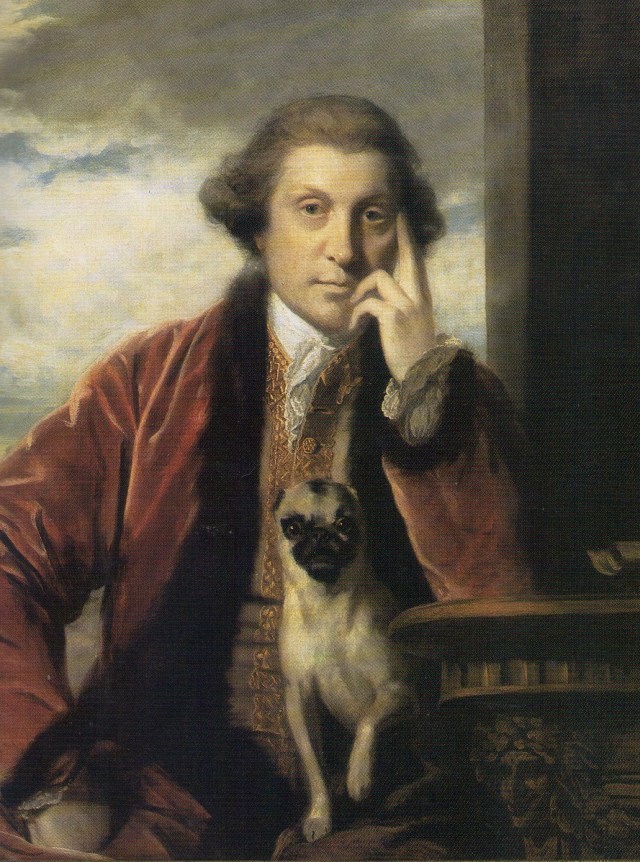
George Augustus Selwyn (c.1764-66)
Oil on canvas (99 x 76 cm)
The Earl of Rosebery, Dalmeny House, near Edinburgh
Apart from being an example of Reynolds’ artistic virtuosity, this portrait is fascinating because it represents a distraught individual whose face does not reveal his morbid character. According to Nicholas Penny:
“George Augustus Selwyn (1719-91), the younger son of parents with high Court positions under George II, spent an extravagant youth in Oxford (whence he was expelled by gross blasphemy) and Paris (to which he frequently returned); to finally settle down to a convivial bachelor life, dozing in the House of Commons and active at the card tables of the clubs of St. James’s. He was noted for his languid manner; his sharp wit; his indifference to female society; his very close attachment (described as “sentimental sodomy”) with Lord March and the Earl of Carlisle (…); and his passion for attending executions.” (1)
Selwyn moved in some of the same social circles as Reynolds and was painted by him five times, something rather odd, since he criticized his colouring, which he considered inferior to Lely’s. The other four portraits were executed in the following chronological order: 1761 = “Portrait of George Selwyn”(whereabouts unknown) “The out-of-town party” painted for Horace Walpole (City of Bristol Museum and Art Gallery) 1770 = “Frederick Howard, 5th Earl of Carlisle and George Selwyn” (Castle Howard) 1783 = “Portrait of George Selwyn” (whereabouts unknown).
The portraits at the Bristol Museum and Art Gallery and Castle Howard are mediocre works, unworthy of Reynolds, particularly considering the dates; these are works that were executed when Reynolds was a mature artist at the peak of his career.
Reynolds started working on this portrait in March 1764, but in April Selwyn left England for France and did not return for a year. Reynolds’ records show ten appointments for Selwyn between February and May 1766. There are several appointments for dogs (one wonders what kind of sitters they were) some or all might have been be for Raton, Selwyn’s beloved pug who also appears in the portrait at Castle Howard.
Reynolds’ ability to represent different textures becomes apparent here in the red velvet, fur-trimmed coat that Selwyn is wearing as well as the fine gold embroidery on his waistcoat. The dog looks definitely evil. The face of the sitter reflects a gentle, placid disposition that is at odds with his morbid obsession with executions and dead bodies. Regarding the latter, there is an amusing anecdote, when Selwyn found out that his friend Henry Fox, 1st Baron Holland, was dying he went to visit him but was refused admission. When Fox learned of this he quipped: “If Mr Selwyn calls again, show him up. If I am alive, I shall be glad to see him, and if I am dead, I am sure he will be delighted to see me” (2)
(1) “Reynolds” = Catalogue of the exhibition organized by the Royal Academy of Arts in 1986 (p. 231)
(2) Quoted by Stella Tillyard in her book “Aristocrats” (1994)
 Old Masters