
CLAUDE LEFEBVRE (1632-1674)
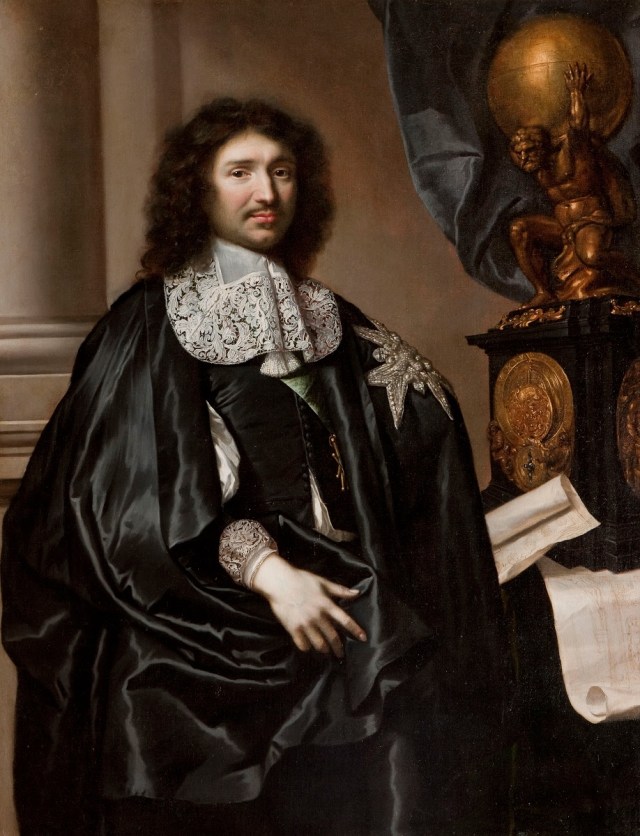
Portrait of Jean-Baptiste Colbert (1666)
Oil on canvas (138 x 113 cm)
Chateau de Versailles
To enlarge the image, right-click on it, then “Open in a new tab”
Claude Lefebvre was the son of the painter Jean Lefebvre (1600-1664); he was baptized on 12th September 1632 at the church of Saint Louis de Fontainebleau, his godfather was the painter Claude Hoey (1585-1660) who held the prestigious post of valet de chambre du Roi; his godmother was Dame Morilot daughter of the King’s Prosecutor at Fontainebleau. His first teacher was Claude Hoey, followed by Eustache Le Sueur (1654) and Charles Lebrun (1655) who advised Lefevre to dedicate himself to portraiture.
In March 1663, the Academy instructed Lefebvre and other artists, to execute their reception piece, the chosen theme being The Academy, led by Virtue, the King’s Portrait. The painting was never carried out, but in March 1665 Lefebvre was given a fresh subject to illustrate, and on October 30th 1666, he presented his Portrait of Jean-Baptiste Colbert. It received unanimous praise and was placed in the rotunda housing the portraits of the Academy’s benefactors.
Magnificently attired in a black silk cape, Colbert (1619-1683) wears the large star of the Order of the Holy Spirit, a reminder that he had been appointed Treasurer of the King’s Orders in August 1665. The lace of the jabot (or cravat) and cuffs is a splendid example of the new French lace industry recently opened by Colbert to put an end to the import of the excellent and very expensive Venetian lace (1), while the architectural drawing of an arcade on the courtyard side of the Tuilleries is a reference to the major alterations that were carried out on the palace on orders from Colbert, Surintendant des bâtiments du roi since 1664 (2)
Clearly, this flattering portrait summarizes Colbert’s efforts to vigorize the kingdom and promote the greatness of Louis XIV. The fine clock is eloquently surmounted by a figure of Atlas bearing a globe. Its meaning is supplied by the inscription PAR ONERI CERVIX (His Neck Carries a Great Weight). The reference to the giant of the Antiquity is therefore intended to highlight the great weight of the responsibilities resting on the shoulders of the all-mighty minister. The comparison between Colbert and Atlas was made even more explicit in an engraving published by Etienne Gantresl, showing Colbert as Atlas bearing an orb decorated with fleurs-de-lys.
One of the rare dated pictures we know for certain to have been painted by Lefebvre, this masterpiece is characterized by great attention to detail and a very good likeness. Delicately modelled by the light, using very thin pigment, the flesh tones are reminiscent of van Dyck. This refined technique doubtless explains the artist’s great success as a portraitist; a success confirmed by the numerous engravings which has made us familiar with the bulk of his work. Lebrun was obviously a visionary when he advised Lefebvre to quit history painting and concentrate on portraits instead.
(1) The beautiful cravat/jabot worn by Colbert is an imitation of the famous Venetian lace known in France as “gros point de Venise”. There is a full description of the subject in this post: https://oldmasterspaintingscom.wordpress.com/2023/10/24/the-handsome-agostino/
(2) The Superintendent of the King’s Buildings was responsible for the restoration, maintenance, decoration and furnishing of all royal palaces. It was created by François I and abolished by the Revolution.
 Old Masters
Pingback: A Great Nobleman – Old Masters